

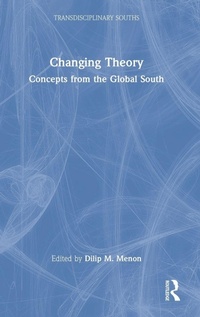
Changing Theory
Concepts from the Global South
1st Edition
Published on 3. May 2022
Book
Hardback
346 pages
978-1-032-18752-5 (ISBN)
Description
This book is an original, systematic, and radical attempt at decolonizing critical theory. Drawing on linguistic concepts from 16 languages from Asia, Africa, the Arab world, and South America, the essays in the volume explore the entailments of words while discussing their conceptual implications for the humanities and the social sciences everywhere. The essays engage in the work of thinking through words to generate a conceptual vocabulary that will allow for a global conversation on social theory which will be necessarily multilingual.
With essays by scholars, across generations, and from a variety of disciplines - history, anthropology, and philosophy to literature and political theory - this book will be essential reading for scholars, researchers, and students of critical theory and the social sciences.
With essays by scholars, across generations, and from a variety of disciplines - history, anthropology, and philosophy to literature and political theory - this book will be essential reading for scholars, researchers, and students of critical theory and the social sciences.
Reviews / Votes
"Changing Theory aims, with intelligence and energy, to engage in the remaking of our conceptual instrumentarium by recovering, through key-word analyses in sixteen languages, what capitalism, colonialism, and the rest sought to destroy. The contributors constitute a galaxy of today's most innovative and critical thinkers from the Global South, and make this book an unprecedented-and never more needed-resource for theoretical renovation."Sheldon Pollock, Arvind Raghunathan Professor Emeritus of Sanskrit and South Asian Studies, Columbia University
"...an impressive array of essays evidencing what today is indisputable: the irreversible shift of knowledge, understanding, and sensing away from 500 years of the consolidation of Western knowledge, regulations of knowing, and vocabulary. The book has stellar reconstitutions of hitherto marginalized praxes of living and knowing...a signal contribution to the explosion of the North Atlantic Universal and the rise of the Planetary Pluriversal."
Walter D. Mignolo, William Hane Wannamaker Distinguished Professor of Romance Studies, Duke University, and author of The Politics of Decolonial Investigations (2021)
"...takes aim at the unconcern for linguistic difference in critical vocabularies of the global public sphere, and introduces a rich selection of keywords...that critique colonial modes of measurement, logical argument, and physical orientation in the world. The juxtaposition of terms, each examined from the perspective of the specific language in which its theory speaks, advances the project of constituting non-universalist epistemologies. A bold experiment in critical world-building from the Global South, this volume is an indispensable tool for reimagining concept-geography [and] cultural translation... Changing Theory changes 'theory' as we know it."
Emily Apter, Silver Professor of French and Comparative Literature, New York University
"Changing Theory forces us to think about the world differently by 'doing things with words.' This brilliant set of reflections by major contemporary theorists on key concepts from the languages of the Global South is a rich provocation to change the world by changing the tools we think with."
Supriya Chaudhuri, Professor Emeritus, Jadavpur University
"By focalizing the central problem of conceptualization through the prism of multilingualism, this book provides a many-sided looking glass to the vexed question of theory and its assumed universalism...once we think through languages beyond the Europhone, theory becomes more vital and closer to home."
Ato Quayson, Jean G. and Morris M. Doyle Professor of Interdisciplinary Studies, Stanford University
"This work is a milestone, marking the Global South both as a field and as an epistemological revolution that is happening around the world. It is not only limited to criticism and deconstruction of colonial knowledge, Eurocentrism, or the North as intellectual lens, as most post-colonial theory has done, but re-discovers the contemporary nature of Southern concepts, and in their singularities and mutually associated global context, reconstructs the world's picture and the universe of our knowledge...This book will be remembered as a classic."
Wang Hui, Professor, Department of Chinese Language and Literature, Tsinghua University
More details
Series
Language
English
Place of publication
London
United Kingdom
Publishing group
Taylor & Francis Ltd
Target group
College/higher education
Illustrations
14 farbige Abbildungen, 12 Farbfotos bzw. farbige Rasterbilder, 2 farbige Zeichnungen
2 Line drawings, color; 12 Halftones, color; 14 Illustrations, color
Dimensions
Height: 240 mm
Width: 161 mm
Thickness: 24 mm
Weight
716 gr
ISBN-13
978-1-032-18752-5 (9781032187525)
Copyright in bibliographic data and cover images is held by Nielsen Book Services Limited or by the publishers or by their respective licensors: all rights reserved.
Schweitzer Classification
Other editions
Additional editions
Book
05/2022
1st Edition
Routledge India
€89.30
Shipment within 10-20 days
E-Book
05/2022
1st Edition
Routledge India
€53.99
Available for download
E-Book
05/2022
1st Edition
Routledge India
€53.99
Available for download
Person
Dilip M. Menon is the Mellon Chair in Indian Studies at the University of Witwatersrand, and Director, Centre for Indian Studies in Africa. He is a historian of South Asia and has recently been working with oceanic histories and questions of epistemology from the Global South. His recent publications include the co-edited volumes Capitalisms: Towards a Global History (2020) and the forthcoming Ocean as Method: Thinking with the Maritime (Routledge, 2022).
Professor Menon was recently awarded the 2021 Falling Walls Foundation Prize for Social Sciences and Humanities.
Professor Menon was recently awarded the 2021 Falling Walls Foundation Prize for Social Sciences and Humanities.
Content
1. Changing Theory: Thinking Concepts from the Global South Part I: Relation 2. Ubuntu/Guanxi 3. Tarbiyya Part II: Commensuration 4. Logic 5. Andaj 6. Izithunguthu Part III: The Political 7. Eddembe 8. Minzu 9. Kavi 10. Rajo gu?a Part IV: The Social 11. Asabiyya 12. Dadani 13. Marumakkathayam Part V: Words in Motion 14. Rantau 15. Musafir 16. Feitico /Umbanda Part VI: Rooted Words 17. Nongqayi/Nongqai 18. Naam Part VII: Indeterminacy 19. Pajuba 20. Ardhanariswara Part VIII: Insurrection 21. Awqat/Aukat