

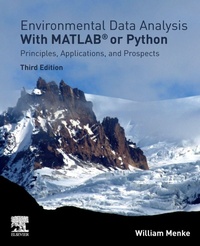
Environmental Data Analysis with MatLab or Python
Principles, Applications, and Prospects
3rd Edition
Published on 18. August 2022
Book
Paperback/Softback
466 pages
978-0-323-95576-8 (ISBN)
Description
Environmental Data Analysis with MATLAB, Third Edition, is a new edition that expands fundamentally on the original with an expanded tutorial approach, more clear organization, new crib sheets, and problem sets providing a clear learning path for students and researchers working to analyze real data sets in the environmental sciences. The work teaches the basics of the underlying theory of data analysis and then reinforces that knowledge with carefully chosen, realistic scenarios, including case studies in each chapter. The new edition is expanded to include applications to Python, an open source software environment.
Significant content in Environmental Data Analysis with MATLAB, Third Edition is devoted to teaching how the programs can be effectively used in an environmental data analysis setting. This new edition offers chapters that can both be used as self-contained resources or as a step-by-step guide for students, and is supplemented with data and scripts to demonstrate relevant use cases.
Significant content in Environmental Data Analysis with MATLAB, Third Edition is devoted to teaching how the programs can be effectively used in an environmental data analysis setting. This new edition offers chapters that can both be used as self-contained resources or as a step-by-step guide for students, and is supplemented with data and scripts to demonstrate relevant use cases.
More details
Edition
3rd edition
Language
English
Place of publication
Oxford
United Kingdom
Publishing group
Elsevier Science & Technology
Target group
Professional and scholarly
Researchers and students in upper-level undergraduate or graduate courses in environmental data.
Product notice
Paperback (trade)
Dimensions
Height: 235 mm
Width: 191 mm
Thickness: 24 mm
Weight
796 gr
ISBN-13
978-0-323-95576-8 (9780323955768)
Copyright in bibliographic data and cover images is held by Nielsen Book Services Limited or by the publishers or by their respective licensors: all rights reserved.
Schweitzer Classification
Other editions
Additional editions
William Menke
Environmental Data Analysis with MatLab or Python
Principles, Applications, and Prospects
E-Book
08/2022
3rd Edition
Academic Press
€105.00
Available for download
Previous edition
William Menke | Joshua Menke
Environmental Data Analysis with MatLab
Book
03/2016
2nd Edition
Academic Press
€93.00
Shipment within 15-20 days
Person
William Menke is a Professor of Earth and Environmental Sciences at Columbia University. His research focuses on the development of data analysis algorithms for time series analysis and imaging in the earth and environmental sciences and the application of these methods to volcanoes, earthquakes, and other natural hazards. He has thirty years of experience teaching data analysis methods to both undergraduates and graduate students. Relevant courses that he has taught include, at the undergraduate level, Environmental Data Analysis and The Earth System, and at the graduate level, Geophysical Inverse Theory, Quantitative Methods of Data Analysis, Geophysical Theory and Practical Seismology.
Content
1. Data Analysis with MATLAB or Python
2. Systematic explorations of a new dataset
3. Modeling observational noise with random variables
4. Linear models as the foundation of data analysis
5. Least squares with prior information
6. Detecting periodicities with Fourier analysis
7. Modeling time-dependent behavior with filters
8. Undirected data analysis using factors, empirical orthogonal functions and clusters
9. Detecting and understanding correlations among data
10. Interpolation, Gaussian Process Regression and Kriging
11. Approximate methods, including linearization and artificial neural networks
12. Assessing the significance of results
2. Systematic explorations of a new dataset
3. Modeling observational noise with random variables
4. Linear models as the foundation of data analysis
5. Least squares with prior information
6. Detecting periodicities with Fourier analysis
7. Modeling time-dependent behavior with filters
8. Undirected data analysis using factors, empirical orthogonal functions and clusters
9. Detecting and understanding correlations among data
10. Interpolation, Gaussian Process Regression and Kriging
11. Approximate methods, including linearization and artificial neural networks
12. Assessing the significance of results