

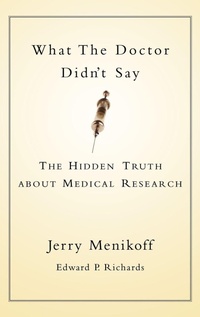
What the Doctor Didn't Say
The Hidden Truth About Medical Research
Published on 7. September 2006
Book
Hardback
336 pages
978-0-19-514797-1 (ISBN)
Description
Most people know precious little about the risks and benefits of participating in a "clinical trial" - a medical research study involving some innovative treatment for a medical problem. Yet millions of people each year participate anyway. What the Doctor Didn't Say explains the reality: that our current system intentionally hides much of the information people need to make the right choice about whether to participate. Witness the following scenarios:
-Hundreds of patients with colon cancer undergo a new form of keyhole surgery at leading cancer centers - never being told that 85% of colorectal surgeons, worried that it increases the risk of the cancer returning, would not themselves undergo that procedure
-Tens of thousands of women at high risk of developing breast cancer are asked to participate in a major research study. They are told about the option of having both breasts surgically removed - but not told about the option of taking a standard osteoporosis pill that might cut the risk of getting breast cancer by one half or more
What the Doctor Didn't Say, written by two prominent experts in the field, is the first book to reveal the secrets that many in the research establishment have fought long and hard to keep from patients. It shows why options not commonly known - including getting a new treatment outside of a research study - can often be the best choice. It explains how patients can make good decisions even if there is only limited information about a treatment's effect. And it does this through the eye-opening of what is happening daily to thousands of people.
Day after day, we are learning how little we know about what really works. Headlines regularly announce that a previously unquestioned treatment - hormane replacement therapy, drugs such as Vioxx or Celebrex - may now be much riskier than we thought. The latest in a surge of recent books criticising the medical establishment (but the first to look at clinical trials specifically), What the Doctor Didn't Tell You helps to empower patients to survive in a world of medical uncertainty, and makes positive recommendations for systemic reform.
-Hundreds of patients with colon cancer undergo a new form of keyhole surgery at leading cancer centers - never being told that 85% of colorectal surgeons, worried that it increases the risk of the cancer returning, would not themselves undergo that procedure
-Tens of thousands of women at high risk of developing breast cancer are asked to participate in a major research study. They are told about the option of having both breasts surgically removed - but not told about the option of taking a standard osteoporosis pill that might cut the risk of getting breast cancer by one half or more
What the Doctor Didn't Say, written by two prominent experts in the field, is the first book to reveal the secrets that many in the research establishment have fought long and hard to keep from patients. It shows why options not commonly known - including getting a new treatment outside of a research study - can often be the best choice. It explains how patients can make good decisions even if there is only limited information about a treatment's effect. And it does this through the eye-opening of what is happening daily to thousands of people.
Day after day, we are learning how little we know about what really works. Headlines regularly announce that a previously unquestioned treatment - hormane replacement therapy, drugs such as Vioxx or Celebrex - may now be much riskier than we thought. The latest in a surge of recent books criticising the medical establishment (but the first to look at clinical trials specifically), What the Doctor Didn't Tell You helps to empower patients to survive in a world of medical uncertainty, and makes positive recommendations for systemic reform.
Reviews / Votes
"Take my advice: study carefully this deftly written account of the hackneyed myths and jarring realities of human subjects experimentation."--Jerome P. Kassirer, M.D., Distinguished Professor, Tufts University School of Medicine, Editor-in-Chief Emeritus, New England Journal of Medicine"A very good book, precisely because it is so disturbing. All of us tend to think that medical research will continue to progress in linear fashion. Yet as Jerry Menikoff's comprehensive and insightful book reveals, many hidden obstacles lie along the path to medical improvements. Most patients enroll in clinical trials because they are desperately ill, and rightly concerned with their own health and welfare. Menikoff highlights the genuine conflicts of
interest between care for the patient and the advancement of science that cannot, and should not, be swept under the rug."--Richard A. Epstein, James Parker Hall Distinguished Service Professor of Law,
University of Chicago
"Finally! A book for the layperson that explodes the myths, unpacks the mysteries and tells the truth about medical research. It should be required reading for anyone thinking of entering a clinical trial. Menikoff has done the public a great service."--Mary Faith Marshall, Ph.D., Professor, Center for Bioethics and Associate Dean, University of Minnesota Medical School
"What the Doctor Didn't Say combines depth of scholarship and clear writing with wisdom, experience and sound judgment to create a volume that is essential for understanding the rights and interests of patients and the obligations of providers in the dance of medicine called informed consent. It provides the gold standard of understanding that should be the starting point for discussion and future research."--Nancy Neveloff Dubler, Director, Division
of Bioethics, Montefiore Medical Center, and Professor of Epidemiology and Population Health, Albert Einstein College of Medicine
"Menikoff's book tells us that if we believe in the research enterprise, then we must accept that persons, consenting and not consenting, will be exposed to risks--sometimes very substantial risks."--New England Journal of Medicine
"This is most definitely a book not to be sneered at; an interesting insight into a mystical sphere of clinical research."--London Medical Student Journal
"His observations regarding clinical trials in the way they are typically conducted are striking...Insightful and sometimes painfully honest book."--The Journal of Legal Medicine
"Take my advice: study carefully this deftly written account of the hackneyed myths and jarring realities of human subjects experimentation."--Jerome P. Kassirer, M.D., Distinguished Professor, Tufts University School of Medicine, Editor-in-Chief Emeritus, New England Journal of Medicine
"A very good book, precisely because it is so disturbing. All of us tend to think that medical research will continue to progress in linear fashion. Yet as Jerry Menikoff's comprehensive and insightful book reveals, many hidden obstacles lie along the path to medical improvements. Most patients enroll in clinical trials because they are desperately ill, and rightly concerned with their own health and welfare. Menikoff highlights the genuine conflicts of
interest between care for the patient and the advancement of science that cannot, and should not, be swept under the rug."--Richard A. Epstein, James Parker Hall Distinguished Service Professor of Law,
University of Chicago
"Finally! A book for the layperson that explodes the myths, unpacks the mysteries and tells the truth about medical research. It should be required reading for anyone thinking of entering a clinical trial. Menikoff has done the public a great service."--Mary Faith Marshall, Ph.D., Professor, Center for Bioethics and Associate Dean, University of Minnesota Medical School
"What the Doctor Didn't Say combines depth of scholarship and clear writing with wisdom, experience and sound judgment to create a volume that is essential for understanding the rights and interests of patients and the obligations of providers in the dance of medicine called informed consent. It provides the gold standard of understanding that should be the starting point for discussion and future research."--Nancy Neveloff Dubler, Director, Division
of Bioethics, Montefiore Medical Center, and Professor of Epidemiology and Population Health, Albert Einstein College of Medicine
"Menikoff's book tells us that if we believe in the research enterprise, then we must accept that persons, consenting and not consenting, will be exposed to risks--sometimes very substantial risks."--New England Journal of Medicine
"His observations regarding clinical trials in the way they are typically conducted are striking...Insightful and sometimes painfully honest book."--Journal of Legal Medicine
More details
Language
English
Place of publication
New York
United States
Target group
College/higher education
Professional and scholarly
Dimensions
Height: 240 mm
Width: 161 mm
Thickness: 23 mm
Weight
669 gr
ISBN-13
978-0-19-514797-1 (9780195147971)
Copyright in bibliographic data and cover images is held by Nielsen Book Services Limited or by the publishers or by their respective licensors: all rights reserved.
Schweitzer Classification
Other editions
Additional editions
Jerry Menikoff | Edward P. Richards
What the Doctor Didn't Say
The Hidden Truth about Medical Research
E-Book
08/2006
OUP USA
€30.49
Available for download
Persons
Jerry Menikoff is Associate Professor of Law, Ethics & Medicine at the University of Kansas School of Medicine, where he is also Director of the Institute for Bioethics, Law & Public Policy and chair of the Human Subjects Committee. He is also Associate Professor of Law at the University of Kansas School of Law. He is the author of a leading textbook on law and bioethics and co-author of a textbook on the ethics and regulation of
research with human subjects. He has on a number of occasions served as a consultant to the federal government on issues relating to protecting research subjects.
Edward P. Richards is Harvey A. Peltier Professor of Law at the Louisiana State University, where he directs the program in Law, Science, and Public Health. He has published several books and more than 100 articles on health and public health policy, and has consulted with state and federal agencies on public health and policy. He worked in medical research before becoming a law professor and has taught both FDA and biotechnology law.
research with human subjects. He has on a number of occasions served as a consultant to the federal government on issues relating to protecting research subjects.
Edward P. Richards is Harvey A. Peltier Professor of Law at the Louisiana State University, where he directs the program in Law, Science, and Public Health. He has published several books and more than 100 articles on health and public health policy, and has consulted with state and federal agencies on public health and policy. He worked in medical research before becoming a law professor and has taught both FDA and biotechnology law.
Content
PART I: HOW GOOD STUDIES CAN BE BAD CHOICES ; PART II: CONSENT: WHAT ARE SUBJECTS TOLD? ; PART III: WHEN CONSENT CAN'T BE OBTAINED ; PART IV: THE ROLE OF MONEY ; PART V: THE CHALLENGE FOR THE FUTURE