

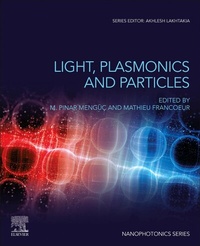
Light, Plasmonics and Particles
Published on 12. May 2023
Book
Paperback/Softback
616 pages
978-0-323-99901-4 (ISBN)
Description
Light, Plasmonics and Particles focuses on the fundamental science and engineering applications of light scattering by particles, aerosols and hydrosols, and of localized plasmonics. The book is intended to be a self-contained and coherent resource volume for graduate students and professionals in the disciplines of materials science, engineering and related disciplines of physics and chemistry. In addition to chapters related to fundamental concepts, it includes detailed discussion of different numerical models, experimental systems and applications.
In order to develop new devices, processes and applications, we need to advance our understanding of light-matter interactions. For this purpose, we need to have a firm grasp of electromagnetic wave phenomena, and absorption and scattering of waves by different size and shape geometrical objects. In addition, understanding of tunneling of waves based on electron and lattice vibrations and coupling with the thermal fluctuations to enhance near-field energy transfer mechanisms are required for the development of future energy harvesting devices and sensors.
In order to develop new devices, processes and applications, we need to advance our understanding of light-matter interactions. For this purpose, we need to have a firm grasp of electromagnetic wave phenomena, and absorption and scattering of waves by different size and shape geometrical objects. In addition, understanding of tunneling of waves based on electron and lattice vibrations and coupling with the thermal fluctuations to enhance near-field energy transfer mechanisms are required for the development of future energy harvesting devices and sensors.
More details
Series
Language
English
Place of publication
Philadelphia
United States
Target group
Professional and scholarly
Product notice
Paperback (trade)
Illustrations
220 illustrations (100 in full color); Illustrations
Dimensions
Height: 235 mm
Width: 191 mm
Thickness: 31 mm
Weight
1045 gr
ISBN-13
978-0-323-99901-4 (9780323999014)
Copyright in bibliographic data and cover images is held by Nielsen Book Services Limited or by the publishers or by their respective licensors: all rights reserved.
Schweitzer Classification
Other editions
Additional editions
M. Pinar Menguc | Mathieu Francoeur
Light, Plasmonics and Particles
E-Book
05/2023
Elsevier
€230.00
Available for download
Persons
Professor M. Pinar Menguec PhD received his BS and MS from ODTU/METU in Ankara, Turkey, and his PhD from Purdue University, USA in 1985, all in Mechanical Engineering. He joined the University of Kentucky (UK) in 1985. In 2008 he was chosen as the Engineering Alumni Association Chair Professor; he still carries this Chair title at Emeritus level. He joined OEzyegin University, Istanbul in 2009 as the founding Head of Mechanical Engineering. The same year,
he established the Centre for Energy, Environment and Economy (CEEE/ECEM), which he is still directing.
Menguec's research areas include radiative transfer, nano-scale transport phenomena, applied optics and sustainable energy applications. His research programs have been funded by more than 60 research projects from several agencies in the US, in Europe and in Turkey. Over the years, he has guided more than 65 MS and PhD students and more than 15 post-docs and visiting researchers. He is the author/co-author of more than 150 archival papers, 220 conference publications, four books, and several book chapters. He is one of the three Editors-in Chief of Journal of Quantitative Spectroscopy and Radiative Transfer (JQSRT), an Honorary Editorial Member of Journal of Enhanced Heat Transfer, and an Editor of Physics Open. He holds six patents and has three patent applications.
Menguec is an elected member of Science Academy of Turkey, a fellow of both ASME (American Society of Mechanical Engineering) and ICHMT (International Center for Heat and Mass Transfer), and a Senior Member of OSA (Optical Society of America). His start-up company STI, was presented the R&D100 Award in 2005 based on a particle characterization technique they developed. In 2018, he received the ASME Heat Transfer Memorial Award, and in 2020 he was chosen as an Outstanding Mechanical Engineer by the Purdue University School of Mechanical Engineering. Professor Mathieu Francoeur PhD received his B.Eng. and M.Sc. degrees in Mechanical Engineering from l'Universite Laval in Quebec City, Canada, and he obtained his Ph.D. in Mechanical Engineering from the University of Kentucky, USA, in 2010. He joined the Department of Mechanical Engineering at the University of Utah in 2010 as a tenure-track Assistant Professor. He was promoted to the rank of tenured Associate Professor in 2016, and he became the Associate Chair of the Department of Mechanical Engineering in 2018. He was awarded the National Science Foundation CAREER Award in 2013 and the Army Research Office Young Investigator Award in 2014. Professor Francoeur's research interests include thermal radiation,
nanoscale heat transfer, and energy conversion. He has produced more than 160 publications, including 56 journal papers and 3 book chapters. He is currently a handling Associate Editor for the Journal of Quantitative Spectroscopy and Radiative Transfer (JQSRT) and Nature Scientific Reports.
he established the Centre for Energy, Environment and Economy (CEEE/ECEM), which he is still directing.
Menguec's research areas include radiative transfer, nano-scale transport phenomena, applied optics and sustainable energy applications. His research programs have been funded by more than 60 research projects from several agencies in the US, in Europe and in Turkey. Over the years, he has guided more than 65 MS and PhD students and more than 15 post-docs and visiting researchers. He is the author/co-author of more than 150 archival papers, 220 conference publications, four books, and several book chapters. He is one of the three Editors-in Chief of Journal of Quantitative Spectroscopy and Radiative Transfer (JQSRT), an Honorary Editorial Member of Journal of Enhanced Heat Transfer, and an Editor of Physics Open. He holds six patents and has three patent applications.
Menguec is an elected member of Science Academy of Turkey, a fellow of both ASME (American Society of Mechanical Engineering) and ICHMT (International Center for Heat and Mass Transfer), and a Senior Member of OSA (Optical Society of America). His start-up company STI, was presented the R&D100 Award in 2005 based on a particle characterization technique they developed. In 2018, he received the ASME Heat Transfer Memorial Award, and in 2020 he was chosen as an Outstanding Mechanical Engineer by the Purdue University School of Mechanical Engineering. Professor Mathieu Francoeur PhD received his B.Eng. and M.Sc. degrees in Mechanical Engineering from l'Universite Laval in Quebec City, Canada, and he obtained his Ph.D. in Mechanical Engineering from the University of Kentucky, USA, in 2010. He joined the Department of Mechanical Engineering at the University of Utah in 2010 as a tenure-track Assistant Professor. He was promoted to the rank of tenured Associate Professor in 2016, and he became the Associate Chair of the Department of Mechanical Engineering in 2018. He was awarded the National Science Foundation CAREER Award in 2013 and the Army Research Office Young Investigator Award in 2014. Professor Francoeur's research interests include thermal radiation,
nanoscale heat transfer, and energy conversion. He has produced more than 160 publications, including 56 journal papers and 3 book chapters. He is currently a handling Associate Editor for the Journal of Quantitative Spectroscopy and Radiative Transfer (JQSRT) and Nature Scientific Reports.
Content
1. Overview of light, plasmonics, and particles
2. Maxwell's equations for single-scattering particles
3. Fluctuational electrodynamics and thermal emission
4. The Lorenz-Mie theory
5. Optical force categorizations in the generalized Lorenz-Mie theory
6. T-matrix method for particles of arbitrary shape and composition
7. Applications of Maxwell's equations to light scattering by dielectric particles
8. Scattering by compact particles using surface integral equations
9. Discrete dipole approximation
10. Discrete dipole approximation with surface interaction
11. The thermal discrete dipole approximation and the discrete system Green's function methods for computational near-field radiative heat transfer
12. Rational design and optical tuning of plasmonic nanoparticles
13. Particle characterization with laboratory nephelometers
14. Imaging aerosol particles with digital in-line holography
15. Polarimetric remote sensing of cometary particles
16. Optical properties of nonspherical, light-absorbing particles: Black carbon and mineral dust aerosols
17. Carbonaceous particles in flames and fires
18. Radiative cooling paints
19. Plasmonic nanofluids for solar thermal applications
20. Near-field energy harvesting
21. Nanoantennas
22. Near-field radiative transfer for biologically inspired structures
23. Biosensing based on plasmonic devices
24. Plasmon and phonon polaritons in planar van der Waals heterostructures
25. Spectrally selective filters and their applications
26. Concluding remarks and future directions
2. Maxwell's equations for single-scattering particles
3. Fluctuational electrodynamics and thermal emission
4. The Lorenz-Mie theory
5. Optical force categorizations in the generalized Lorenz-Mie theory
6. T-matrix method for particles of arbitrary shape and composition
7. Applications of Maxwell's equations to light scattering by dielectric particles
8. Scattering by compact particles using surface integral equations
9. Discrete dipole approximation
10. Discrete dipole approximation with surface interaction
11. The thermal discrete dipole approximation and the discrete system Green's function methods for computational near-field radiative heat transfer
12. Rational design and optical tuning of plasmonic nanoparticles
13. Particle characterization with laboratory nephelometers
14. Imaging aerosol particles with digital in-line holography
15. Polarimetric remote sensing of cometary particles
16. Optical properties of nonspherical, light-absorbing particles: Black carbon and mineral dust aerosols
17. Carbonaceous particles in flames and fires
18. Radiative cooling paints
19. Plasmonic nanofluids for solar thermal applications
20. Near-field energy harvesting
21. Nanoantennas
22. Near-field radiative transfer for biologically inspired structures
23. Biosensing based on plasmonic devices
24. Plasmon and phonon polaritons in planar van der Waals heterostructures
25. Spectrally selective filters and their applications
26. Concluding remarks and future directions