

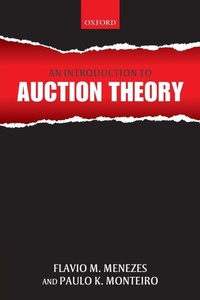
An Introduction to Auction Theory
Published on 12. June 2008
Book
Paperback/Softback
200 pages
978-0-19-927599-1 (ISBN)
Description
The practical importance of auction theory is widely recognized. Indeed, economists have been recognized for their contribution to the design of several auction-like mechanisms, such as the U. S. Federal Communications Commission spectrum auctions, the 3G auctions in Europe and beyond, and the auction markets for electricity markets around the world.
Moreover, auction theory is now seen as an important component of an economist's training. For example, some of the more celebrated results from the single-object auction theory are now usually taught in advanced undergraduate and first-year graduate courses on the economics of information. The techniques and insights gained from the study of auction theory provide a useful starting point for those who want to venture into the economics of information, mechanism design, and regulatory economics.
This book provides a step-by-step, self-contained treatment of the theory of auctions. The aim is to provide an introductory textbook that will allow students and readers with a calculus background to work through all the basic results. Coverage includes: the basic independent-private-model; the effects of introducing correlation in valuations on equilibrium behaviour and the seller's expected revenue; mechanism design; and the theory of multi-object auctions. The paperback edition of the text includes a new chapter which acts as a guide to current developments in auction theory.
Moreover, auction theory is now seen as an important component of an economist's training. For example, some of the more celebrated results from the single-object auction theory are now usually taught in advanced undergraduate and first-year graduate courses on the economics of information. The techniques and insights gained from the study of auction theory provide a useful starting point for those who want to venture into the economics of information, mechanism design, and regulatory economics.
This book provides a step-by-step, self-contained treatment of the theory of auctions. The aim is to provide an introductory textbook that will allow students and readers with a calculus background to work through all the basic results. Coverage includes: the basic independent-private-model; the effects of introducing correlation in valuations on equilibrium behaviour and the seller's expected revenue; mechanism design; and the theory of multi-object auctions. The paperback edition of the text includes a new chapter which acts as a guide to current developments in auction theory.
Reviews / Votes
Although the book focuses squarely on auctions, it is likely to be helpful in courses dealing with information economics generally. A particular virtue of the book is the tangible, hands-on, approach taken to explaining the revelation principle...a very helpful collection of core results and techniques. * John Asker Economic Record *More details
Language
English
Place of publication
Oxford
United Kingdom
Target group
Professional and scholarly
Dimensions
Height: 234 mm
Width: 156 mm
Thickness: 11 mm
Weight
313 gr
ISBN-13
978-0-19-927599-1 (9780199275991)
Copyright in bibliographic data and cover images is held by Nielsen Book Services Limited or by the publishers or by their respective licensors: all rights reserved.
Schweitzer Classification
Other editions
Additional editions
Flavio M. Menezes | Paulo K. Monteiro
An Introduction to Auction Theory
Book
11/2004
Oxford University Press
€92.00
Shipment within 15-20 days
Persons
Flavio Menezes joined the University of Queensland as a Chair in Economics after more than a decade at the Australian National University, where he was, amongst other responsibilities, the Foundation Director of the Australian Centre of Regulatory Economics. Flavio is also a former part-time Vice President and Senior Consultant with the Regulatory Economics and Public Policy Practice at CRA International in Canberra. Flavio Menezes has published widely in the economics of information and uncertainty. He is regarded as Australasia's leading auction expert.
Paulo Monteiro was Associate Professor at Federal University of Rio de Janeiro and then at IMPA (Institute of Pure and Applied Mathematics.) He is presently at the Postgraduate School of Economics of the Getulio Vargas Foundation (FGV-EPGE). Monteiro researches on infinite dimensional general equilibrium theory, mechanism design, and auction theory.
Paulo Monteiro was Associate Professor at Federal University of Rio de Janeiro and then at IMPA (Institute of Pure and Applied Mathematics.) He is presently at the Postgraduate School of Economics of the Getulio Vargas Foundation (FGV-EPGE). Monteiro researches on infinite dimensional general equilibrium theory, mechanism design, and auction theory.
Content
1. Introduction ; 2. Preliminaries ; 3. Private Values ; 4. Common Value ; 5. Affiliated Values ; 6. Mechanism Design ; 7. Multiple Objects ; 8. Guide to current developments in auction theory ; A. Probability ; B. Differential Equations ; C. Affiliation ; D. Convexity ; References