

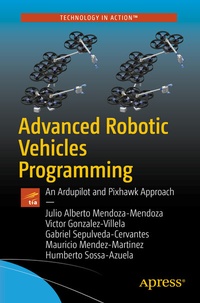
Advanced Robotic Vehicles Programming
An Ardupilot and Pixhawk Approach
Published on 4. February 2020
Book
Paperback/Softback
XXVIII, 439 pages
978-1-4842-5530-8 (ISBN)
Description
Learn how to program robotic vehicles with ardupilot libraries and pixhawk autopilot, both of which are open source technologies with a global scope. This book is focused on quadcopters but the knowledge is easily extendable to three-dimensional vehicles such as drones, submarines, and rovers.Pixhawk and the ardupilot libraries have grown dramatically in popularity due to the fact that the hardware and software offer a real-time task scheduler, huge data processing capabilities, interconnectivity, low power consumption, and a global developer support.
This book shows you how take your robotic programming skills to the next level. From hardware to software, Advanced Robotic Vehicles Programming links theory with practice in the development of unmanned vehicles. By the end of this book, you'll learn the pixhawk software and ardupilot libraries to develop your own autonomous vehicles.
What You'll Learn
Model and implement elementary controls in any unmanned vehicle Select hardware and software components during the design process of an unmanned vehicle Use other compatible hardware and software development packages Understand popular scientific and technical nomenclature in the field Identify relevant complexities and processes for the operation of an unmanned vehicle Who This Book Is For
Undergraduate and graduate students, researchers, makers, hobbyists, and those who want to go beyond basic programming of an Arduino for any kind of robotic vehicle.
More details
Edition
First Edition
Language
English
Place of publication
Berkeley
United States
Target group
Professional and scholarly
Product notice
Paperback (trade)
Unsewn / adhesive bound
Illustrations
81 s/w Abbildungen, 138 farbige Abbildungen
XXVIII, 439 p. 219 illus., 138 illus. in color.
Dimensions
Height: 235 mm
Width: 155 mm
Thickness: 25 mm
Weight
703 gr
ISBN-13
978-1-4842-5530-8 (9781484255308)
DOI
10.1007/978-1-4842-5531-5
Schweitzer Classification
Other editions
Additional editions
Julio Alberto Mendoza-Mendoza | Victor Javier Gonzalez-Villela | Gabriel Sepulveda-Cervantes
Advanced Robotic Vehicles Programming
An Ardupilot and Pixhawk Approach
E-Book
02/2020
APress
€56.99
Available for download
Persons
Julio Mendoza-Mendoza earned his computing doctoral degree at CIC IPN in 2016, where he specialized in underactuated robotics, UAS, and intelligent and nonlinear control. He also earned his advanced-technologies master degree and mechatronics-engineering bachelor at UPIITA IPN, in 2011 and 2008 respectively. Currently, Julio is working on 5 patents related to his research field and developing his flying serial-robot manipulator theory at FI UNAM through his postdoctoral 2017 DGAPA grant.
V. J. Gonzalez-Villela received his B.Eng. degree in Mechanical and Electrical Engineering and the M.Eng. degree in Electrical Engineering in 1987 and 1993, respectively, from the National Autonomous University of Mexico (UNAM), and a Ph.D. degree in Kinematics, Dynamics, and Nonlinear Systems applied to Mobile Robot Modelling and Control from Loughborough University, Loughborough, UK, in 2006. He is currently a Titular Professor in the Department of Mechatronics Engineering, UNAM. His research focuses on Mobile, Hybrid and Adaptive Robots, and Artificial Intuition.
V. J. Gonzalez-Villela received his B.Eng. degree in Mechanical and Electrical Engineering and the M.Eng. degree in Electrical Engineering in 1987 and 1993, respectively, from the National Autonomous University of Mexico (UNAM), and a Ph.D. degree in Kinematics, Dynamics, and Nonlinear Systems applied to Mobile Robot Modelling and Control from Loughborough University, Loughborough, UK, in 2006. He is currently a Titular Professor in the Department of Mechatronics Engineering, UNAM. His research focuses on Mobile, Hybrid and Adaptive Robots, and Artificial Intuition.
Content
Part 1: Introduction.- Chapter 1: Hardware and Software Description.- Chapter 2: Ardupilot Working Environment.- Chapter 3: Recap and Definitions.- Part 2: Sequential Mode.- Chapter 4: Basic Input and Output Operations.- Chapter 5: Advanced Operations: Serial Communications, Data Storage, Motion Units and Basis of Time Management.- Chapter 6: Application to Quadcopter Drone Control with a Smooth Flight Mode: .- Part 3: Real Time Mode.- Chapter 7: Real Time Working Environment.- Chapter 8: Compendium of the Previous Chapters in Real Time Mode with Application Code.- Appendices.