

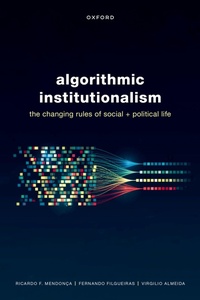
Algorithmic Institutionalism
The Changing Rules of Social and Political Life
Published on 12. December 2023
Book
Hardback
192 pages
978-0-19-287007-0 (ISBN)
Description
Algorithmic Institutionalism is the first book to conceive algorithms as institutions in contemporary societies, focusing on different dimensions of how they structure decision-making and enact power relations. In many situations in contemporary societies, algorithms structure social interactions, resulting in patterns of action and human behavior in collective contexts. Almeida, Filgueiras, and Mendonca discuss how algorithms are gradually occupying an institutional space in societies, deciding on different aspects of social life and shaping collective and individual human behaviors.
As institutions, algorithms work as decision systems that define what is allowed, hindered, facilitated, or made impossible as well as positions within society's organizational structures. Algorithmic institutionalism uses the perspective of institutional theories to explain the functioning of these decision systems and how they establish patterns and norms that affect human behavior and lead to deep changes in contemporary society. The book points to the challenges of political orders that are gradually institutionalized with algorithms, comprising new dynamics of interaction between humans and machines. These disruptive dynamics of interaction between humans and machines create new challenges related to the democratization of algorithms and the impasses that emerge with technological advancement through digital technologies.
Providing an analytical framework for an adequate comprehension of the social and political implications of algorithmic systems, Algorithmic institutionalism applies this framework to make sense of recommendation systems, the platformization of governments, and the deployment of algorithms in security. It then addresses the challenge of developing approaches to democratize the new political order influenced by the global expansion of algorithmic decision-making, pointing to key democratic values that are relevant once we consider the construction of legitimate decisions in contemporary societies.
As institutions, algorithms work as decision systems that define what is allowed, hindered, facilitated, or made impossible as well as positions within society's organizational structures. Algorithmic institutionalism uses the perspective of institutional theories to explain the functioning of these decision systems and how they establish patterns and norms that affect human behavior and lead to deep changes in contemporary society. The book points to the challenges of political orders that are gradually institutionalized with algorithms, comprising new dynamics of interaction between humans and machines. These disruptive dynamics of interaction between humans and machines create new challenges related to the democratization of algorithms and the impasses that emerge with technological advancement through digital technologies.
Providing an analytical framework for an adequate comprehension of the social and political implications of algorithmic systems, Algorithmic institutionalism applies this framework to make sense of recommendation systems, the platformization of governments, and the deployment of algorithms in security. It then addresses the challenge of developing approaches to democratize the new political order influenced by the global expansion of algorithmic decision-making, pointing to key democratic values that are relevant once we consider the construction of legitimate decisions in contemporary societies.
Reviews / Votes
This is an excellent book that makes us think and that offers us an excellent signalling framework for the navigation of this challenging journey through such imprecise roads. * Edesio Fernandes, Lincoln Institute of Land Policy * The authors explore their creation and evolution, rules and norms, power relations, and societal implications. Recognizing that algorithms lend themselves to technocracy, the final chapter gives special consideration to democratizing algorithms and the necessity of submitting them to public scrutiny. While the authors argue that algorithms can be understood using institutional theory, they also suggest that institutional theory can be shaped by studying algorithms and invite future research on this subject. Recommended. * Choice *More details
Language
English
Place of publication
Oxford
United Kingdom
Target group
Professional and scholarly
Product notice
sewn/stitched
Cloth over boards
Dimensions
Height: 241 mm
Width: 165 mm
Thickness: 22 mm
Weight
445 gr
ISBN-13
978-0-19-287007-0 (9780192870070)
Copyright in bibliographic data and cover images is held by Nielsen Book Services Limited or by the publishers or by their respective licensors: all rights reserved.
Schweitzer Classification
Other editions
Additional editions
Ricardo Fabrino Mendonca | Virgilio Almeida | Fernando Filgueiras
Algorithmic Institutionalism
The Changing Rules of Social and Political Life
E-Book
11/2023
1st Edition
OUP eBook
€75.49
Available for download
Ricardo Fabrino Mendonca | Virgilio Almeida | Fernando Filgueiras
Algorithmic Institutionalism
The Changing Rules of Social and Political Life
E-Book
11/2023
1st Edition
OUP eBook
€75.49
Available for download
Persons
Ricardo F. Mendonca is an Associate Professor of Political Science at the Federal University of Minas Gerais in Brazil (Brazil). He is a Research Fellow at the Brazilian National Institute for Digital Democracy (INCT.DD) and the coordinator of Margem (Research Group on Democracy and Justice). He holds fellowships from the Brazilian National Council for Scientific and Technological Development (CNPq) and from Fundacao de Amparo a Pesquisa do Estado de Minas (Fapemig). Mendonca's recent publications include Research Methods in Deliberative Democracy (Oxford University Press, 2022) and Deliberative Systems in Theory and Practice (Routledge, 2019).
Fernando Filgueiras is an Associate Professor at the School of Social Science, Federal University of Goias (UFG), and Professor of PHD Professional Program in Public Policy, National School of Public Administration (ENAP). He has a Ph.D. in Political Science from the University Research Institute of Rio de Janeiro (Iuperj), and served as a director for Research and Graduate Studies of the National School of Public Administration (ENAP), Brazil.
Virgilio Almeida is a faculty associate with the Berkman Klein Center for Internet and Society at Harvard University, and has a PhD in computer science from Vanderbilt University. He is also a Professor Emeritus of Computer Science at Federal University of Minas Gerais (UFMG). Almeida was the National Secretary for Information Technology Policies of the Brazilian government from 2011 to 2015. He was the chair of the Brazilian Internet Steering Committee (CGI.br) from 2011 to 2016, and was also the chair of NETmundial, the Global Multistakeholder Conference on the Future of Internet Governance, held in Sao Paulo, Brazil in 2014. He was one of the commissioners of the Global Commission for the Stability of Cyberspace (cyberstability.org).
Fernando Filgueiras is an Associate Professor at the School of Social Science, Federal University of Goias (UFG), and Professor of PHD Professional Program in Public Policy, National School of Public Administration (ENAP). He has a Ph.D. in Political Science from the University Research Institute of Rio de Janeiro (Iuperj), and served as a director for Research and Graduate Studies of the National School of Public Administration (ENAP), Brazil.
Virgilio Almeida is a faculty associate with the Berkman Klein Center for Internet and Society at Harvard University, and has a PhD in computer science from Vanderbilt University. He is also a Professor Emeritus of Computer Science at Federal University of Minas Gerais (UFMG). Almeida was the National Secretary for Information Technology Policies of the Brazilian government from 2011 to 2015. He was the chair of the Brazilian Internet Steering Committee (CGI.br) from 2011 to 2016, and was also the chair of NETmundial, the Global Multistakeholder Conference on the Future of Internet Governance, held in Sao Paulo, Brazil in 2014. He was one of the commissioners of the Global Commission for the Stability of Cyberspace (cyberstability.org).
Content
1: Algorithms as Institutions
2: Reading Contemporary Issues via the Lens of Algorithmic Institutionalism
3: Algorithmic Recommenders
4: Redesigning Governments Through Algorithmic Systems
5: Security in Algorithmic Times
6: Algorithms and Politics-From an Epistocratic View to a Democratic Approach
7: Final Remarks: A Needed Agenda
2: Reading Contemporary Issues via the Lens of Algorithmic Institutionalism
3: Algorithmic Recommenders
4: Redesigning Governments Through Algorithmic Systems
5: Security in Algorithmic Times
6: Algorithms and Politics-From an Epistocratic View to a Democratic Approach
7: Final Remarks: A Needed Agenda