

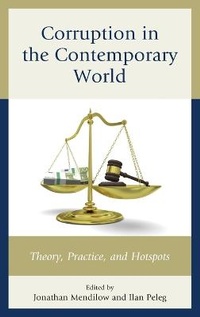
Corruption in the Contemporary World
Theory, Practice, and Hotspots
Published on 17. September 2014
Book
Hardback
280 pages
978-0-7391-9468-3 (ISBN)
Description
This book deals with large-scale, systemic corruption, a phenomenon that it identifies as part of the political landscape in most, if not all, societies of the contemporary world. While the analysis is grounded in the political thought of earlier thinkers, especially Edmund Burke, and integrates the insights of several modern analysts of corruption, the volume offers a new, updated theoretical perspective on the topic. This perspective reflects deep concerns with corruption in a world facing accelerated social transition, increased economic polarization, and growing distrust toward political elites in many countries.
This book approaches corrupt practices both theoretically and empirically, offering the perspectives of scholars who come to the topic from different traditions and cultures. It contains the collective efforts of members of the Research Committee on Political Finance and Public Corruption of the International Political Science Association. In formulating a comprehensive approach on corruption, the volume offers insights in regard to new developments in the United States, in Middle Eastern countries (especially in the wake of the Arab Spring), in several European counties (Austria, Italy, Spain), as well as in the People's Republic of China. The analysis goes beyond the traditional legal definitions of corruption or purely economic views of it and focuses more broadly on institutional, cultural, and normative dimensions of this globally important phenomenon.
This book approaches corrupt practices both theoretically and empirically, offering the perspectives of scholars who come to the topic from different traditions and cultures. It contains the collective efforts of members of the Research Committee on Political Finance and Public Corruption of the International Political Science Association. In formulating a comprehensive approach on corruption, the volume offers insights in regard to new developments in the United States, in Middle Eastern countries (especially in the wake of the Arab Spring), in several European counties (Austria, Italy, Spain), as well as in the People's Republic of China. The analysis goes beyond the traditional legal definitions of corruption or purely economic views of it and focuses more broadly on institutional, cultural, and normative dimensions of this globally important phenomenon.
Reviews / Votes
Corruption has for a long time been notoriously hard to define. What it is perceived to be is not necessarily what it is. It is congruous and sometimes fuses with notions such as extortion and redistribution of wealth or even welfare benefits. Can it be eradicated? Should it be embraced as an acceptable way of running political systems and institutions? These questions raise the intricate issue of the tenuous line which separates the political sphere from the economic or the public spheres.The contributions gathered in this opus by Mendilow and Peleg take us on a journey to the heart of the matter: from Burke's ideas to the reality on the ground, from ancient Greece to modern Italy, Austria, or China. We shall take a close look at the solemn workings of the U.S. Supreme Court as well as the successive waves of the Arab Spring which were backed by angry mobs. Very promising explorations indeed! -- Eric Phelippeau, University Paris Ouest - Nanterre la Defense Corruption is liable to become an emotionally charged indicator of academic and public discourse in future global discussions, and this book promotes the issue of corruption to the very forefront of the global public debate. This book explores understanding the phenomenon of corruption, which could lead to constructive and successful actions being taken to combat, prevent, and understand corruption through the different cases of countries analyzed. This book should be a must read for all the public officials, business environments, academic representatives, students, NGOs, and all who want to dive into deep analyses and understanding of corruption phenomenon. -- Olga Guzhva, V.N. Karazin Kharkov National University
More details
Language
English
Place of publication
United States
Publishing group
Bloomsbury Publishing Plc
Target group
Professional and scholarly
Illustrations
7 Graphs, 14 Tables
Dimensions
Height: 240 mm
Width: 161 mm
Thickness: 24 mm
Weight
531 gr
ISBN-13
978-0-7391-9468-3 (9780739194683)
Copyright in bibliographic data and cover images is held by Nielsen Book Services Limited or by the publishers or by their respective licensors: all rights reserved.
Schweitzer Classification
Other editions
Additional editions
Corruption in the Contemporary World
Theory, Practice, and Hotspots
E-Book
09/2014
1st Edition
Lexington Books
€49.99
Available for download
Persons
Jonathan Mendilow chairs the Research Committee on Political Finance & Political Corruption of the International Political Science Association and the Department of Political Science at Rider University.
Ilan Peleg is Charles A. Dana Professor of Government and Law at Lafayette College and adjunct scholar at the Middle East Institute in Washington, DC.
Ilan Peleg is Charles A. Dana Professor of Government and Law at Lafayette College and adjunct scholar at the Middle East Institute in Washington, DC.
Content
Chapter 1: Introduction: Edmund's Burke's Concept of Corruption and Beyond
Jonathan Mendilow and Ilan Peleg
Chapter 2: The Meaning of Corruption in World Opinion
Frank Louis Rusciano
Chapter 3: The Shifting Landscape of Corruption in America: Legal Corruption, Systemic Corruption or a New Form
Barry Seldes
Chapter 4: Can Public Funding and Citizen United Coexist?
Robert G. Boatright
Chapter 5: Corruption and the Arab Spring: Comparing the Pre- and Post-Spring Situation
Ilan Peleg and Jonathan Mendilow
Chapter 6:Ancient Democracy and the Modern Era: Why is Corruption so Common These Days?
Rebecca R. Fiske
Chapter 7: The Austrian Way: Neo-Corporatism and Neoliberal Corruption
Barbara Franz and Juergen Pfeffer
Chapter 8: Corruptible Competition: Power Nodes, Corruption, and Sleaze
Michael J. Brogan
Chapter 9: Tackling Corruption, finally? How Domestic and Supranational Factors have Led to Incremental Policy Change in Italy
Daniela R. Piccio, Fabrizio Di Mascio, and Alessandro Natalini
Chapter 10: Corruption Perception and Collective Action: The Case of Spain
Manuel Villoria, Fernando Jimenez-Sanchez and Ana Revuelta
Chapter 11: State Capitalism and Corruption: The Case of China
Jacob Sprague White
Chapter 12: Anthropological Approaches to Corruption: Globalizing Processes & Case Studies
Roberta Fiske-Rusciano
Jonathan Mendilow and Ilan Peleg
Chapter 2: The Meaning of Corruption in World Opinion
Frank Louis Rusciano
Chapter 3: The Shifting Landscape of Corruption in America: Legal Corruption, Systemic Corruption or a New Form
Barry Seldes
Chapter 4: Can Public Funding and Citizen United Coexist?
Robert G. Boatright
Chapter 5: Corruption and the Arab Spring: Comparing the Pre- and Post-Spring Situation
Ilan Peleg and Jonathan Mendilow
Chapter 6:Ancient Democracy and the Modern Era: Why is Corruption so Common These Days?
Rebecca R. Fiske
Chapter 7: The Austrian Way: Neo-Corporatism and Neoliberal Corruption
Barbara Franz and Juergen Pfeffer
Chapter 8: Corruptible Competition: Power Nodes, Corruption, and Sleaze
Michael J. Brogan
Chapter 9: Tackling Corruption, finally? How Domestic and Supranational Factors have Led to Incremental Policy Change in Italy
Daniela R. Piccio, Fabrizio Di Mascio, and Alessandro Natalini
Chapter 10: Corruption Perception and Collective Action: The Case of Spain
Manuel Villoria, Fernando Jimenez-Sanchez and Ana Revuelta
Chapter 11: State Capitalism and Corruption: The Case of China
Jacob Sprague White
Chapter 12: Anthropological Approaches to Corruption: Globalizing Processes & Case Studies
Roberta Fiske-Rusciano