

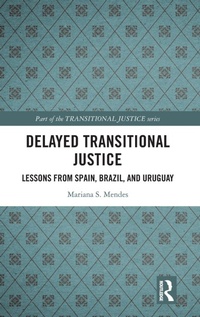
Delayed Transitional Justice
Lessons from Spain, Brazil, and Uruguay
1st Edition
Published on 24. July 2023
Book
Hardback
256 pages
978-1-032-31836-3 (ISBN)
Description
This book addresses the issue of the timing of transitional justice policies in countries that had negotiated transitions from authoritarianism to democracy.
Why are transitional justice measures often being implemented decades after the events they refer to? More specifically, what combination of factors leads to the implementation of transitional justice policies at certain moments in time? And, what explains countries' different choices and trajectories? To address these questions, this book pursues a comparative analysis of three cases: comparing a case of 'robust' implementation of transitional justice measures (Uruguay), a case where only victim-centered measures were approved (Spain), and a case that sits in between these two (Brazil). Through an in-depth empirical analysis of these specific country-cases, and focusing on seven different transitional justice initiatives, the book identifies the determinants behind delayed transitional justice policies and explains why such policies are more robust in some settings than in others. In doing so, it provides a holistic account of post-transitional justice outcomes, offering more general conclusions and insights about the study of the drivers of transitional justice.
This book will appeal to scholars and students of transitional justice in politics, law, and sociology, as well as to policymakers involved in the implementation and administration of transitional justice measures.
Why are transitional justice measures often being implemented decades after the events they refer to? More specifically, what combination of factors leads to the implementation of transitional justice policies at certain moments in time? And, what explains countries' different choices and trajectories? To address these questions, this book pursues a comparative analysis of three cases: comparing a case of 'robust' implementation of transitional justice measures (Uruguay), a case where only victim-centered measures were approved (Spain), and a case that sits in between these two (Brazil). Through an in-depth empirical analysis of these specific country-cases, and focusing on seven different transitional justice initiatives, the book identifies the determinants behind delayed transitional justice policies and explains why such policies are more robust in some settings than in others. In doing so, it provides a holistic account of post-transitional justice outcomes, offering more general conclusions and insights about the study of the drivers of transitional justice.
This book will appeal to scholars and students of transitional justice in politics, law, and sociology, as well as to policymakers involved in the implementation and administration of transitional justice measures.
More details
Series
Language
English
Place of publication
London
United Kingdom
Publishing group
Taylor & Francis Ltd
Target group
College/higher education
Academic, Postgraduate, and Undergraduate
Illustrations
6 s/w Abbildungen, 6 s/w Zeichnungen, 12 s/w Tabellen
12 Tables, black and white; 6 Line drawings, black and white; 6 Illustrations, black and white
Dimensions
Height: 240 mm
Width: 161 mm
Thickness: 19 mm
Weight
567 gr
ISBN-13
978-1-032-31836-3 (9781032318363)
Copyright in bibliographic data and cover images is held by Nielsen Book Services Limited or by the publishers or by their respective licensors: all rights reserved.
Schweitzer Classification
Other editions
Additional editions
Book
11/2024
1st Edition
Routledge
€63.40
Shipment within 10-20 days
E-Book
07/2023
1st Edition
Routledge
€55.49
Available for download
E-Book
07/2023
1st Edition
Routledge
€55.49
Available for download
Person
Mariana S. Mendes is a post-doctoral researcher at the Mercator Forum for Migration and Democracy, Institute of Political Science, Technical University Dresden, Germany.
Content
Acknowledgments
Introduction
PART I
Conceptual and theoretical framework
1 Definition and operationalization of transitional justice: The Transitional Justice Scale
2 Theoretical framework: A holistic approach to delayed transitional justice
PART II
Transitional justice trajectories in context
3 Spain: From deliberate forgetting to limited acknowledgment
4 Uruguay: From blockage to criminal accountability
5 Brazil: From a marginal issue to the 'right to truth'
PART III
Comparative analysis 2
6 Making sense of the timing of transitional justice
7 Making sense of differences in countries' trajectories
Conclusion
Annex
Index
Introduction
PART I
Conceptual and theoretical framework
1 Definition and operationalization of transitional justice: The Transitional Justice Scale
2 Theoretical framework: A holistic approach to delayed transitional justice
PART II
Transitional justice trajectories in context
3 Spain: From deliberate forgetting to limited acknowledgment
4 Uruguay: From blockage to criminal accountability
5 Brazil: From a marginal issue to the 'right to truth'
PART III
Comparative analysis 2
6 Making sense of the timing of transitional justice
7 Making sense of differences in countries' trajectories
Conclusion
Annex
Index