

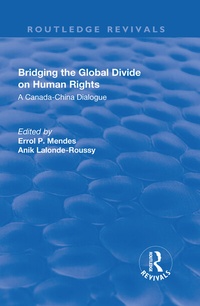
Bridging the Global Divide on Human Rights: A Canada-China Dialogue
A Canada-China Dialogue
1st Edition
Published on 26. November 2019
Book
Hardback
388 pages
978-1-138-71616-2 (ISBN)
Description
This title was first published in 2003. In this collection of essays that explores Western and Chinese perspectives on human rights, leading Canadian and Chinese scholars bridge the global divide on some of the key aspects of human rights. Issues covered include the role of civil society in human rights protection, the imperative of the rule of law in the protection of human rights, freedom of expression and its relation to social, economic and cultural development and corruption in the public and private sectors. The volume also focuses on the domestic implementation of human rights treaties and offers gender perspectives on implementing social and economic rights in an era of globalization. The independent Chinese and Canadian scholars present a new vision of global pluralism in the area of human rights protection in a modernizing China and in the rest of the world.
More details
Series
Language
English
Place of publication
London
United Kingdom
Publishing group
Taylor & Francis Ltd
Target group
College/higher education
Dimensions
Height: 219 mm
Width: 152 mm
Weight
880 gr
ISBN-13
978-1-138-71616-2 (9781138716162)
Copyright in bibliographic data and cover images is held by Nielsen Book Services Limited or by the publishers or by their respective licensors: all rights reserved.
Schweitzer Classification
Other editions
Additional editions
Errol P. Mendes | Anik Lalonde-Roussy
Bridging the Global Divide on Human Rights: A Canada-China Dialogue
A Canada-China Dialogue
E-Book
06/2019
1st Edition
Routledge
€73.99
Available for download
Errol P. Mendes | Anik Lalonde-Roussy
Bridging the Global Divide on Human Rights: A Canada-China Dialogue
A Canada-China Dialogue
E-Book
06/2019
1st Edition
Routledge
€73.99
Available for download
Persons
Errol P. Mendes, Anik Lalonde-Roussy
Content
Introduction; Part I: Implementing Human Rights via Civil Society, Government and the Legal System; Chapter 1: Reflections on Civil Society and Human Rights; Chapter 2: The Detention System in China; Chapter 3: To Whom Must We Answer? Exploring the Relationship between Sovereignty, the Rule of Law and Human Rights in Chinese and Canadian Practice; Chapter 4: Private Property and Individual Freedoms; Part II: The Domestic Implementation of Human Rights in Customary International Law and in the Two International Covenants; Chapter 5: Implementing International Human Rights Treaties in China; Chapter 6: The Domestic Implementation of International Law: A Canadian Case Study; Part III: Integrating the Obligations Contained in the International Covenants on Human Rights with the Convention on the Rights of the Child; Chapter 7: The Child's Right to Birth Registration: International and Chinese Perspectives; Chapter 8: 'Particularizing the Universal': The Challenge of Children's Rights; Part IV: Gender Perspectives on Implementing Social and Economic Rights in an Era of Globalization; Chapter 9: The Question of State Responsibility at International Law for Acts of Violence Against Women; Chapter 10: The Rise of a Women's Human Rights Epistemic Network in the 1990s: Global Norms, Gender Politics and Civil Society; Chapter 11: Globalization and Gender: Reflections on Human Rights and the 'Neutrality' of the Marketplace; Part V: Freedom of Expression and its Relation to Social, Economic and Cultural Development; Chapter 12: Freedom of Expression and Social Development: An Empirical Analysis of the Great Leap Forward; Chapter 13: From Gridlock to Growth: India's Experience with Free Expression; Chapter 14: Corruption: The Cancer of the International Bill of Rights - Democracy and Freedom of Expression, the Main Treatments?; Part VI: Corruption in the Private Sector and its Impact on Ensuring the Right to Subsistence; Chapter 15: The Control of Corruption and Protection of Human Rights; Chapter 16: Corruption, Worker Rights and Good Governance