

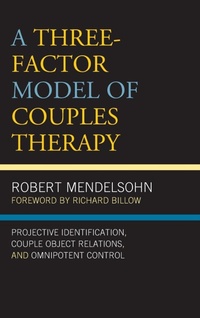
A Three-Factor Model of Couples Therapy
Projective Identification, Couple Object Relations, and Omnipotent Control
Published on 7. August 2017
Book
Hardback
284 pages
978-1-4985-5707-8 (ISBN)
Description
Couple psychotherapy extends the work of the psychotherapist to the patient's most significant committed adult relationship, yet the therapy is difficult both conceptually and technically. One major reason for this difficulty is that in every couple's treatment there is a confusing array of psychological defenses as well as regressive and nonregressive couple object relations-as distinct from the object relations that each individual member brings to the couple. Further, many of these processes are occurring outside consciousness and at the very same time. This book is an attempt to clarify all the confusing issues by presenting a three-factor model of couple psychotherapy within a psychodynamic framework. This model has been found to be very effective with many different kinds of couples. The book suggests that there are three powerful couple dynamics that shape every couple's treatment: (A) the quality and quantity of the couple's projective identifications; (B) the level of their "couple object relations"; and (C) the presence or absence of the defense of omnipotent control. These three variables are the most important factors in the therapy; they determine the success or failure of every therapy with every couple. These dynamics also determine quite a bit about how to conduct a couple therapy with regard to the therapist's level of activity, tone, the way of sorting the material in his or her head, and even the kinds of interventions he/she chooses (whether or not, for example, the therapist will use certain resistance techniques). Understanding these three variables and how they interact is key to the success of the therapy.
Reviews / Votes
A Couple's Therapist is destined for 'deja vu,' a career of groundhog days. Dr. Mendelsohn shares the phenomenology of his discovery process-as he understands how he comes to be (by necessity) a major player in the couple's parasitic, symbiotic, narcissistic, sibling, or Oedipal dramas. The journey makes for compelling reading, and is inspirational. Mendelsohn's style his inimitable, it's his and his alone. But the concepts and techniques he offers are adaptable; they may free up the thinking and practice of a contemporary couple's therapist, no matter his or her orientation. -- Richard Billow, Adelphi University Bob Mendelsohn has advanced the practice of couple psychoanalysis by integrating his marvelous and unique three-factor model with Kleinian/Bionion object relations ideas about unconscious projective processes. He makes the model accessible to the reader with evocative case material. This book should be in every couple therapist's library regardless of levels of experience. -- Carl Bagnini, LCSW, BCD, The International Psychotherapy Institute; Author of Keeping Couples in Treatment: Working from Surface to DepthMore details
Series
Language
English
Place of publication
United States
Publishing group
Bloomsbury Publishing Plc
Target group
Professional and scholarly
Dimensions
Height: 235 mm
Width: 157 mm
Thickness: 21 mm
Weight
615 gr
ISBN-13
978-1-4985-5707-8 (9781498557078)
Copyright in bibliographic data and cover images is held by Nielsen Book Services Limited or by the publishers or by their respective licensors: all rights reserved.
Schweitzer Classification
Other editions
Additional editions
Robert Mendelsohn
A Three-Factor Model of Couples Therapy
Projective Identification, Couple Object Relations, and Omnipotent Control
E-Book
08/2017
1st Edition
Lexington Books
€107.99
Available for download
Robert Mendelsohn
A Three-Factor Model of Couples Therapy
Projective Identification, Couple Object Relations, and Omnipotent Control
E-Book
08/2017
1st Edition
Lexington Books
€107.99
Available for download
Persons
Robert Mendelsohn is professor of psychology at the Derner School of Psychology, Adelphi University.
Content
Chapter 1: Psychodynamic Couple Therapy and the Three-Factor Model: Projective Identification, Couple Object Relations, and Omnipotent Control
Chapter 2: Factor One: First Among Three: How Does Projective Identification Show Itself In Interaction With Each Other Factor?
Chapter 3: Factor Two: The Couple's Level of Object Relations
Chapter 4: Factor Three: Omnipotent Control
Chapter 5: Theoretical Implications: The Role Of Projective Identification and Unconscious Enactments
Chapter 6: Clinical and Technical Implications
Chapter 7: Clinical And Technical Innovations: Projective Identification and Special Techniques For Working With Resistance In Couple Therapy
Chapter 2: Factor One: First Among Three: How Does Projective Identification Show Itself In Interaction With Each Other Factor?
Chapter 3: Factor Two: The Couple's Level of Object Relations
Chapter 4: Factor Three: Omnipotent Control
Chapter 5: Theoretical Implications: The Role Of Projective Identification and Unconscious Enactments
Chapter 6: Clinical and Technical Implications
Chapter 7: Clinical And Technical Innovations: Projective Identification and Special Techniques For Working With Resistance In Couple Therapy