

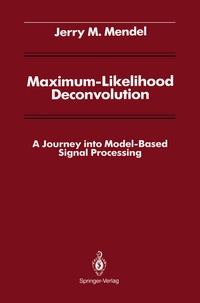
Maximum-Likelihood Deconvolution
A Journey into Model-Based Signal Processing
Published on 17. September 2011
Book
Paperback/Softback
XIV, 227 pages
978-1-4612-7985-3 (ISBN)
Description
Convolution is the most important operation that describes the behavior of a linear time-invariant dynamical system. Deconvolution is the unraveling of convolution. It is the inverse problem of generating the system's input from knowledge about the system's output and dynamics. Deconvolution requires a careful balancing of bandwidth and signal-to-noise ratio effects. Maximum-likelihood deconvolution (MLD) is a design procedure that handles both effects. It draws upon ideas from Maximum Likelihood, when unknown parameters are random. It leads to linear and nonlinear signal processors that provide high-resolution estimates of a system's input. All aspects of MLD are described, from first principles in this book. The purpose of this volume is to explain MLD as simply as possible. To do this, the entire theory of MLD is presented in terms of a convolutional signal generating model and some relatively simple ideas from optimization theory. Earlier approaches to MLD, which are couched in the language of state-variable models and estimation theory, are unnecessary to understand the essence of MLD. MLD is a model-based signal processing procedure, because it is based on a signal model, namely the convolutional model. The book focuses on three aspects of MLD: (1) specification of a probability model for the system's measured output; (2) determination of an appropriate likelihood function; and (3) maximization of that likelihood function. Many practical algorithms are obtained. Computational aspects of MLD are described in great detail. Extensive simulations are provided, including real data applications.
More details
Series
Edition
Softcover reprint of the original 1st ed. 1990
Language
English
Place of publication
New York
United States
Target group
Professional and scholarly
Research
Illustrations
XIV, 227 p.
Dimensions
Height: 235 mm
Width: 155 mm
Thickness: 14 mm
Weight
376 gr
ISBN-13
978-1-4612-7985-3 (9781461279853)
DOI
10.1007/978-1-4612-3370-1
Schweitzer Classification
Other editions
Additional editions
Book
12/1989
Springer
€85.55
Article exhausted; check different version
Persons
Jerry M. Mendel received the Ph.D. degree in Electrical Engineering from the Polytechnic Institute of Brooklyn, Brooklyn, NY. Currently, he is Emeritus Professor of Electrical Engineering at the University of Southern California in Los Angeles, where he worked for 44 years. He has published close to 600 technical papers and is author and/or co-author of 12 books, including Uncertain Rule-based Fuzzy Logic Systems: Introduction and New Directions (Prentice-Hall, 2001), Perceptual Computing: Aiding People in Making Subjective Judgments (Wiley & IEEE Press, 2010), Introduction to Type-2 Fuzzy Logic Control: Theory and Application (Wiley & IEEE Press, 2014) and Uncertain Rule-based Fuzzy Systems: Introduction and New Directions, 2nd ed. (Springer, 2017). He is a Life Fellow of the IEEE, a Distinguished Member of the IEEE Control Systems Society, and a Fellow of the International Fuzzy Systems Association and the Asia-Pacific AI Association. He was President of the IEEE Control Systems Society in 1986, a member of the Administrative Committee of the IEEE Computational Intelligence Society for nine years, and Chairman of its Fuzzy Systems Technical Committee and the Computing With Words Task Force of that TC. Among his awards are the 1983 Best Transactions Paper Award of the IEEE Geoscience and Remote Sensing Society, the 1992 Signal Processing Society Paper Award, the 2002 and 2014 Transactions on Fuzzy Systems Outstanding Paper Awards, a 1984 IEEE Centennial Medal, an IEEE Third Millenium Medal, a Fuzzy Systems Pioneer Award (2008) from the IEEE Computational Intelligence Society for fundamental theoretical contributions and seminal results in fuzzy systems, and the 2021 IEEE Lotfi A. Zadeh Pioneer Award for developing and promoting type-2 fuzzy logic. As of March 27, 2023, his publications have been cited (Google Scholar) more than 63,000 times, with an h-index of 100 and an i10-index of 320.
Content
1 - Introduction.- 1.1 Introduction.- 1.2 Our Approach.- 1.3 Likelihood Versus Probability.- 1.4 Maximum-Likelihood Method.- 1.5 Comments.- 2 - Convolutional Model.- 2.1 Introduction.- 2.2 The Seismic Convolutional Model.- 2.3 Input.- 2.4 Channel Model IR (Seismic Wavelet).- 2.5 Measurement Noise.- 2.6 Other Effects.- 2.7 Mathematical Model.- 2.8 Summary.- 3 - Likelihood.- 3.1 Introduction.- 3.2 Loglikelihood.- 3.3 Likelihood Function.- 3.4 Using Given Information.- 3.5 Message for the Reader.- 3.6 Mathematical Likelihood Functions.- 3.7 Mathematical Loglikelihood Functions.- 3.8 Summary.- 4 - Maximizing Likelihood.- 4.1 Introduction.- 4.2 A Rationale.- 4.3 Block Component Search Algorithms.- 4.4 Mathematical Fact.- 4.5 Separation Principle.- 4.6 Update Random Parameters.- 4.7 Binary Detection.- 4.8 Update Wavelet Parameters.- 4.9 Update Statistical Parameters.- 4.10 Message for the Reader.- 4.11 Summary.- 5 - Properties and Performance.- 5.1 Introduction.- 5.2 Minimum-Variance Deconvolution.- 5.3 Detectors.- 5.4 A Modified Likelihood Function.- 5.5 An Objective Function.- 5.6 Marquardt-Levenberg Algorithm.- 5.7 Convergence.- 5.8 Entropy Interpretation.- 5.9 Summary.- 6 - Examples.- 6.1 Introduction.- 6.2 Some Real Data Examples.- 6.3 Minimum-Variance Deconvolution.- 6.4 Detection.- 6.5 Block Component Method.- 6.6 Backscatter.- 6.7 Noncausal Channel Models.- 6.8 Summary.- 7 - Mathematical Details for Chapter 4.- 7.1 Introduction.- 7.2 Mathematical Fact.- 7.3 Separation Principle.- 7.4 Minimum-Variance Deconvolution.- 7.5 Threshold Detector.- 7.6 Single Most-Likely Replacement Detector.- 7.7 Single Spike Shift Detector.- 7.8 SSS-SMLR Detector.- 7.9 Marquardt-Levenberg Algorithm.- 7.10 Calculating Gradients.- 7.11 Calculating Second Derivatives.- 7.12 Why vr Cannot be Estimated: Maximization of L or M is an Ill-Posed Problem.- 7.13 An Algorithm for ?.- 8 - Mathematical Details for Chapter 5.- 8.1 Introduction.- 8.2 MVD Filter Properties.- 8.3 Threshold Detector.- 8.4 Modified Likelihood Function.- 8.5 Separation Principle for P and Derivation of N from P.- 8.6 Why vr Cannot be Estimated: Maximization of P or N is not an Ill-Posed Problem.- 8.7 SMLR1 Detector Based on N.- 8.8 Quadratic Convergence of the Newton-Raphson Algorithm.- 8.9 Wavelet Identifiability.- 8.10 Convergence of Adaptive SMLR Detector.- 9 - Computational Considerations.- 9.1 Introduction.- 9.2 Recursive Processing.- 9.3 Summary.- References.