

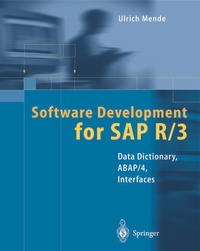
Software Development for SAP R/3®
Data Dictionary, ABAP/4®, Interfaces
Published on 3. October 2013
Book
Paperback/Softback
XI, 347 pages
978-3-642-62971-6 (ISBN)
Description
The use of commercial standard software is increasing in importance throughout the world. With its R/3 product, SAP AG has brought the package on the market that provides the most comprehensive functionality. When standard solutions are used, there is, a priori, a conflict of aims between what the standard offers and the company-specific requirements. SAP counters this in the R/3 System by building a modular software that can be customized to meet the cus tomer requirements. However, many users still see themselves forced to make in-house devel opments, to various degrees, to fit the R/3 System. Here they can use the ABAP Workbench that SAP supplies with every system. The present book targets those persons who need to perform these customer-oriented supple mentary developments. It leads the reader through the fundamentals of software development within the R/3 System using the ABAP Workbench. These principles differ from other devel opment environments, in particular, through their complexity and the close integration with the R/3 System. Because an installation for testing and training purposes on the PC at home is not an option, I considered a structured, understandable introduction to the material in the form of a If you initially read the book "offline" from an R/3 System, you will book to be more important.
More details
Edition
Softcover reprint of the original 1st ed. 2000
Language
English
Place of publication
Berlin
Germany
Publishing group
Springer Berlin
Target group
Professional and scholarly
Professional/practitioner
Illustrations
XI, 347 p.
Dimensions
Height: 242 mm
Width: 193 mm
Thickness: 20 mm
Weight
707 gr
ISBN-13
978-3-642-62971-6 (9783642629716)
DOI
10.1007/978-3-642-57225-8
Schweitzer Classification
Other editions
Additional editions
E-Book
12/2012
Springer
€96.29
Available for download
Book
02/2000
1st Edition
Springer
€101.60
Article exhausted; check different version
Content
1 Introduction.- 1.1 Content and Aim of the Book.- 1.2 Limitations.- 2 R/3 Computer and Software Architecture.- 2.1 Three-level Client-Server Architecture.- 2.2 Software Architecture.- 2.3 Operational Modes for Developers.- 3 The Example - A Service System.- 3.1 Logical Data Model.- 3.2 Use of the Example.- 4 Data Dictionary and Data Modeler.- 4.1 Data Dictionary.- 4.2 Data Modeler.- 5 Workbench.- 5.1 Program Development Objects.- 5.2 Primary Objects.- 5.3 Use of the Workbench.- 5.4 Important Workbench Tools.- 6 ABAP/4 Fundamentals.- 6.1 ABAP/4 Characteristics.- 6.2 Internal Fields.- 6.3 Output Instructions - WRITE, SKIP, ULINE, NEW-PAGE.- 6.4 Control Instructions.- 6.5 Field Strings.- 6.6 Internal Tables.- 6.7 User-Defined Data Types - TYPES.- 6.8 Field Symbols - FIELD-SYMBOLS, ASSIGN.- 6.9 Database Access Using Open SQL.- 6.10 Database Access with Native SQL.- 7 Interactive Reports.- 7.1 Event Control.- 7.2 Texts and Menus.- 7.3 List Processing.- 7.4 Group Change.- 8 Advanced Programming Techniques.- 8.1 Macros and Includes.- 8.2 Subprogram Technique Using Forms.- 8.3 Data Exchange Between Reports.- 8.4 Logical Databases.- 8.5 Function Groups and Function Modules.- 8.6 Authorization Checks.- 9 Development of Dialog Transactions.- 9.1 Concept.- 9.2 Dialog Program Components and Their Processing.- 9.3 Screen Processing.- 9.4 Screen Flow Control.- 9.5 Example 1: Hand Calculator.- 9.6 Screen Layout Features.- 9.7 Example 2: Two Table Controls on a Dynpro.- 9.8 Database Operations.- 9.9 Example 3: Updating Action.- 9.10 Transaction Manager for Complex Business Transactions.- 10 Background Processing.- 10.1 Concept.- 10.2 Interactive Processing with the Job Control.- 10.3 Programming the Job Control - an Example.- 10.4 Special Questions Concerning the Background Processing.- 11 File Interfaces.- 11.1 Read and Write Files on the Application Server.- 11.2 Read and Write PC Files.- 11.3 Processing of the Data from an ASCII File.- 11.4 Logical File Interfaces (LFI).- 12 Batch Input.- 12.1 Concept.- 12.2 Classic Batch Input Using Sessions.- 12.3 Batch Input Using CALL TRANSACTION.- 13 Desktop Integration.- 13.1 Remote Function Call (RFC).- 13.2 Desktop Integration with OLE.- 14 Development Aids.- 14.1 Pretty Printer and Program Checks.- 14.2 Testing of Function Modules.- 14.3 Dump Analysis.- 14.4 Debugger.- 14.5 SQL Trace.- 14.6 Runtime Analyses.- A Important System Fields from the SYST Structure.- B Important Transaction Codes.- C Programs.- D Sample Tables.- E Diskette Contents.