

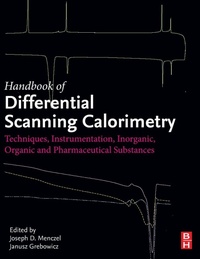
Handbook of Differential Scanning Calorimetry
Techniques, Instrumentation, Inorganic, Organic and Pharmaceutical Substances
Published on 8. March 2023
Book
Hardback
874 pages
978-0-12-811347-9 (ISBN)
Description
Differential scanning calorimetry (DSC) is the most important thermal analysis technique used today and the most common thermal analysis instrument found in chemical characterization laboratories. DSC has become an everyday tool in characterization laboratories, but many researchers using this technique have a limited understanding of the true breadth of its capabilities. Up to now, there has been no book that would describe the application of DSC in all the various areas of materials chemistry. The Handbook of Differential Scanning Calorimetry has been written to fill that void. This book is designed to summarize the knowledge of differential scanning calorimetry so that materials researchers and application chemists are given both a better understanding of techniques , as well as a review of the full scope of its capabilities. It also discusses how to properly interpret the DSC thermograms data obtained. Included in this work is the most up-to-date information written by some of the leaders in the field. It is written not only to help users get the most out of their equipment, After reading this book, people in all chemical and biological areas will have a broad overview of this measuring technique, and will be able to utilize this analytical technique more efficiently.
More details
Language
English
Place of publication
Woburn
United States
Publishing group
Elsevier - Health Sciences Division
Target group
Professional and scholarly
Materials researchers, thermal analysts, academics, post-doc graduate students
Product notice
Laminated cover
Dimensions
Height: 235 mm
Width: 191 mm
Thickness: 46 mm
Weight
1699 gr
ISBN-13
978-0-12-811347-9 (9780128113479)
Copyright in bibliographic data and cover images is held by Nielsen Book Services Limited or by the publishers or by their respective licensors: all rights reserved.
Schweitzer Classification
Other editions
Additional editions
Joseph D. Menczel | Janusz Grebowicz
Handbook of Differential Scanning Calorimetry
Techniques, Instrumentation, Inorganic, Organic and Pharmaceutical Substances
E-Book
02/2023
Butterworth-Heinemann
€230.00
Available for download
Persons
Dr. Menczel is a recognized expert in thermal analysis of polymers with some thirty years of industrial and academic experience. He has researched more than 120 polymeric systems in which he studied calibration of DSCs, glass transition, nucleation, crystallization, melting, stability, mechanical and micromechanical properties of polymers, and polymer-water interactions. Dr. Menczel holds six patents and is the author of seventy scholarly papers. He is the author of two chapters in the book Thermal Characterization of Polymeric Materials. Dr. Menczel is an elected NATAS fellow and was the 2010 recipient of the Mettler-Toledo Award in Thermal Analysis. Dr. Grebowicz is a Professor of Chemistry and Physics at the University of Houston-Downtown and a 2014/15 Fulbright Scholar at AGH UST. His areas of expertise are thermal analysis, polymer physical chemistry, phase structure and phase transitions in materials, such as low molecular weight chemicals, polymers and geological materials. He has several significant contributions to science including: design of first ever schematic of all phases and mesophases (with his recognition of new mesophase: conformationally disordered crystals - Condis Crystals), recognition of Rigid Amorphous phase and first ever demonstration of capillary breakup of liquid threads in molten polymer systems - polymer blends (high viscosity). He has authored over 70 papers in these areas.
A native of Poland, he received his MS degree in physics from the University of Lodz. His MS project was on polymer physics: development of experimental methods of characterization morphology of semi-crystalline polymers. Soon after, he was appointed a researcher at the Center of Molecular and Macromolecular Studies, Polish Academy of Sciences. There he received his PhD in research on polymer blends followed by a series of post-doctoral studies at Rensselaer Polytechnic Institute, Max Planck Institute (Mainz, Germany), and the University of Massachusetts, Amherst. He became a world-class specialist in thermal analysis, as recognized by his colleagues in the field. For over a decade he worked for Shell Oil, Westhollow Technology Center in Houston, as the head of the Thermal Analysis laboratory (global reach).
A native of Poland, he received his MS degree in physics from the University of Lodz. His MS project was on polymer physics: development of experimental methods of characterization morphology of semi-crystalline polymers. Soon after, he was appointed a researcher at the Center of Molecular and Macromolecular Studies, Polish Academy of Sciences. There he received his PhD in research on polymer blends followed by a series of post-doctoral studies at Rensselaer Polytechnic Institute, Max Planck Institute (Mainz, Germany), and the University of Massachusetts, Amherst. He became a world-class specialist in thermal analysis, as recognized by his colleagues in the field. For over a decade he worked for Shell Oil, Westhollow Technology Center in Houston, as the head of the Thermal Analysis laboratory (global reach).
Content
CHAPTER 1 Fundamentals of DSC
CHAPTER 2 The Theory of Modulated Temperature Differential Scanning Calorimetry
CHAPTER 3 Chip-Based Fast Scanning Calorimetry
CHAPTER 4 DSC of Inorganic Materials
CHAPTER 5 DSC of Low Molecular Mass Organic Materials and Pharmaceuticals
CHAPTER 6 Simultaneous DSC Techniques
CHAPTER 7 Instrumentation
CHAPTER 2 The Theory of Modulated Temperature Differential Scanning Calorimetry
CHAPTER 3 Chip-Based Fast Scanning Calorimetry
CHAPTER 4 DSC of Inorganic Materials
CHAPTER 5 DSC of Low Molecular Mass Organic Materials and Pharmaceuticals
CHAPTER 6 Simultaneous DSC Techniques
CHAPTER 7 Instrumentation