

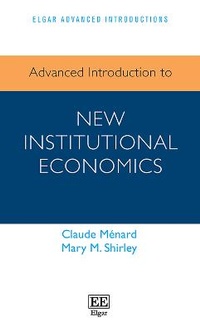
Advanced Introduction to New Institutional Economics
Published on 18. January 2022
Book
Hardback
200 pages
978-1-78990-448-2 (ISBN)
Description
Elgar Advanced Introductions are stimulating and thoughtful introductions to major fields in the social sciences, business and law, expertly written by the world'AEos leading scholars. Designed to be accessible yet rigorous, they offer concise and lucid surveys of the substantive and policy issues associated with discrete subject areas.
New institutional economics (NIE) is a powerful tool for understanding real world phenomena. This Advanced Introduction explores NIE's answers to fundamental questions about the organization, growth and development of economies, such as why are some countries rich and others poor? Why are activities organized as firms or markets or through alternative organizational solutions? When are shared resources overexploited?
Key Features:
Elucidates the essence of NIE's main branches, focusing on the
governance of transactions and organizations (identified with Oliver
Williamson), the fundamental institutional environment (Douglass
North), and the role of communal institutions and collective action (Elinor
Ostrom)
Explores how NIE has transformed perspectives on collective action, state
and legal institutions, public policy and regulation, and economic growth
Extensive references to allow interested readers to dive deeper into specific topics
Authored by scholars associated early on with leading figures in NIE and the development of NIE's research agenda.
This Advanced Introduction is an ideal read for advanced students of economics, political science, management, law and sociology interested in learning about new institutional economics. Policy makers, especially those responsible for business and utility regulation and development policy and assistance, will also benefit from this concise yet detailed book.
New institutional economics (NIE) is a powerful tool for understanding real world phenomena. This Advanced Introduction explores NIE's answers to fundamental questions about the organization, growth and development of economies, such as why are some countries rich and others poor? Why are activities organized as firms or markets or through alternative organizational solutions? When are shared resources overexploited?
Key Features:
Elucidates the essence of NIE's main branches, focusing on the
governance of transactions and organizations (identified with Oliver
Williamson), the fundamental institutional environment (Douglass
North), and the role of communal institutions and collective action (Elinor
Ostrom)
Explores how NIE has transformed perspectives on collective action, state
and legal institutions, public policy and regulation, and economic growth
Extensive references to allow interested readers to dive deeper into specific topics
Authored by scholars associated early on with leading figures in NIE and the development of NIE's research agenda.
This Advanced Introduction is an ideal read for advanced students of economics, political science, management, law and sociology interested in learning about new institutional economics. Policy makers, especially those responsible for business and utility regulation and development policy and assistance, will also benefit from this concise yet detailed book.
Reviews / Votes
'This Advanced Introduction provides a terrific exposition of New Institutional Economics. The foundations of transaction costs, property rights, and contracting produce applications concerning institutions large and small, covering a substantial share of economic activity. Much of the world's economic progress and institutional change will rely on these ideas.' -- Robert Gibbons, Massachusetts Institute of Technology, USMore details
Series
Language
English
Place of publication
Cheltenham
United Kingdom
Target group
College/higher education
Dimensions
Height: 216 mm
Width: 138 mm
ISBN-13
978-1-78990-448-2 (9781789904482)
Copyright in bibliographic data and cover images is held by Nielsen Book Services Limited or by the publishers or by their respective licensors: all rights reserved.
Schweitzer Classification
Persons
Claude Menard, Professor of Economics, Centre d'Economie de la Sorbonne, Universite de Paris (Pantheon-Sorbonne), France and Mary M. Shirley, President, The Ronald Coase Institute, US
Content
Contents: Preface 1. Building a new paradigm 2. Transaction costs 3. Property rights 4. Contracts PART II INSTITUTIONAL LAYERS 5. The organization of transactions 6. State and legal institutions PART III TRANSVERSAL TOPICS 7. Institutions and public policy 8. Institutional change and development 9. Entering new terrains: the future of NIE Bibliography Index