

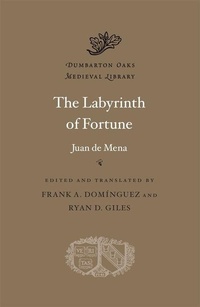
The Labyrinth of Fortune
Published on 6. May 2025
Book
Hardback
336 pages
978-0-674-29091-4 (ISBN)
Description
A classic, Dantesque political epic from medieval Spain that inspired Cervantes and Gongora, in its first English translation.
Why do the injustices of the past still afflict the present? With this question, Juan de Mena is transported to heaven by a vision in the Dantesque The Labyrinth of Fortune. Composed in 1444 by Mena, a royal chronicler and Latin secretary in the court of Juan II of Castile, El Laberinto de Fortuna became the most important political allegory of medieval Spain. Allegorizing the past, present, and unknowable future through the figure of Providence, the poem reflects on the contentious kingship of Juan II and frames the Reconquest of Moorish territories-the foundational mythos of the emerging nation-as a virtuous, sacred task that would restore justice and the moral order because it fulfills a destiny ordained by God. This is the first English translation of a masterpiece that enriched the Spanish language with a density of learned allusions and a new Latinate humanistic style that deeply influenced subsequent writers such as Miguel Cervantes and Luis de Gongora.
Why do the injustices of the past still afflict the present? With this question, Juan de Mena is transported to heaven by a vision in the Dantesque The Labyrinth of Fortune. Composed in 1444 by Mena, a royal chronicler and Latin secretary in the court of Juan II of Castile, El Laberinto de Fortuna became the most important political allegory of medieval Spain. Allegorizing the past, present, and unknowable future through the figure of Providence, the poem reflects on the contentious kingship of Juan II and frames the Reconquest of Moorish territories-the foundational mythos of the emerging nation-as a virtuous, sacred task that would restore justice and the moral order because it fulfills a destiny ordained by God. This is the first English translation of a masterpiece that enriched the Spanish language with a density of learned allusions and a new Latinate humanistic style that deeply influenced subsequent writers such as Miguel Cervantes and Luis de Gongora.
Reviews / Votes
[A] fine edition and translation of an impressive and significant work. -- M. A. Orthofer * Complete Review *More details
Series
Language
English
Place of publication
Cambridge, Mass
United States
Dimensions
Height: 206 mm
Width: 138 mm
Thickness: 26 mm
Weight
428 gr
ISBN-13
978-0-674-29091-4 (9780674290914)
Copyright in bibliographic data and cover images is held by Nielsen Book Services Limited or by the publishers or by their respective licensors: all rights reserved.
Schweitzer Classification