

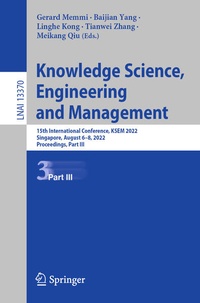
Knowledge Science, Engineering and Management
15th International Conference, KSEM 2022, Singapore, August 6-8, 2022, Proceedings, Part III
Published on 31. July 2022
Book
Paperback/Softback
XVI, 753 pages
978-3-031-10988-1 (ISBN)
Description
The three-volume sets constitute the refereed proceedings of the 15th International Conference on Knowledge Science, Engineering and Management, KSEM 2022, held in Singapore, during August 6-8, 2022.
The 169 full papers presented in these proceedings were carefully reviewed and selected from 498 submissions. The papers are organized in the following topical sections:
Volume I:Knowledge Science with Learning and AI (KSLA)
Volume II:Knowledge Engineering Research and Applications (KERA)
Volume III:Knowledge Management with Optimization and Security (KMOS)
The 169 full papers presented in these proceedings were carefully reviewed and selected from 498 submissions. The papers are organized in the following topical sections:
Volume I:Knowledge Science with Learning and AI (KSLA)
Volume II:Knowledge Engineering Research and Applications (KERA)
Volume III:Knowledge Management with Optimization and Security (KMOS)
More details
Series
Edition
1st ed. 2022
Language
English
Place of publication
Cham
Switzerland
Publishing group
Springer International Publishing
Target group
Professional and scholarly
Illustrations
42 s/w Abbildungen, 240 farbige Abbildungen
XVI, 753 p. 282 illus., 240 illus. in color.
Dimensions
Height: 235 mm
Width: 155 mm
Thickness: 42 mm
Weight
1147 gr
ISBN-13
978-3-031-10988-1 (9783031109881)
DOI
10.1007/978-3-031-10989-8
Schweitzer Classification
Other editions
Additional editions
Gerard Memmi | Baijian Yang | Linghe Kong
Knowledge Science, Engineering and Management
15th International Conference, KSEM 2022, Singapore, August 6-8, 2022, Proceedings, Part III
E-Book
07/2022
Springer
€117.69
Available for download
Content
Knowledge Management with Optimization and Security (KMOS).
- Study on Chinese Named Entity Recognition Based on Dynamic Fusion and Adversarial Training.- Spatial Semantic Learning for Travel Time Estimation.- A Fine-Grained Approach for Vulnerabilities Discovery using Augmented Vulnerability Signatures.- PPBR-FL: a Privacy-preserving and Byzantine-robust Federated Learning System.- GAN-Based Fusion Adversarial Training.- MAST-NER: A Low-Resource Named Entity Recognition Method based on Trigger Pool.- Fuzzy information measures feature selection using descriptive statistics data.- Prompt-Based Self-Training Framework for Few-Shot Named Entity Recognition.- Learning Advisor-Advisee Relationship from Multiplex Network Structure.- CorefDRE: Coref-aware Document-level Relation Extraction.- Single Pollutant Prediction Approach by Fusing MLSTM and CNN.- A Multi-objective Evolutionary Algorithm Based on Multi-layer Network Reduction for Community Detection.- Detection DDoS of attacks based on federated learning with Digital Twin Network.- A Privacy-Preserving Subgraph-Level Federated Graph Neural Network via Differential Privacy.