

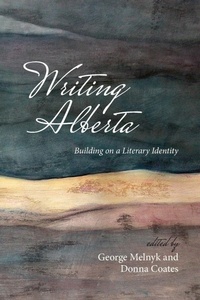
Writing Alberta
Building on a Literary Identity
Published on 30. June 2017
Book
Paperback/Softback
280 pages
978-1-55238-890-7 (ISBN)
Description
Alberta writing has a long tradition. Beginning with the pictographs of Writing-on-Stone, followed by Euro-Canadian exploration texts, the post-treaty writing of the agrarian colonization period, and into the present era, Alberta writing has come to be seen as a distinct literature. In this volume Melnyk and Coates continue the project of scholarly analysis of Alberta literature that they began with Wild Words: Essays on Alberta Literature (2009). They argue that the essays in their new book confirm that Alberta's literary identity is historically contingent with a diverse, changing content, that makes its definition a work-in-progress.
The essays in this volume provide contemporary perspectives on major figures in poetry and fiction, such as Robert Kroetsch, Sheila Watson, Alice Major, and Fred Stenson. Other essays bring to light relatively unknown figures such as the Serbian Canadian writer David Albahari and the pioneer clergyman Nestor Dmytrow.
Writing Alberta offers a detailed discussion of contemporary Indigenous writers, an overview of Alberta historiography of the past century, and the fascinating autobiographical reflections of the novelist Katherine Govier on her literary career and its Alberta influences. This Collection demonstrates that Alberta writers, especially in the contemporary period, are not afraid to uncover, re-think, and re-imagine parts of Alberta history, thereby exposing what had been lain to rest as an unfinished business needing serious re-consideration.
The essays in this volume provide contemporary perspectives on major figures in poetry and fiction, such as Robert Kroetsch, Sheila Watson, Alice Major, and Fred Stenson. Other essays bring to light relatively unknown figures such as the Serbian Canadian writer David Albahari and the pioneer clergyman Nestor Dmytrow.
Writing Alberta offers a detailed discussion of contemporary Indigenous writers, an overview of Alberta historiography of the past century, and the fascinating autobiographical reflections of the novelist Katherine Govier on her literary career and its Alberta influences. This Collection demonstrates that Alberta writers, especially in the contemporary period, are not afraid to uncover, re-think, and re-imagine parts of Alberta history, thereby exposing what had been lain to rest as an unfinished business needing serious re-consideration.
Reviews / Votes
Writing Alberta is an extraordinary collection of thirteen deftly crafted and presented essaysa| [It] is an especially and unreservedly recommended addition to community and academic library Canadian Literary Studies collections. - Helen Dumont, Midwest Book Review Imagine, if you will, that you are standing beside me in a bookstore. Then imagine me telling you that I am reading a collection of academic essays about Alberta writers. Is that you I see streaking away to the farthest bookshelf? Is that me you see streaking away beside you? Well, no, not this time. According to poet John Ciardi, the best that any literary analysis can do is to prepare the reader to enter a work more perceptively. It's a subtle gift, and the best of the 13 essays in Writing Alberta do just that.. As a whole, Writing Alberta will deepen understanding of Alberta literaturea| Early writers could be as full of hiss and vinegar as writers today - and as determined to find effective ways to write about this place we call Alberta. - Merna Summers, Alberta ViewsMore details
Series
Language
English
Place of publication
Calgary
Canada
Target group
Professional and scholarly
Dimensions
Height: 229 mm
Width: 152 mm
Thickness: 15 mm
Weight
413 gr
ISBN-13
978-1-55238-890-7 (9781552388907)
Copyright in bibliographic data and cover images is held by Nielsen Book Services Limited or by the publishers or by their respective licensors: all rights reserved.
Schweitzer Classification
Persons
R. Douglas Francis is a professor of history at the University of Calgary. He has published extensively in the areas of Canadian and western Canadian intellectual and cultural history. George Melnyk is professor emeritus of Communication, Media, and Film at the University of Calgary. He is the author and editor of over two dozen books in Canadian Studies, including the two-volume The Literary History of Alberta (1998-99). He is also co-editor with Tamara Palmer Seiler of The Wild Rose Anthology of Alberta Prose (2003) and co-editor with Donna Coates of Wild Words: Essays on Alberta Literature (2009). His most recent title is First Person Plural (2015), a collection of his essays on the self and its image. He is currently preparing the second volume in the trilogy. Donna Coates teaches in the English Department at the University of Calgary. She has published dozens of articles and book chapters on Australian, Canadian, New Zealand, and American women's responses to the First and Second World Wars, the Vietnam War, and contemporary warfare in fiction and drama. With Sherrill Grace, she has selected and edited Canada and the Theatre of War, Volume One (2008) and Volume Two (2010). With George Melnyk, she edited Wild Words: Essays on Alberta Writing (2007). She has edited Sharon Pollock: First Woman of Canadian Theatre, published in 2015 with the University of Calgary Press. She is currently completing a book on Australian women's war fictions and editing an eight-volume collection on women and war for the History of Feminism series published by Routledge. Geo Takach is a writer, speaker, instructor, filmmaker, and scholar. He recently joined the faculty of Royal Roads University. Cynthia Zimmerman, is associate professor of English, Glendon College, York University. Her articles and essays on Canadian drama have been published in a wide range of publications. Series editor Christopher Innes is professor of English at York University. Joseph J. Pivato is a professor of Literary Studies in the Faculty of Humanities and Social Sciences at Athabasca University. He is the founding professor of the Master of Arts Integrated Studies program. His research has helped to establish the academic recognition of ethnic minority writing in Canada, particularly the Italian-Canadian literature.
Content
Introduction
Writing Alberta: Continuities, Interventions, and Lacunae
George Melnyk and Donna Coates
Chapter 1. My Alberta Home
Katherine Govier
Chapter 2. ""My Bones Have Known this Land Long Before Alberta Was Born"": Intersection in Indigenous Geography and Creative Expression
Tasha Hubbard
Chapter 3. Strategies for Storying the Terrible Truth in John Estacio's and John Murrell's Filumena and Betty Jane Hegerat's the Boy
Tamara Palmer Seiler
Chapter 4. Alberta's Environmental Janus: Andrew Nikiforuk and Chris TurnerGeo Takach
Chapter 5. Alberta in the Alberta Novels of David Albahari
George Melnyk
Chapter 6. Science and the City: The Poetics of Alice Major's Edmonton
Neil Querengesser
Chapter 7. Double Vision in Betty Lambert's Jennie's Story
Cynthia Zimmerman
Chapter 8. Seeing Seeing, and Telling Telling: Framing and Transparency in Robert Kroetsch's The Hornbooks of Rita K. and James Turrell's ""Twilight Art""
Harry Vandervlist
Chapter 9. The Mythological and the Real: Sheila Watson's Life and Writing
Joseph Pivato
Chapter 10. Gwen Pharis Ringwood and Elsie Park Gowan: Writing the Land, 1933-1979
Moria Day
Chapter 11. Writing Alberta's History
R. Douglas Francis
Chapter 12. Fin de SiA?cle Lunacy in Fred Stenson's The Great Karoo
Donna Coates
Chapter 13. The ""Father"" of Ukrainian-language Fiction and Nonfiction in Alberta: Rev. Nestor Dmytrow, 1863-1925
Jars Balan
Contributors
Writing Alberta: Continuities, Interventions, and Lacunae
George Melnyk and Donna Coates
Chapter 1. My Alberta Home
Katherine Govier
Chapter 2. ""My Bones Have Known this Land Long Before Alberta Was Born"": Intersection in Indigenous Geography and Creative Expression
Tasha Hubbard
Chapter 3. Strategies for Storying the Terrible Truth in John Estacio's and John Murrell's Filumena and Betty Jane Hegerat's the Boy
Tamara Palmer Seiler
Chapter 4. Alberta's Environmental Janus: Andrew Nikiforuk and Chris TurnerGeo Takach
Chapter 5. Alberta in the Alberta Novels of David Albahari
George Melnyk
Chapter 6. Science and the City: The Poetics of Alice Major's Edmonton
Neil Querengesser
Chapter 7. Double Vision in Betty Lambert's Jennie's Story
Cynthia Zimmerman
Chapter 8. Seeing Seeing, and Telling Telling: Framing and Transparency in Robert Kroetsch's The Hornbooks of Rita K. and James Turrell's ""Twilight Art""
Harry Vandervlist
Chapter 9. The Mythological and the Real: Sheila Watson's Life and Writing
Joseph Pivato
Chapter 10. Gwen Pharis Ringwood and Elsie Park Gowan: Writing the Land, 1933-1979
Moria Day
Chapter 11. Writing Alberta's History
R. Douglas Francis
Chapter 12. Fin de SiA?cle Lunacy in Fred Stenson's The Great Karoo
Donna Coates
Chapter 13. The ""Father"" of Ukrainian-language Fiction and Nonfiction in Alberta: Rev. Nestor Dmytrow, 1863-1925
Jars Balan
Contributors