

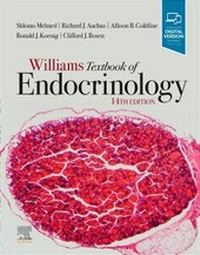
Williams Textbook of Endocrinology
14th Edition
Published on 19. December 2019
Book
Hardback
1792 pages
978-0-323-55596-8 (ISBN)
Description
Expertly bridging the gap between basic science and clinical information, Williams Textbook of Endocrinology, 14th Edition, brings together an outstanding collection of world-renowned authors to provide authoritative discussions of the full spectrum of adult and pediatric endocrine system disorders. New chapters and significant revisions throughout keep you up to date with recent advances in medications, therapies, clinical trials, and more. This essential reference is a must-have resource for endocrinologists, endocrine surgeons, gynecologists, internists, pediatricians, and other clinicians who need current, comprehensive coverage of this multifaceted field.
Up to date with recent advances in medications, therapies, and clinical trials.
Provides state-of-the-art coverage of diabetes, metabolic syndrome, metabolic bones disorders, obesity, thyroid disease, testicular disorders, newly defined adrenal disorders and much more - all designed to help you provide optimal care to every patient.
Contains new chapters on Global Burden of Endocrine Disease, Navigation of Endocrine Guidelines, and Transgender Endocrinology.
Includes significant updates to the Diabetes section, including a new chapter on Physiology of Insulin Secretion and greater coverage of Type 2 Diabetes.
Presents current information in a highly illustrated, user-friendly format for quick reference.
Enhanced eBook version included with purchase. Your enhanced eBook allows you to access all of the text, figures, and references from the book on a variety of devices.
Up to date with recent advances in medications, therapies, and clinical trials.
Provides state-of-the-art coverage of diabetes, metabolic syndrome, metabolic bones disorders, obesity, thyroid disease, testicular disorders, newly defined adrenal disorders and much more - all designed to help you provide optimal care to every patient.
Contains new chapters on Global Burden of Endocrine Disease, Navigation of Endocrine Guidelines, and Transgender Endocrinology.
Includes significant updates to the Diabetes section, including a new chapter on Physiology of Insulin Secretion and greater coverage of Type 2 Diabetes.
Presents current information in a highly illustrated, user-friendly format for quick reference.
Enhanced eBook version included with purchase. Your enhanced eBook allows you to access all of the text, figures, and references from the book on a variety of devices.
Reviews / Votes
Doody's Core Titles (R) 2020 Essential PurchaseMore details
Edition
14th edition
Language
English
Place of publication
Philadelphia
United States
Target group
Professional and scholarly
Illustrations
Approx. 2000 illustrations (2000 in full color); Illustrations
Dimensions
Height: 276 mm
Width: 216 mm
Weight
3810 gr
ISBN-13
978-0-323-55596-8 (9780323555968)
Copyright in bibliographic data and cover images is held by Nielsen Book Services Limited or by the publishers or by their respective licensors: all rights reserved.
Schweitzer Classification
Other editions
New editions
Shlomo Melmed | Richard J. Auchus | Allison B. Goldfine
Williams Textbook of Endocrinology
Book
09/2024
15th Edition
Elsevier
€242.50
Available immediately
Additional editions
Shlomo Melmed | Ronald Koenig | Clifford J. Rosen
Williams Textbook of Endocrinology E-Book
Williams Textbook of Endocrinology E-Book
E-Book
11/2019
14th Edition
Elsevier
€163.99
Available for download
Previous edition
Shlomo Melmed | Kenneth S. Polonsky | P. Reed Larsen
Williams Textbook of Endocrinology
Book
11/2015
13th Edition
Elsevier
€175.78
Article exhausted; check for reprint
Persons
Shlomo Melmed, MB, ChB, FRCP, MACP, is Executive VP and Dean of the Medical Faculty at Cedars-Sinai Medical Center. He leads Cedars-Sinai's research and education programs, recruiting nationally recognized faculty leadership, establishing new educational programs and maintaining the highest academic standards. Dr. Melmed holds the Helene A. and Philip E. Hixon Distinguished Chair in Investigative Medicine. An international authority on pituitary medicine, he has pioneered the discovery and application of novel treatments for endocrine tumors and has authored more than 350 peer-reviewed articles.
Dr. Melmed has been a faculty leader at Cedars-Sinai for nearly 40 years and has been the health system's chief academic officer since 1998. Dr. Melmed's laboratory consistently has received competitive grant awards from the National Institutes of Health since 1980, and he has trained over 80 physicians, scientists and graduate students who occupy leading positions in academic endocrinology worldwide. He is on the editorial board of the Journal of Clinical Investigation and is also an Associate Dean of the UCLA School of Medicine.
Dr. Melmed has been a faculty leader at Cedars-Sinai for nearly 40 years and has been the health system's chief academic officer since 1998. Dr. Melmed's laboratory consistently has received competitive grant awards from the National Institutes of Health since 1980, and he has trained over 80 physicians, scientists and graduate students who occupy leading positions in academic endocrinology worldwide. He is on the editorial board of the Journal of Clinical Investigation and is also an Associate Dean of the UCLA School of Medicine.
Author
Professor of Medicine, Dean of the Medical Faculty, Cedars Sinai Health System, USA
Professor of Medicine, Tufts University School of Medicine, Boston, Massachusetts, USA
Professor, Departments of Pharmacology and Internal Medicine, Division of Metabolism, Endocrinology, and Diabetes, University of Michigan, Endocrinology Service Chief, Ann Arbor VA Healthcare System, Ann Arbor, Michigan, USA
Content
Section I: HORMONES AND HORMONE ACTION
1. Principles of Endocrinology
2. Principles of Hormone Action
3. Genetics of Endocrinology
4. Laboratory Techniques for Recognition of Endocrine Disorders
5. The Global Burden of Endocrine Disease
6. Navigating Through Clinical Practice Guidelines in Endocrinology
Section II: HYPOTHALAMUS AND PITUITARY
7. Neuroendocrinology
8. Pituitary Physiology and Diagnostic Evaluation
9. Pituitary Masses and Tumors
10. Posterior Pituitary
Section III: THYROID
11. Thyroid Physiology and Diagnostic Evaluation
12. Hyperthyroid Disorders
13. Hypothyroidism and Thyroiditis
14. Nontoxic Diffuse Goiter, Nodular Thyroid Disorders, and Thyroid Malignancies
Section IV: ADRENAL CORTEX AND ENDOCRINE HYPERTENSION
15. The Adrenal Cortex
16. Endocrine Hypertension
Section V: SEXUAL DEVELOPMENT AND FUNCTION
17. Physiology and Pathology of the Female Reproductive Axis
18. Hormonal Contraception
19. Testicular Disorders
20. Sexual Dysfunction in Men and Women
21. Transgender Endocrinology
Section VI: ENDOCRINOLOGY AND THE LIFE SPAN
Section VI A: Maternal-Fetal
22. Endocrine Changes in Pregnancy
23. Endocrinology of Fetal Development
Section VI B: Childhood
24. Disorders of Sex Development
25. Normal and Aberrant Growth in Children
26. Physiology and Disorders of Puberty
Section VI C: Adult
27. Hormones and Athletic Performance
28. Endocrinology and Aging
Section VII: MINERAL METABOLISM
29. Hormones and Disorders of Mineral Metabolism
30. Osteoporosis: Basic and Clinical Aspects
31. Rickets and Osteomalacia
32. Kidney Stones
Section VIII: DISORDERS OF CARBOHYDRATE AND FAT METABOLISM
33. Physiology of Insulin Secretion
34. Pathophysiology of Type 2 Diabetes Mellitus
35. Therapeutics of Type 2 Diabetes Mellitus
36. Type 1 Diabetes Mellitus
37. Complications of Diabetes Mellitus
38. Hypoglycemia
39. Neuroendocrine Control of Energy Stores
40. Obesity
41. Disorders of Lipid Metabolism
Section IX: POLYENDOCRINE AND NEOPLASTIC DISORDERS
42. Multiple Endocrine Neoplasia
43. The Immunoendocrinopathy Syndromes
44. Endocrinology of HIV/AIDS
45. Neuroendocrine Tumors
46. Endocrinology of Cancer Survivors
1. Principles of Endocrinology
2. Principles of Hormone Action
3. Genetics of Endocrinology
4. Laboratory Techniques for Recognition of Endocrine Disorders
5. The Global Burden of Endocrine Disease
6. Navigating Through Clinical Practice Guidelines in Endocrinology
Section II: HYPOTHALAMUS AND PITUITARY
7. Neuroendocrinology
8. Pituitary Physiology and Diagnostic Evaluation
9. Pituitary Masses and Tumors
10. Posterior Pituitary
Section III: THYROID
11. Thyroid Physiology and Diagnostic Evaluation
12. Hyperthyroid Disorders
13. Hypothyroidism and Thyroiditis
14. Nontoxic Diffuse Goiter, Nodular Thyroid Disorders, and Thyroid Malignancies
Section IV: ADRENAL CORTEX AND ENDOCRINE HYPERTENSION
15. The Adrenal Cortex
16. Endocrine Hypertension
Section V: SEXUAL DEVELOPMENT AND FUNCTION
17. Physiology and Pathology of the Female Reproductive Axis
18. Hormonal Contraception
19. Testicular Disorders
20. Sexual Dysfunction in Men and Women
21. Transgender Endocrinology
Section VI: ENDOCRINOLOGY AND THE LIFE SPAN
Section VI A: Maternal-Fetal
22. Endocrine Changes in Pregnancy
23. Endocrinology of Fetal Development
Section VI B: Childhood
24. Disorders of Sex Development
25. Normal and Aberrant Growth in Children
26. Physiology and Disorders of Puberty
Section VI C: Adult
27. Hormones and Athletic Performance
28. Endocrinology and Aging
Section VII: MINERAL METABOLISM
29. Hormones and Disorders of Mineral Metabolism
30. Osteoporosis: Basic and Clinical Aspects
31. Rickets and Osteomalacia
32. Kidney Stones
Section VIII: DISORDERS OF CARBOHYDRATE AND FAT METABOLISM
33. Physiology of Insulin Secretion
34. Pathophysiology of Type 2 Diabetes Mellitus
35. Therapeutics of Type 2 Diabetes Mellitus
36. Type 1 Diabetes Mellitus
37. Complications of Diabetes Mellitus
38. Hypoglycemia
39. Neuroendocrine Control of Energy Stores
40. Obesity
41. Disorders of Lipid Metabolism
Section IX: POLYENDOCRINE AND NEOPLASTIC DISORDERS
42. Multiple Endocrine Neoplasia
43. The Immunoendocrinopathy Syndromes
44. Endocrinology of HIV/AIDS
45. Neuroendocrine Tumors
46. Endocrinology of Cancer Survivors