

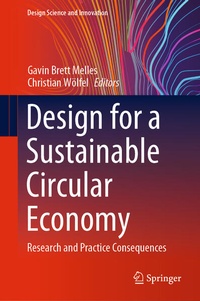
Design for a Sustainable Circular Economy
Research and Practice Consequences
Published on 3. January 2024
Book
Hardback
VIII, 232 pages
978-981-99-7531-0 (ISBN)
Description
This multi-authored book aims to illustrate the social, economic, and ecological factors that should determine and be determined by design in the implementation of a sustainable circular economy and society. We take design to refer to a continuum of perspectives and applications from industrial design to policy design, and this broad perspective invites theoretical and methodological contributions from a range of fields. In addition to bringing scholarly diversity to circularity, we expand and challenge the mainstream circular economy narrative of material efficiencies and green growth to include the demands of inclusive growth and ecological boundaries consistent with sustainable development. Readers from within and beyond design, conscious of the limitations of circular green growth will find new inspiration in this book regarding the nature of a sustainable circular economy and society and the broad design agenda that must be implemented to enable a just and informed circular transition.
More details
Series
Edition
2024 ed.
Language
English
Place of publication
Singapore
Singapore
Target group
Professional and scholarly
Illustrations
25 farbige Abbildungen, 15 s/w Abbildungen
VIII, 232 p. 40 illus., 25 illus. in color.
Dimensions
Height: 241 mm
Width: 160 mm
Thickness: 19 mm
Weight
530 gr
ISBN-13
978-981-99-7531-0 (9789819975310)
DOI
10.1007/978-981-99-7532-7
Schweitzer Classification
Other editions
Additional editions
Gavin Brett Melles | Christian Wölfel
Design for a Sustainable Circular Economy
Research and Practice Consequences
Book
01/2025
Springer
€160.49
Shipment within 3-4 weeks
Gavin Brett Melles | Christian Wölfel
Design for a Sustainable Circular Economy
Research and Practice Consequences
E-Book
12/2023
1st Edition
Springer
€160.49
Available for download
Persons
Gavin Brett Melles Ph.D. (Education), M.Sc. (Sustainable Development), is a professor (adjunct) of sustainability and social innovation at Swinburne University's Design School. He was recently (2021-2022) a senior international fellow in sustainability at the Technical Design Department of Technical University Dresden. He is a research af?liate at the Centre for Design Innovations and Manufacturing Futures Research Institute at Swinburne University. His research and teaching interests include education, sustainability, and related issues.
Christian Wölfel Ph.D., is a trained industrial designer, researcher, and lecturer at the Chair of Industrial Design Engineering at Technische Universität Dresden, Germany. His research relates to the design and experience of complex systems in professional domains. It is grounded in cognitive and social sciences and aims for sustainable solutions. He teaches design fundamentals, design theory, and design research in interdisciplinary settings. He is a board member of the German Society for Design Theory and Research (DGTF) and works occasionally as a consultant for B2B companies.
Christian Wölfel Ph.D., is a trained industrial designer, researcher, and lecturer at the Chair of Industrial Design Engineering at Technische Universität Dresden, Germany. His research relates to the design and experience of complex systems in professional domains. It is grounded in cognitive and social sciences and aims for sustainable solutions. He teaches design fundamentals, design theory, and design research in interdisciplinary settings. He is a board member of the German Society for Design Theory and Research (DGTF) and works occasionally as a consultant for B2B companies.
Content
Designing the sustainable circular economy: from products to politics.- Beyond eco-design towards designing sustainable circular production-consumption systems.- Connecting global sustainability with circular product design.- Mapping Circular economy and the role of design in Portugal.- Circular Packaging in the Cosmetics Industry - A Systematic Review on Challenges and the Current State of Sustainable Strategies and Solutions