

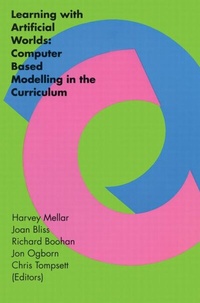
Learning With Artificial Worlds
Computer Based Modelling In The Curriculum
Published on 15. September 1994
Book
Paperback/Softback
243 pages
978-0-7507-0313-0 (ISBN)
Description
First Published in 1994. This book is about modelling in education. It is about providing children with computer tools to enable them to create their own worlds, to express their own representations of their world, and also to explore other people's representations - learning with artificial worlds. This title is best suited for the classroom teacher who has used some modelling, and now wishes to seriously consider the role of modelling within their curriculum.
More details
Language
English
Place of publication
London
United Kingdom
Publishing group
Taylor & Francis Ltd
Target group
College/higher education
Professional and scholarly
Postgraduate and Professional
Dimensions
Height: 234 mm
Width: 156 mm
Weight
385 gr
ISBN-13
978-0-7507-0313-0 (9780750703130)
Copyright in bibliographic data and cover images is held by Nielsen Book Services Limited or by the publishers or by their respective licensors: all rights reserved.
Schweitzer Classification
Other editions
Additional editions
Harvey Mellar | Joan Bliss | Richard Boohan
Learning With Artificial Worlds
Computer Based Modelling In The Curriculum
E-Book
06/2014
1st Edition
Routledge
€45.99
Available for download
Harvey Mellar | Joan Bliss | Richard Boohan
Learning With Artificial Worlds
Computer Based Modelling In The Curriculum
E-Book
06/2014
1st Edition
Routledge
€45.99
Available for download
Persons
Mellar, Harvey; Bliss, Joan; Boohan, Richard; Ogborn, Jon; Tompsett, Chris
Content
Part 1 The nature of modelling: computational issues in modelling, Jon Ogborn and Rob Miller; representations and representation systems, Haralambos Sakondis. Part 2 Mathematics and reality: reasoning with a quantitative modelling tool, Richard Boohan and Tim Brosnan; integrating situated-based and algebraic approaches - the role of spreadsheets, Rosamund Sutherland; models and metaphors in reasoning about probability, Peter Wilder. Part 3 Commonsense reasoning about quantities: reasoning with a semi-quantitative tool, Joan Bliss. Part 4 Thinking with objects, links and logic: an introduction to qualitative modelling tool, Joan Bliss and Haralambos Sakondis; creating worlds with objects and events, Richard Boohan.