

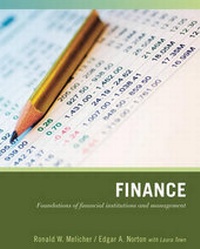
Finance
Foundations of Financial Institutions and Management
Published on 22. September 2006
Book
Paperback/Softback
608 pages
978-0-470-00720-4 (ISBN)
Description
How do financial markets and institutions affect businesses and individuals? How do firms raise funds? How can an individual use markets and institutions to meet their own personal goals? In order to answer these questions, a reader must have a strong understanding of financial markets and institutions. This concise book provides the necessary information, presenting the general principles of finance and showing how they are applied in the field.
More details
Language
English
Place of publication
Chichester
United Kingdom
Publishing group
John Wiley and Sons Ltd
Target group
Professional and scholarly
Illustrations
Illustrations
Dimensions
Height: 231 mm
Width: 191 mm
Thickness: 33 mm
Weight
886 gr
ISBN-13
978-0-470-00720-4 (9780470007204)
Copyright in bibliographic data and cover images is held by Nielsen Book Services Limited or by the publishers or by their respective licensors: all rights reserved.
Schweitzer Classification
Other editions
New editions
Ronald W. Melicher | Edgar A. Norton
Wiley Pathways Finance Reprint
Foundations of Financial Institutions and Management
Book
05/2008
1st Edition
Wiley
€81.00
Article is exhausted; no reprint
Persons
Ronald Melicher is a Professor of Finance and Chair of the Finance Division in the College of Business at the University of Colorado at Boulder. He is also a President's Teaching Scholar and the W. H. Baughn Distinguished Scholar. Dr. Melicher is currently in his 31st year of teaching at the University of Colorado. Edgar Norton's teaching and research interests include investments, corporate finance, and entrepreneurial finance. His research has been published in a variety of finance, economic, and small business journals, including Financial Review nad the Journal of Business Research. A recipient of an Award of Excellence for a research paper at a conference sponsored by the International Council for Small Business, he was recognized in an article in the Journal of Management as one of the most productive entrepreneurship researchers of the early 1990s. He has co-authored four books.
Content
Preface. Acknowledgments. Part I: Basic Financial Principles. 1. Introduction to Finance. Introduction. 1.1 Why Study Finance? 1.2 What Is Finance? 1.3 Four Principles of Finance. 1.4 The Financial System. 1.5 Financial Functions. 1.6. Types of Financial Institutions. 1.7 Types of Financial Markets. 1.8 Types of Securities. 1.9 International Securities and Markets. 2. Money and Interest Rates. Introduction. 2.1 Overview of the Monetary System. 2.2 The Federal Reserve System. 2.3 The Development of Money in the United States. 2.4 U.S. Money Supply Today. 2.5 Money Supply and Economic Activity. 2.6 Interest: The Cost of Money. 2.7 Structure of Interest Rates. 2.8 The Yield Curve. 3. Time Value of Money. Introduction. 3.1 The Math of Finance. 3.2 Compounding to Determine Future Values. 3.3 Inflation or Purchasing Power Implications. 3.4 Discounting to Determine Present Values. 3.5 Finding Interest Rates and Time Requirements. 3.6 Future Value of an Annuity. 3.7 Future Value of an Annuity Due. 3.8 Frequent Compounding or Discounting Intervals. 3.9 APR Versus EAR. 3.10 Cost of Consumer Credit. 4. Financial Statements, Cash Flow and Taxes. Introduction. 4.1 Overview of Financial Statements. 4.2 U.S. Business Organizations. 4.3 Starting a Business. 4.4 Annual Reports. 4.5 Balance Sheet. 4.6 Income Statement. 4.7 Cash Flow Statement. 4.8 Financial Statements of Different Companies. 4.9 Our Federal Tax System. 5. Analysis Of Financial Statements. Introduction. 5.1 Financial Statement Analysis. 5.2 Ratio Analysis. 5.3 Types of Financial Ratios. 5.4 Du Pont Method of Ratio Analysis. 5.5 Long-Term Financial Planning. 5.6 Cost-Volume-Profit Analysis. Part II: Using Financial Principles in Business. 6. The Basics of Capital Budgeting. Introduction. 6.1 Overview of Capital Budgeting. 6.2 Capital Budgeting Decisions. 6.3 Capital Budgeting Techniques. 7. Cash Flow Estimation and Risk Analysis. Introduction. 7.1 Cash Flows and Competitive Advantage. 7.2 Isolating Project Cash Flows. 7.3 Approaches to Estimating Project Cash Flows. 7.4 Risk-Related Considerations. 7.5 Strategic Analysis. 7.6 Real-Option Analysis. 8. Managing Working Capital. Introduction. 8.1 Identifying Working Capital. 8.2 Operating Cash and Conversion Cycles. 8.3 Working Capital Requirements. 8.4 Cash Budgets. 8.5 Seasonal versus Level Production. 8.6 Management of Current Assets. 8.7 Getting-and Keeping-the Cash. 8.8 Accounts Receivable Management And Credit Analysis. 8.9 Inventory Management. 8.10 Technology and Managing Working Capital . 9. Short-Term Business Financing. Introduction. 9.1 Strategies for Financing Working Capital. 9.2 Factors Affecting Short-Term Financing. 9.3 Short-Term Financing Sources. 9.4 Computing Interest Rates. 9.5 Asset-Based Lending for Short-Term Financing. 9.6 Other Forms of Security. 9.7 The Cost of Short-Term Financing. 10. Risk and Rate of Return. Introduction. 10.1 Historical Return and Risk for a Single Asset. 10.2 Expected Measures of Return and Risk. 10.3 Historical Returns and Risk of Different Assets. 10.4 Efficient Capital Markets. 10.5 Portfolio Returns and Risk. 10.6 Diversification. 10.7 Portfolio Risk and the Number of Investments. 10.8 Capital Asset Pricing Model. 11. Capital Structure and the Cost of Capital. Introduction. 11.1 Capital Structure. 11.2 Required Rate of Return and the Cost of Capital. 11.3 Weighted Average Cost of Capital. 11.4 Making Capital Structure Decisions. 11.5 Planning Growth Rates. 11.6 EBIT/EPS Analysis. 11.7 Combined Operating and Financial Leverage Effects. 11.8 Other Costs and Risks. 11.9 Debt and Equity. Part III: Stocks, Bonds, and the International Market. 12. Stocks and the Markets: Trading Securities. Introduction. 12.1 Types of Common Stock. 12.2 Preferred Stock. 12.3 The New York Stock Exchange. 12.4 Stock Transactions. 12.5 Initial Public Offerings (IPOs). 12.6 Direct and Indirect Costs of Going Public. 12.7 Trading Securities-Secondary Securities Markets. 12.8 A Word on Commissions. 12.9 Security Market Indexes. 12.10 Inside Information and Other Ethical Issues. 13. Distributions To Stockholders. Introduction. 13.1 Dividends versus Capital Gains. 13.2 Estimating Future Dividends. 13.3 Dividend Stability and Dividend Policy. 13.4 Constant Growth Stocks. 13.5 Reading Stock Quotes. 13.6 Tracking Stocks. 13.7 Evaluating the Corporation. 13.8 Stock Options. 13.9 Dividend Reinvestment Plans. 14. Annuities, Bonds, Futures and Options. Introduction. 14.1 Annuities. 14.2 Bonds. 14.3 Bondholder Security. 14.4 Other Types of Bonds. 14.5 Bond Income and Strategies. 14.6 Global Bond Market. 14.7 Reading Bond Quotes. 14.8 Futures and Options. 15. International Trade and Finance. Introduction. 15.1 International Monetary System. 15.2 European Unification. 15.3 Currency Exchange Markets And Rates. 15.4 Investing Overseas. 15.5 Arbitrage. 15.6 Exchange Rate Developments for the U.S. Dollar. 15.7 Conducting Business Internationally. 15.8 Financing International Trade. 15.9 Other Aids to International Trade. 15.10 Balance in International Trade. Appendices. Glossary. Index.