

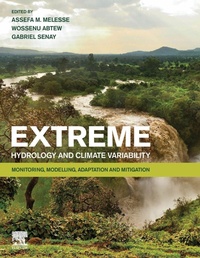
Extreme Hydrology and Climate Variability
Monitoring, Modelling, Adaptation and Mitigation
Published on 3. July 2019
Book
Paperback/Softback
580 pages
978-0-12-815998-9 (ISBN)
Description
Extreme Hydrology and Climate Variability: Monitoring, Modelling, Adaptation and Mitigation is a compilation of contributions by experts from around the world who discuss extreme hydrology topics, from monitoring, to modeling and management. With extreme climatic and hydrologic events becoming so frequent, this book is a critical source, adding knowledge to the science of extreme hydrology. Topics covered include hydrometeorology monitoring, climate variability and trends, hydrological variability and trends, landscape dynamics, droughts, flood processes, and extreme events management, adaptation and mitigation. Each of the book's chapters provide background and theoretical foundations followed by approaches used and results of the applied studies.
This book will be highly used by water resource managers and extreme event researchers who are interested in understanding the processes and teleconnectivity of large-scale climate dynamics and extreme events, predictability, simulation and intervention measures.
This book will be highly used by water resource managers and extreme event researchers who are interested in understanding the processes and teleconnectivity of large-scale climate dynamics and extreme events, predictability, simulation and intervention measures.
More details
Language
English
Place of publication
United States
Target group
Professional and scholarly
Water Resource Managers, Hydrology, water engineering, water management, climate science, Hydrometeorologists
Product notice
Paperback (trade)
Dimensions
Height: 279 mm
Width: 216 mm
Thickness: 30 mm
Weight
1332 gr
ISBN-13
978-0-12-815998-9 (9780128159989)
Copyright in bibliographic data and cover images is held by Nielsen Book Services Limited or by the publishers or by their respective licensors: all rights reserved.
Schweitzer Classification
Other editions
Additional editions
Assefa M. Melesse | Wossenu Abtew | Gabriel Senay
Extreme Hydrology and Climate Variability
Monitoring, Modelling, Adaptation and Mitigation
E-Book
07/2019
Elsevier
€175.00
Available for download
Persons
Dr. Assefa M. Melesse is a Distinguished University Professor of Water Resources Engineering at Florida International University. He earned his ME (2000) and PhD (2002) from the University of Florida in Agricultural Engineering. His areas of research and experience include climate change impact modeling, watershed modeling, ecohydrology, sediment transport, surface and groundwater interactions modeling, water-energy-carbon fluxes coupling and simulations, remote sensing hydrology, river basin management, and land cover change detection and scaling. Dr. Melesse is a registered Professional Engineer (PE), Board Certified Enviromental Engineer (BCEE) and also a Board Certified Water Resources Engineer (BC.WRE) with over 30 years of teaching and research experience, and has authored/edited 11 books, over 230 journal articles, and over 100 book chapters. Dr. Wossenu Abtew is a registered professional civil engineer working on water resources field for over 25 years. He is trained in agricultural engineering and is also a hydrologist. He earned his Ph.D in interdisciplinary engineering focusing in Civil Engineering and Agricultural Engineering from Texas Tech University in 1989. He earned his Master of Science degree in Agricultural Engineering from Texas Tech University in 1986. Dr. Abtew has published a book on evaporation and evapotranspiration. He has participated in a workshop on the Nile river basin and edited a proceeding for the workshop and published chapters and journal article on the Nile. Dr. Abtew is author and editor of three books, and over 100 book chapters, journal and proceedings articles, conference papers and technical reports. Dr. Abtew is a Principal Engineer at the South Florida Water Management District. He has over 27 years of experience in water resources and environmental restoration area at the South Florida Water management District. He a certified water resource engineer (D.WRE) by the American Academy of Water Resources Engineers. He is an affiliated faculty at Florida International University, Department of Earth and Environment. Gabriel Senay is a Research Physical Scientist with the U.S. Geological Survey Earth Resources Observation and Science (USGS EROS) Center, co-located with the North Central Climate Science Center in Fort Collins, Colorado and is a faculty affiliate with the Ecosystem Science and Sustainability, Colorado State University. He conducts applied research on water use and availability assessment and drought monitoring using satellite-derived data and hydrologic modelling with over 20 years of experience. His research contributes to the development and dissemination of a suite of drought monitoring and early warning products through the Famine Early Warning Systems Network (FEWS NET) for Africa, Central America, and parts of Asia (https://earlywarning.usgs.gov/fews). Similarly, through the USGS Water Census program, he works on the estimation and mapping of landscape water use dynamics and trends for the United States. He is a licensed professional engineer in Civil Engineering (Water Resources) and earned his M.Sc. (1991) in Hydrology from Wageningen University, The Netherlands, and a Ph.D. (1996) from The Ohio State University, Columbus, OH.
Editor
Distinguished University Professor of Water Resources Engineering, Florida International University, Miami, FL, USA
Principal Engineer of Water and Environment Consulting; Affiliate Faculty, Florida International University
Research Physical Scientist, U.S. Geological Survey; Faculty Affiliate, Colorado State University
Content
1. Hydormeteorology Monitoring
2. Hydrologic Variability and trends
3. Landscape dynamics and regional weather patterns
4. Droughts
5. Floods
6. Extreme events management: adaptation and mitigation
2. Hydrologic Variability and trends
3. Landscape dynamics and regional weather patterns
4. Droughts
5. Floods
6. Extreme events management: adaptation and mitigation