

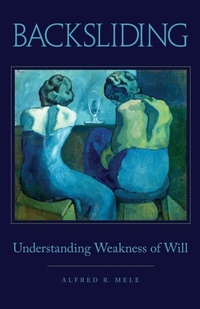
Backsliding
Understanding Weakness of Will
Published on 27. March 2014
Book
Paperback/Softback
160 pages
978-0-19-936664-4 (ISBN)
Description
People backslide.They freely do things they believe it would be best on the whole not to do -- a judgment developed from their own point of view, not just the perspective of their peers or their parents. The aim of this book is to to clarify the nature of backsliding - of actions that display some weakness of will -- using traditional philosophical techniques that date back to Plato and Aristotle (whose work on weakness of will or "akrasia" he discusses) and some new studies in the emerging field of experimental philosophy. Mele then attacks the thesis that backsliding is an illusion because people never freely act contrarily to what they judge is best. He argues that it is extremely plausible that if people ever act freely, they sometimes backslide. At the book's heart is the development of a theoretical and empirical framework that sheds light both on backsliding and on exercises of self-control that prevent it. Here, Mele draws on work in social and developmental psychology and in psychiatry to motivate a view of human behavior in which both backsliding and overcoming the temptation to backslide are explicable. He argues that backsliding is no illusion and our theories about the springs of action, the power of evaluative judgments, human agency, human rationality, practical reasoning, and motivation should accommodate backsliding.
Reviews / Votes
Full of intellectually stimulating arguments. * CHOICE * Alfred Mele here caps, or continues, an impressive sequence of well-argued monographs on connected topics by one that is commendably brief. It offers at once a reconsideration that touches on recent developments, and a summing-up that resumes past discussions. The result will be welcome, and can be widely recommended. It includes well-developed arguments against what can seem two plausible claims, that backsliding is always compulsive, and that one cannot be effectively motivated to adopt a strategy to weaken the force of what is currently one's strongest motivation. * A. W. Price, Mind *More details
Language
English
Place of publication
New York
United States
Target group
Professional and scholarly
College/higher education
Dimensions
Height: 216 mm
Width: 140 mm
Thickness: 9 mm
Weight
211 gr
ISBN-13
978-0-19-936664-4 (9780199366644)
Copyright in bibliographic data and cover images is held by Nielsen Book Services Limited or by the publishers or by their respective licensors: all rights reserved.
Schweitzer Classification
Other editions
Additional editions
E-Book
06/2012
1st Edition
OUP eBook
€19.99
Available for download
Book
05/2012
1st Edition
Oxford University Press Inc
€103.90
Shipment within 15-20 days
Person
Alfred R. Mele is the William H. and Lucyle T. Werkmeister Professor of Philosophy at Florida State
University. He is the author of six previous OUP books: Irrationality (1987), Springs of Action (1992), Autonomous Agents (1995), Motivation and Agency (2003), Free Will and Luck (2006), and Effective Intentions (2009). He also is the editor of The Philosophy of Action (OUP 1997) and a coeditor of four other OUP volumes: Mental Causation (1993), The Oxford Handbook of Rationality (2004), Rationality and the Good (2007), and Free Will and Consciousness: How Might They Work? (2010).
University. He is the author of six previous OUP books: Irrationality (1987), Springs of Action (1992), Autonomous Agents (1995), Motivation and Agency (2003), Free Will and Luck (2006), and Effective Intentions (2009). He also is the editor of The Philosophy of Action (OUP 1997) and a coeditor of four other OUP volumes: Mental Causation (1993), The Oxford Handbook of Rationality (2004), Rationality and the Good (2007), and Free Will and Consciousness: How Might They Work? (2010).
Content
Preface ; 1. Introduction ; 2. Weakness of Will and Akrasia ; 3. Weakness and Compulsion ; 4. Accounting for Backsliding: Background and More ; 5. Self-Control ; 6. Conclusion ; References ; Index