

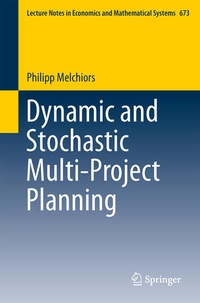
Dynamic and Stochastic Multi-Project Planning
Published on 8. May 2015
Book
Paperback/Softback
XV, 204 pages
978-3-319-04539-9 (ISBN)
Description
This book deals with dynamic and stochastic methods for multi-project planning. Based on the idea of using queueing networks for the analysis of dynamic-stochastic multi-project environments this book addresses two problems: detailed scheduling of project activities, and integrated order acceptance and capacity planning. In an extensive simulation study, the book thoroughly investigates existing scheduling policies. To obtain optimal and near optimal scheduling policies new models and algorithms are proposed based on the theory of Markov decision processes and Approximate Dynamic programming. Then the book presents a new model for the effective computation of optimal policies based on a Markov decision process. Finally, the book provides insights into the structure of optimal policies.
More details
Series
Edition
2015 ed.
Language
English
Place of publication
Cham
Switzerland
Publishing group
Springer International Publishing
Target group
Professional and scholarly
Research
Illustrations
37 s/w Abbildungen
XV, 204 p. 37 illus.
Dimensions
Height: 235 mm
Width: 155 mm
Thickness: 13 mm
Weight
341 gr
ISBN-13
978-3-319-04539-9 (9783319045399)
DOI
10.1007/978-3-319-04540-5
Schweitzer Classification
Other editions
Additional editions
Philipp Melchiors
Dynamic and Stochastic Multi-Project Planning
E-Book
04/2015
1st Edition
Springer
€53.49
Available for download
Person
Philipp Melchiors is a consultant for an Operations Research focused consulting company. Prior to his current position he worked as research and teaching assistant at the TUM School of Management, Technische Universität München. During this time he wrote his Ph.D. thesis on "Dynamic and stochastic multi-project planning".
Content
1. Introduction.- 2. Problem Statements.- 3. Literature Review.- 4. Continuous-time Markov Decision Processes.- 5. Generation of Problem Instances.- 6. Scheduling Using Priority Policies.- 7. Optimal and Near Optimal Scheduling Policies.- 8. Integrated Dynamic Order Acceptance and Capacity Planning.- 9. Conclusions and Future Work.