

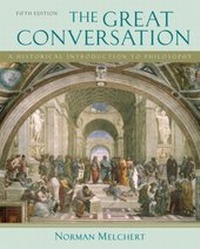
The Great Conversation
A Historical Introduction to Philosophy
5th Edition
Published in November 2006
Book
Hardback
784 pages
978-0-19-530682-8 (ISBN)
Description
Now in its fifth edition, this historically organized introductory text treats philosophy as a dramatic and continuous story--a conversation about humankind's deepest and most persistent concerns. Tracing the exchange of ideas between history's key philosophers, The Great Conversation: A Historical Introduction to Philosophy, Fifth Edition, demonstrates that while constructing an argument or making a claim, one philosopher almost always has others in mind. The book addresses the fundamental questions of human life: Who are we? What can we know? How should we live? and What sort of reality do we inhabit? The fifth edition retains the distinctive feature of previous editions: author Norman Melchert provides a generous selection of excerpts from major philosophical works and makes them more easily understandable to students with his lucid and engaging explanations. Ranging from the Pre-Socratics to Derrida and Quine, the selections are organized historically and include four complete works: Plato's Euthyphro, Apology, and Crito, and Descartes' Meditations on First Philosophy.
The author's commentary offers a rich intellectual and cultural context for the philosophical ideas conveyed in the excerpts. Extensive cross-referencing shows students how philosophers respond appreciatively or critically to the thoughts of other philosophers. The text is enhanced by two types of exercises--"Basic Questions" and "For Further Thought"--and more than sixty illustrations.
New to the Fifth Edition: * A new chapter (25) on Simone de Beauvoir and her contributions to philosophy * New material on Buddhist, Muslim, and Jewish thinkers, including profiles of the Buddha, Avicenna (Ibn Sina), Averroes (Ibn Rushd), and Maimonides (Moses ben Maimon) * A new profile of Jean-Jacques Rousseau * Improved translations of several of Plato's works, including Protagoras, Gorgias, Phaedo, Symposium,Meno, and the Republic * Review questions that are now dispersed throughout the chapters (instead of at chapter ends) to follow relevant passages and facilitate classroom discussion * Thirteen new images, including seven explanatory cartoons that help students understand key concepts * A revised Instructor's Manual and Test Bank containing essential points, teaching suggestions, and multiple-choice, short-answer, and essay exam questions The Great Conversation, Fifth Edition, is also available in two paperback volumes to suit your course needs. Volume I: Pre-Socratics through Descartes includes chapters 1-13 of the combined volume, while Volume II: Descartes through Derrida and Quine includes chapters 12-26.
The author's commentary offers a rich intellectual and cultural context for the philosophical ideas conveyed in the excerpts. Extensive cross-referencing shows students how philosophers respond appreciatively or critically to the thoughts of other philosophers. The text is enhanced by two types of exercises--"Basic Questions" and "For Further Thought"--and more than sixty illustrations.
New to the Fifth Edition: * A new chapter (25) on Simone de Beauvoir and her contributions to philosophy * New material on Buddhist, Muslim, and Jewish thinkers, including profiles of the Buddha, Avicenna (Ibn Sina), Averroes (Ibn Rushd), and Maimonides (Moses ben Maimon) * A new profile of Jean-Jacques Rousseau * Improved translations of several of Plato's works, including Protagoras, Gorgias, Phaedo, Symposium,Meno, and the Republic * Review questions that are now dispersed throughout the chapters (instead of at chapter ends) to follow relevant passages and facilitate classroom discussion * Thirteen new images, including seven explanatory cartoons that help students understand key concepts * A revised Instructor's Manual and Test Bank containing essential points, teaching suggestions, and multiple-choice, short-answer, and essay exam questions The Great Conversation, Fifth Edition, is also available in two paperback volumes to suit your course needs. Volume I: Pre-Socratics through Descartes includes chapters 1-13 of the combined volume, while Volume II: Descartes through Derrida and Quine includes chapters 12-26.
More details
Edition
5th Revised edition
Language
English
Place of publication
New York
United States
Target group
College/higher education
Edition type
Revised edition
Illustrations
halftones, 67 Zeichnungen
67 line drawings and halftones
Dimensions
Height: 234 mm
Width: 190 mm
Thickness: 35 mm
Weight
1344 gr
ISBN-13
978-0-19-530682-8 (9780195306828)
Copyright in bibliographic data and cover images is held by Nielsen Book Services Limited or by the publishers or by their respective licensors: all rights reserved.
Schweitzer Classification
Other editions
Previous edition

Norman Melchert
The Great Conversation : A Historical Introduction to Philosophy
A Historical Introduction to Philosophy
Book
07/2001
4th Edition
Oxford University Press Inc
€54.46
Article exhausted; check for reprint
Content
*=NEW TO THIS EDITION; 1. BEFORE PHILOSOPHY: MYTH IN HESIOD AND HOMER; Hesiod: War among the Gods; Homer: Heroes, Gods, and Excellence; 2. PHILOSOPHY BEFORE SOCRATES; Thales: The One as Water; Anaximander: The One as the Boundless; Xenophanes: The Gods as Fictions; PROFILE: PYTHAGORAS; Heraclitus: Oneness in the Logos; Parmenides: Only the One; Zeno: The Paradoxes of Common Sense; Atomism: The One and the Many Reconciled; 3. THE SOPHISTS: RHETORIC AND RELATIVISM IN ATHENS; Democracy; The Persian Wars; The Sophists; Physis and Nomos; Athens and Sparta at War; Aristophanes and Reaction; 4. SOCRATES: TO KNOW ONESELF; Character; Is Socrates a Sophist?; What Socrates "Knows"; 5. THE TRIAL AND DEATH OF SOCRATES; Translator's Introduction; The Dialogue; Commentary and Questions; Translator's Introduction; The Dialogue; Commentary and Questions; Translator's Introduction; The Dialogue; Commentary and Questions; Phaedo (Death Scene); Translator's Introduction; The Dialogue (Selection); Commentary and Questions; 6. PLATO: KNOWING THE REAL AND THE GOOD; Knowledge and Opinion; The World and the Forms; The Love of Wisdom; The Soul; Morality; The State; Problems with the Forms; 7. ARISTOTLE: THE REALITY OF THE WORLD; Aristotle and Plato; Logic and Knowledge; The World; First Philosophy; The Soul; The Good Life; Virtue or Excellence (Arete); 8. EPICUREANS, STOICS, AND SKEPTICS: HAPPINESS FOR THE MANY; The Epicureans; The Stoics; The Skeptics; 9. THE CHRISTIANS: SIN, SALVATION, AND LOVE; Background; Jesus; The Meaning of Jesus; 10. AUGUSTINE: GOD AND THE SOUL; Wisdom, Happiness, and God; The Interior Teacher; God and the World; Human Nature and Its Corruption; Human Nature and Its Restoration; Augustine on Relativism; The Two Cities; Christians and Philosophers; 11. ANSELM AND AQUINAS: EXISTENCE AND ESSENCE IN GOD AND THE WORLD; Anselm: On That, Than Which No Greater Can Be Conceived; Thomas Aquinas: Rethinking Aristotle; * PROFILE: AVICENNA (IBN SIN=A); * PROFILE: AVERROES (IBN RUSHD); * PROFILE: MAIMONIDES (MOSES BEN MAIMON); Ockham and Skeptical Doubts--Again; 12. MOVING FROM MEDIEVAL TO MODERN; The World God Made for Us; The Humanists; Reforming the Church; Skeptical Thoughts Revived; Copernicus to Kepler to Galileo: The Great Triple Play; 13. RENE DESCARTES: DOUBTING OUR WAY TO CERTAINTY; The Method; Meditations: Commentary and Questions; Meditation I; Meditation II; Meditation III; Meditation IV; Meditation V; Meditation VI; What Has Descartes Done?; 14. HOBBES, LOCKE, AND BERKELEY: MATERIALISM AND THE BEGINNINGS OF EMPIRICISM; Thomas Hobbes: Catching Persons in the Net of the New Science; PROFILE: FRANCIS BACON; John Locke: Looking to Experience; George Berkeley: Ideas into Things; 15. DAVID HUME: UNMASKING THE PRETENSIONS OF REASON; How Newton Did It; To Be the Newton of Human Nature; The Theory of Ideas; The Association of Ideas; Causation: The Very Idea; The Disappearing Self; * PROFILE: THE BUDDHA; Rescuing Human Freedom; Is It Reasonable to Believe in God?; Understanding Morality; Is Hume a Skeptic?; 16. IMMANUEL KANT: REHABILITATING REASON (WITHIN STRICT LIMITS); Critique; Judgments; Geometry, Mathematics, Space, and Time; Common Sense, Science, and the A Priori Categories; PROFILE: BARUCH SPINOZA; Phenomena and Noumena; PROFILE: GOTTFRIED WILHELM VON LEIBNIZ; Reasoning and the Ideas of Metaphysics: God, World, and Soul; Reason and Morality; * PROFILE: JEAN-JACQUES ROUSSEAU; 17. GEORG WILHELM FRIEDRICH HEGEL: TAKING HISTORY SERIOUSLY; Historical and Intellectual Context; Epistemology Internalized; PROFILE: ARTHUR SCHOPENHAUER; Self and Others; Stoic and Skeptical Consciousness; Hegel's Analysis of Christianity; Reason and Reality: The Theory of Idealism; Spirit Made Objective: The Social Character of Ethics; History and Freedom; 18. KIERKEGAARD AND MARX: TWO WAYS TO "CORRECT" HEGEL; Kierkegaard: On Individual Existence; Marx: Beyond Alienation and Exploitation; 19. THE UTILITARIANS: MORAL RULES AND THE HAPPINESS OF ALL (INCLUDING WOMEN); The Classic Utilitarians; The Rights of Women; 20. FRIEDRICH NIETZSCHE: THE VALUE OF EXISTENCE; Pessimism and Tragedy; Good-bye Real World; The Death of God; Revaluation of Values; The Overman; Affirming Eternal Recurrence; 21. THE PRAGMATISTS: THOUGHT AND ACTION; Charles Sanders Peirce; John Dewey; PROFILE: WILLIAM JAMES; 22. ANALYSIS: LOGICAL ATOMISM AND THE LOGICAL POSITIVISTS; Language and Its Logic; PROFILE: BERTRAND RUSSELL; Ludwig Wittgenstein: Tractatus Logico-Philosophicus; Logical Positivism; 23. ORDINARY LANGUAGE: "THIS IS SIMPLY WHAT I DO"; The Later Wittgenstein: Philosophical Investigations; The Continuity of Wittgenstein's Thought; Our Groundless Certainty; 24. MARTIN HEIDEGGER: THE MEANING OF BEING; What Is the Question?; The Clue; Phenomenology; PROFILE: JEAN-PAUL SARTRE; Being-in-the-World; The "Who" of Dasein; Modes of Disclosure; Falling-Away; Care; Truth; Death; Conscience, Guilt, and Resoluteness; Temporality as the Meaning of Care; The Priority of Being; * 25. SIMONE DE BEAUVOIR: EXISTENTIALIST, FEMINIST; * Ambiguity; * Ethics; * Woman; 26. POSTMODERNISM AND PHYSICAL REALISM: DERRIDA, RORTY, QUINE, AND DENNETT; Postmodernism; Physical Realism