

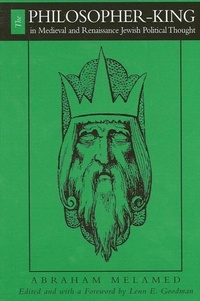
The Philosopher-King in Medieval and Renaissance Jewish Political Thought
Published on 24. October 2002
Book
Paperback/Softback
287 pages
978-0-7914-5568-5 (ISBN)
Description
Illustrates Plato's theory of the philosopher-king in the context of medieval and Renaissance Jewish thought.
This original treatment of medieval and Renaissance Jewish thinkers expands the scope of Jewish philosophy and adds new depth to our understanding of Jewish culture of the period. While medieval Christian political philosophy was based on Aristotle's Politics, Muslim and Jewish philosophy adhered to the Platonic tradition. In this book, Abraham Melamed explores a major aspect of this tradition-the theory of the philosopher-king-as it manifested itself in medieval Jewish political philosophy, tracing the theory's emergence in Jewish thought as well as its patterns of transmittal, adaptation, and absorption. The Maimonidean encounter with the theory, via al-Farabi, is also examined, as is its influence upon later scholars such as Felaquera, ibn Latif, Narboni, Shemtov ibn Shemtov, Polkar, Alemanno, Abarbanel, and others. Also discussed is the influence of Averroe's commentary on Plato's Republic, and the Machiavellian rejection of the theory of the philosopher-king and its influence upon early modern Jewish scholars, such as Simone Luzzatto and Spinoza, who rejected it in favor of a so-called "Republican" attitude.
This original treatment of medieval and Renaissance Jewish thinkers expands the scope of Jewish philosophy and adds new depth to our understanding of Jewish culture of the period. While medieval Christian political philosophy was based on Aristotle's Politics, Muslim and Jewish philosophy adhered to the Platonic tradition. In this book, Abraham Melamed explores a major aspect of this tradition-the theory of the philosopher-king-as it manifested itself in medieval Jewish political philosophy, tracing the theory's emergence in Jewish thought as well as its patterns of transmittal, adaptation, and absorption. The Maimonidean encounter with the theory, via al-Farabi, is also examined, as is its influence upon later scholars such as Felaquera, ibn Latif, Narboni, Shemtov ibn Shemtov, Polkar, Alemanno, Abarbanel, and others. Also discussed is the influence of Averroe's commentary on Plato's Republic, and the Machiavellian rejection of the theory of the philosopher-king and its influence upon early modern Jewish scholars, such as Simone Luzzatto and Spinoza, who rejected it in favor of a so-called "Republican" attitude.
Reviews / Votes
"Melamed's careful analysis of the philosopher-king motif captures the core of medieval Jewish philosophy: the fusion of philosophy and law. Melamed is thoroughly familiar with all of the relevant primary sources of Jewish, Greek, Muslim, and Christian philosophers, and with the scholarship about them. Moreover, he takes this research forward by looking at the demise of the Platonic tradition brought about by exposure to the political philosophy of Machiavelli." -Hava Tirosh-Samuelson, author of Between Worlds: The Life and Thought of Rabbi David ben Judah Messer LeonMore details
Series
Language
English
Place of publication
Albany, NY
United States
Target group
College/higher education
Professional and scholarly
US School Grade: College Graduate Student and over
Product notice
Paperback (trade)
Dimensions
Height: 216 mm
Width: 173 mm
Thickness: 15 mm
Weight
381 gr
ISBN-13
978-0-7914-5568-5 (9780791455685)
Copyright in bibliographic data and cover images is held by Nielsen Book Services Limited or by the publishers or by their respective licensors: all rights reserved.
Schweitzer Classification
Other editions
Additional editions
Abraham Melamed | Lenn E. Goodman
The Philosopher-King in Medieval and Renaissance Jewish Political Thought
E-Book
02/2012
1st Edition
De Gruyter
€36.49
Available for download
Persons
Abraham Melamed is Professor of Jewish Philosophy at the University of Haifa.
Content
Foreword
Preface
1. Philosopher, King, Prophet
2. The Sources
3. First Influences
4. The Class System
5. Transmission
6. Adaptation
7. Application
8. Christian Applications and the Machiavellian Revolution
9. Rejection
Afterword
Appendix: The Hebrew Versions of the Philosopher King's Virtues
Notes
Bibliography
Index
Preface
1. Philosopher, King, Prophet
2. The Sources
3. First Influences
4. The Class System
5. Transmission
6. Adaptation
7. Application
8. Christian Applications and the Machiavellian Revolution
9. Rejection
Afterword
Appendix: The Hebrew Versions of the Philosopher King's Virtues
Notes
Bibliography
Index