

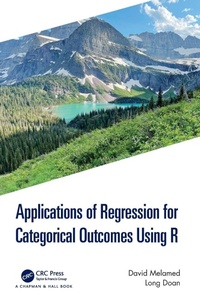
Applications of Regression for Categorical Outcomes Using R
1st Edition
Published on 26. July 2023
Book
Paperback/Softback
222 pages
978-1-032-50951-8 (ISBN)
Description
This book covers the main models within the GLM (i.e., logistic, Poisson, negative binomial, ordinal, and multinomial). For each model, estimations, interpretations, model fit, diagnostics, and how to convey results graphically are provided. There is a focus on graphic displays of results as these are a core strength of using R for statistical analysis. Many in the social sciences are transitioning away from using Stata, SPSS and SAS, to using R, and this book uses statistical models which are relevant to the social sciences. Social Science Applications of Regression for Categorical Outcomes Using R will be useful for graduate students in the social sciences who are looking to expand their statistical knowledge, and for Quantitative social scientists due to it's ability to act as a practitioners guide.
Key Features:
Applied- in the sense that we will provide code that others can easily adapt
Flexible- R is basically just a fancy calculator. Our programs will enable users to derive quantities that they can use in their work
Timely- many in the social sciences are currently transitioning to R or are learning it now. Our book will be a useful resource
Versatile- we will write functions into an R package that can be applied to all of the regression models we will cover in the book
Aesthetically pleasing- one advantage of R relative to other software packages is that graphs are fully customizable. We will leverage this feature to yield high-end graphical displays of results
Affordability- R is free. R packages are free. There is no need to purchase site licenses or updates.
Key Features:
Applied- in the sense that we will provide code that others can easily adapt
Flexible- R is basically just a fancy calculator. Our programs will enable users to derive quantities that they can use in their work
Timely- many in the social sciences are currently transitioning to R or are learning it now. Our book will be a useful resource
Versatile- we will write functions into an R package that can be applied to all of the regression models we will cover in the book
Aesthetically pleasing- one advantage of R relative to other software packages is that graphs are fully customizable. We will leverage this feature to yield high-end graphical displays of results
Affordability- R is free. R packages are free. There is no need to purchase site licenses or updates.
Reviews / Votes
"Overall, Applications of Regression for Categorical Outcomes Using R is a well-written and valuable introduction to modeling categorical outcomes for graduate students and practitioners in the social sciences and related disciplines. The book achieves its aims (described using a mountain climbing analogy) to "explain how to choose which peak totackle given an empirical problem, distinguish among truly different options, and equivocate when choices are more preferences than substantive decisions." (pg. 1) The consistent structure across chapters, focus on conceptual understanding, and guidance on grappling with practical considerations make it a nice text for an applied graduate course or for those seeking to learn (or review) these methods."- Maria Tackett, "Applications of Regression for Categorical Outcomes Using R." The American Statistician, August 2025.
More details
Language
English
Place of publication
United Kingdom
Publishing group
Taylor & Francis Ltd
Target group
College/higher education
Postgraduate
Illustrations
49 s/w Abbildungen, 16 farbige Abbildungen, 49 s/w Zeichnungen, 18 s/w Tabellen, 16 farbige Zeichnungen
18 Tables, black and white; 16 Line drawings, color; 49 Line drawings, black and white; 16 Illustrations, color; 49 Illustrations, black and white
Dimensions
Height: 234 mm
Width: 156 mm
Thickness: 13 mm
Weight
371 gr
ISBN-13
978-1-032-50951-8 (9781032509518)
Copyright in bibliographic data and cover images is held by Nielsen Book Services Limited or by the publishers or by their respective licensors: all rights reserved.
Schweitzer Classification
Other editions
Additional editions

David Melamed | Long Doan
Applications of Regression for Categorical Outcomes Using R
E-Book
07/2023
1st Edition
Chapman & Hall/CRC
€86.99
Available for download

David Melamed | Long Doan
Applications of Regression for Categorical Outcomes Using R
E-Book
07/2023
1st Edition
Chapman & Hall/CRC
€86.99
Available for download
David Melamed | Long Doan
Applications of Regression for Categorical Outcomes Using R
Book
07/2023
1st Edition
Chapman & Hall/CRC
€249.40
Shipment within 15-20 days
Persons
David Melamed is a Professor of Sociology and Translational Data Analytics at The Ohio State University. His research interests include the emergence of stratification, cooperation and segregation in dynamical systems, and statistics and methodology. Since 2019 he has been co-Editor of Sociological Methodology.
Long Doan is an Associate Professor of Sociology at the University of Maryland, College Park. His research examines how various social psychological processes like identity, intergroup competition, and bias help to explain the emergence and persistence of social stratification. He focuses on inequalities based on sexuality, gender, and race.
Long Doan is an Associate Professor of Sociology at the University of Maryland, College Park. His research examines how various social psychological processes like identity, intergroup competition, and bias help to explain the emergence and persistence of social stratification. He focuses on inequalities based on sexuality, gender, and race.
Content
1. Introduction 2. Introduction to R Studio and Packages 3. Overview of OLS Regression and Introduction to the General Linear Model 4. Describing Categorical Variables and Some Useful Tests of Association 5. Regression for Binary Outcomes 6. Regression for Binary Outcomes - Moderation and Squared Terms 7. Regression for Ordinal Outcomes 8. Regression for Nominal Outcomes 9. Regression for Count Outcomes 10. Additional Outcome Types 11. Special Topics: Comparing Between Models and Missing Data