

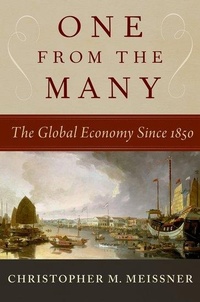
One From the Many
The Global Economy Since 1850
Published on 19. June 2024
Book
Paperback/Softback
348 pages
978-0-19-775931-8 (ISBN)
Description
Amid a recent surge in arguments that the global economy has begun to "de-globalize," a question has emerged: will globalization survive? In One from the Many: The Global Economy since 1850, Christopher M. Meissner argues that based on the long-run of history, globalization will not be easily vanquished.
This brief introduction to the economic history of the global economy and the process of globalization since 1850 tracks and explains changes in international trade, migration, and capital flows over time. All key indicators of globalization rose between 1850 and 1914 during the first wave of globalization. Between 1918 and 1939 the global economy stagnated, suffering a momentous collapse during the Great Depression of the 1930s. After World War II, the global economy re-emerged and integration deepened.
A long-run view suggests that rising integration and growth of global economy can generate economic benefits and raise welfare. Given these lessons, the global economy will almost surely survive and integration will continue to grow. However, globalization can only survive if humanity continues to recognize its common interests and the untapped potential of further integration. At the same time, the potential adverse effects of greater integration must be acknowledged, mitigated, and minimized. Meissner's brief history of the global economy offers economics, political science, and history students a new perspective on the history of its subject matter, with an eye on a future where globalization has the potential to persist as an integrative force.
This brief introduction to the economic history of the global economy and the process of globalization since 1850 tracks and explains changes in international trade, migration, and capital flows over time. All key indicators of globalization rose between 1850 and 1914 during the first wave of globalization. Between 1918 and 1939 the global economy stagnated, suffering a momentous collapse during the Great Depression of the 1930s. After World War II, the global economy re-emerged and integration deepened.
A long-run view suggests that rising integration and growth of global economy can generate economic benefits and raise welfare. Given these lessons, the global economy will almost surely survive and integration will continue to grow. However, globalization can only survive if humanity continues to recognize its common interests and the untapped potential of further integration. At the same time, the potential adverse effects of greater integration must be acknowledged, mitigated, and minimized. Meissner's brief history of the global economy offers economics, political science, and history students a new perspective on the history of its subject matter, with an eye on a future where globalization has the potential to persist as an integrative force.
Reviews / Votes
The book reveals how globalization has been a powerful driver of progress while also amplifying inequalities and challenges-a story of both triumph and turmoil. * S&G Consulting Firm * Christopher M. Meissner's book is an authoritative and meticulously researched reminder that globalization is a deeply rooted historical process. Meissner, an economist at the University of California, Davis, provides a crisp, straightforward, and nontechnical account of the global economy since 1850. The strength of Meissner's book is that it provides the historical and economic context needed for understanding the tradeoff implied by simultaneously catering to the needs of both the domestic and international economies and the global economy's inner workings, together with the institutional arrangements that have been at their core over the last two centuries. These features enable the reader to gain an appreciation for the role played by historical inertia in shaping current economic and (geo)political events. * Mihai Paraschiv, H.Net Book Reviews * Explores integration in trade, capital, and labor markets during the periods of 600 BCE to 1850 CE, 1850 to 1914, 1919 to 1938, and 1945 to the present, investigating the impact that integration had on local economies within each period and how globalization might look in the future. * Journal of Economic Literature (Vol. 63, No. 4) * One from the Many, The Global Economy Since 1850 will prove to be an invaluable resource for anyone looking for a treatise on the world economy since the mid-nineteenth century with a particular emphasis on the forces of globalization. * Jeff Chan, The Economic History Review *More details
Language
English
Place of publication
New York
United States
Target group
College/higher education
Dimensions
Height: 231 mm
Width: 158 mm
Thickness: 27 mm
Weight
482 gr
ISBN-13
978-0-19-775931-8 (9780197759318)
Copyright in bibliographic data and cover images is held by Nielsen Book Services Limited or by the publishers or by their respective licensors: all rights reserved.
Schweitzer Classification
Other editions
Additional editions
Book
02/2024
Oxford University Press Inc
€81.71
Shipment within 15-20 days
E-Book
02/2024
OUP eBook
€22.49
Available for download
E-Book
02/2024
OUP eBook
€22.49
Available for download
Person
Christopher M. Meissner is professor of economics at the University of California, Davis and a Research Associate at the National Bureau of Economic Research.
Content
Chapter 1 Introduction
Chapter 2 The Very Long Run: 10,000 BCE - 1820 CE Chapter 3 The Great Specialization: 1820 -1914 Chapter 4 International Investment, 1820 -1914 Chapter 5 Inter-dependence and Instability in the Classical Gold Standard Era Chapter 6 The Great Migrations Chapter 7 The Beginning of the End: Backlash to the First Wave of Globalization Chapter 8 World War I and its Legacy (Prologue to the Great Depression): 1914-1928 Chapter 9 The Great Depression: An Unprecedented International Economic Crisis Chapter 10 Rebuilding the World Economy (yet, again) Chapter 11 The Global Economy in the Post-War Era Chapter 12 The Bretton Woods System - A New Regime Chapter 13 International Financial Flows and Financial Crises after the End of the Bretton Woods System
Chapter 14 The International Economy since 2000: Hyperglobalization and Beyond Chapter 15 Prospects for the Global Economy in the 21st Century References
Chapter 2 The Very Long Run: 10,000 BCE - 1820 CE Chapter 3 The Great Specialization: 1820 -1914 Chapter 4 International Investment, 1820 -1914 Chapter 5 Inter-dependence and Instability in the Classical Gold Standard Era Chapter 6 The Great Migrations Chapter 7 The Beginning of the End: Backlash to the First Wave of Globalization Chapter 8 World War I and its Legacy (Prologue to the Great Depression): 1914-1928 Chapter 9 The Great Depression: An Unprecedented International Economic Crisis Chapter 10 Rebuilding the World Economy (yet, again) Chapter 11 The Global Economy in the Post-War Era Chapter 12 The Bretton Woods System - A New Regime Chapter 13 International Financial Flows and Financial Crises after the End of the Bretton Woods System
Chapter 14 The International Economy since 2000: Hyperglobalization and Beyond Chapter 15 Prospects for the Global Economy in the 21st Century References