

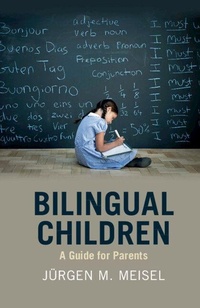
Bilingual Children
A Guide for Parents
Published on 27. June 2019
Book
Paperback/Softback
272 pages
978-1-316-63261-1 (ISBN)
Description
Are you raising your child bilingually, or planning to do so in the future, but are unsure how to proceed? Using a question-and-answer format, this practical and reassuring guide will enable readers to make informed decisions about how to raise their child with two or more languages. To grow up bilingually is a necessity or an opportunity for more children today than ever before. However, parents are frequently uncertain about what to do, or even fear that they may be putting their child's development at risk. Disentangling fact from myth, it shows that a child can acquire more than one 'first' language simultaneously and that one language need not have negative effects on the other. Each chapter is devoted to a question typically asked by parents in counselling sessions, followed by a concise answer, summaries of the evidence and practical tips.
Reviews / Votes
'Prospective parents considering raising their children with two or more languages or parents who are already doing so will find this book by an eminent child bilingualism specialist invaluable. A combination of deep insights based on solid scientific research and well considered common sense, together with attention to families' well-being, make sure that this guide will greatly help families on their bilingual path.' Annick De Houwer, Universitaet Erfurt, Germany 'Juergen M. Meisel is an internationally respected authority on child bilingualism. Bilingual Children is a beautifully written, eminently readable guide for parents and caregivers who want to understand the advantages and (mostly mythical) drawbacks of raising children with a command of two or more languages. The book is a practical, research-informed guide on how to do it successfully, whether within a family or a societal bi- or multilingual setting, when the child's first exposure to the languages is simultaneous or sequential, and for children of different starting ages. Highly recommended.' Michael H. Long, University of Maryland 'This study will be valuable to all who are interested in or curious about bilingualism.' L. Lopez, Choice 'While seeking to foster bilingualism during childhood is a laudable and quite reasonable goal, there is no one-size-fits-all approach for each family. This book is an invaluable resource for those wishing to understand scientific evidence and practical choices that will help them to support bilingual children. It is therefore highly recommended reading for parents and caregivers of young bi- or multicultural individuals.' Daniel O. Jackson, Japan Journal of Multilingualism and MulticulturalismMore details
Language
English
Place of publication
Cambridge
United Kingdom
Product notice
Paperback (trade)
Illustrations
Worked examples or Exercises; 6 Halftones, black and white
Dimensions
Height: 216 mm
Width: 140 mm
Thickness: 16 mm
Weight
351 gr
ISBN-13
978-1-316-63261-1 (9781316632611)
Copyright in bibliographic data and cover images is held by Nielsen Book Services Limited or by the publishers or by their respective licensors: all rights reserved.
Schweitzer Classification
Other editions
Additional editions
Book
06/2019
Cambridge University Press
€93.10
Shipment within 15-20 days
Person
Jürgen M. Meisel is Professor emeritus and former Chair of the Research Center on Bilingualism at the Universität Hamburg, as well as Adjunct Professor and Distinguished Fellow, Faculty of Arts, University of Calgary. He has been engaged in parent counselling for more than thirty-five years. He is a founding editor of the journal Bilingualism: Language and Cognition and author of seven books and numerous articles.
Content
1. Bilingualism in early childhood - disentangling myths and facts; 2. How infants become native speakers; 3. Two languages in one mind - differentiating linguistic systems; 4. Keeping languages apart: mixing, interference and interaction of languages; 5. Language dominance, strong and weak languages; 6. Trilingual and more - the role of input; 7. The age question; 8. Benefits and advantages of child bilingualism; References; Index.