

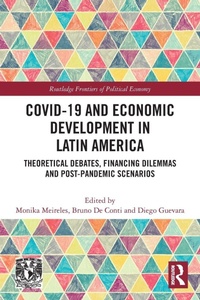
COVID-19 and Economic Development in Latin America
Theoretical Debates, Financing Dilemmas and Post-Pandemic Scenarios
1st Edition
Published on 18. December 2024
Book
Paperback/Softback
142 pages
978-1-032-40984-9 (ISBN)
Description
The impact of the COVID-19 pandemic on the global economy, just as with the Great Recession a decade earlier, has served to reinforce the fact that the world is hierarchically organized and the distribution of power between countries is distinctly asymmetric. Gathering multiple viewpoints of Latin American researchers, this book explores the impacts of the pandemic, including unequal access to vaccines and recovery finance, on economies in the region. The book is organised in three substantial sections: the first brings together conceptual work which rethinks the fundamental categories for critical thinking on the challenges for Latin American development in a post-pandemic scenario. In the second part, the chapters focus on studying the Latin American financial reconfiguration that is being driven by the pandemic, particularly through a comparison of the experience of countries of the world economy's core and periphery. Finally, the third part evaluates the concrete experiences of different Latin American countries in this very specific historical moment, emphatically analyzing the economic policy responses that the governments are adopting to deal with the current sanitary emergency and its economic and social effects. From this, the book suggests keystone elements for the relaunch of development strategies in the region as it recovers from the pandemic. This book will be of particular interest to readers of critical or heterodox perspectives on the economics of the pandemic, Latin American development and emerging economies.
More details
Series
Language
English
Place of publication
London
United Kingdom
Publishing group
Taylor & Francis Ltd
Target group
College/higher education
Professional and scholarly
Academic and Postgraduate
Illustrations
34 s/w Abbildungen, 34 s/w Zeichnungen, 3 s/w Tabellen
3 Tables, black and white; 34 Line drawings, black and white; 34 Illustrations, black and white
Dimensions
Height: 234 mm
Width: 156 mm
Thickness: 8 mm
Weight
243 gr
ISBN-13
978-1-032-40984-9 (9781032409849)
Copyright in bibliographic data and cover images is held by Nielsen Book Services Limited or by the publishers or by their respective licensors: all rights reserved.
Schweitzer Classification
Other editions
Additional editions
Monika Meireles | Bruno De Conti | Diego Guevara
COVID-19 and Economic Development in Latin America
Theoretical Debates, Financing Dilemmas and Post-Pandemic Scenarios
Book
07/2023
1st Edition
Routledge
€205.70
Shipment within 10-20 days
Monika Meireles | Bruno De Conti | Diego Guevara
COVID-19 and Economic Development in Latin America
Theoretical Debates, Financing Dilemmas and Post-Pandemic Scenarios
E-Book
07/2023
1st Edition
Routledge
€55.49
Available for download
Monika Meireles | Bruno De Conti | Diego Guevara
COVID-19 and Economic Development in Latin America
Theoretical Debates, Financing Dilemmas and Post-Pandemic Scenarios
E-Book
07/2023
1st Edition
Routledge
€55.49
Available for download
Persons
Monika Meireles holds a bachelor's degree in Economics from the School of Economics of the University of Sao Paulo (FEA-USP for its acronym in Portuguese), and a master's degree in Latin American Integration from the Graduate Program in Latina American Integration of the same institution (Prolam-USP for its acronym in Portuguese) and a doctorate from the Graduate Program in Latin American Studies of the National Autonomous University of Mexico (Ppela-UNAM for its acronym in Spanish). Currently she is a full time Senior Researcher A assigned to the Fiscal and Financial Economics Unit of IIEc-UNAM; member of the National System of Researchers (SNI for its acronym in Spanish) of Conacyt (level I) and she was awarded the Recognition of Distinction of the National University for Young Academics (RDUNJA for its acronym in Spanish) in the area of research in economic-administrative sciences in the 2019 edition.
Bruno De Conti, Associate professor of the Institute of Economics of the University of Campinas (Unicamp), Brazil. Investigator of the Center for Studies on Economic Current Affairs and Policy (Cecon for its acronym in Portuguese) and of the Center for Brazil-China Studies (CEBC for its acronym in Portuguese) of the same university. His main areas of research are: International Monetary System hierarchies; BRICS and China's economy.
Diego Guevara, Associate Professor at the National University of Colombia with a doctorate in Economics from the same institution. He is professor of Macroeconomics and editor of the journal Cuadernos de Economia. His current research focuses on financialization in emerging countries and macroeconomics and the energy transition.
Bruno De Conti, Associate professor of the Institute of Economics of the University of Campinas (Unicamp), Brazil. Investigator of the Center for Studies on Economic Current Affairs and Policy (Cecon for its acronym in Portuguese) and of the Center for Brazil-China Studies (CEBC for its acronym in Portuguese) of the same university. His main areas of research are: International Monetary System hierarchies; BRICS and China's economy.
Diego Guevara, Associate Professor at the National University of Colombia with a doctorate in Economics from the same institution. He is professor of Macroeconomics and editor of the journal Cuadernos de Economia. His current research focuses on financialization in emerging countries and macroeconomics and the energy transition.
Content
Introduction I. Rethinking Development and Financial Dependency: Theoretical Reflections 1. Dependency, Finance and Development: Echoes of the Past That Resonate in the Present 2. International Division of Finance: Functionality and Dependency of the System's Periphery 3. Latin America: Between Regressive Structural Change and the Pandemic II. Financialization and Financial Reconfiguration in the Pandemic 4. Dependent Financialization of Latin America: A View from the COVID-19 Crisis 5. Latin American Development Banks in the Pandemic Crisis 6. They Win in Mexico: Pension Funds and Financial Benefits during the Pandemic III. Economic Policy Response to the COVID-19 Crisis 7. Potential of Coordination Between Monetary and Fiscal Policy: The Experience of Latin America during COVID-19 8. Countercyclical Fiscal Policy and Fiscal Impulses: Post-Pandemic Challenges - The Cases of Brazil and Mexico 9. Effects of International Liquidity Cycles on Argentina during the Pandemic