

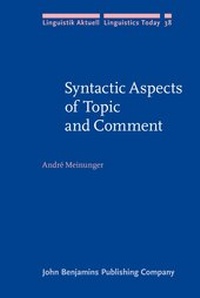
Syntactic Aspects of Topic and Comment
Published on 20. October 2000
Book
Hardback
245 pages
978-90-272-2759-1 (ISBN)
Description
The book focuses on the syntactic behavior of argument noun phrases depending on their discourse status. The main language of consideration is German, but it is shown that the observations can be carried over to other languages. The claim is that discourse-new arguments remain inside the VP where they are base generated. The hierarchy of argument projection is claimed to be fix within and across languages. With the major attention to direct objects it is then argued that discourse-old, here called topical noun phrases undergo raising to agreement projections. This movement can be realized differently: scrambling, object agreement, clitic-doubling, differences in morphological case and stress pattern turn out to be analyzable as one underlying phenomenon. It is furthermore shown that many so-called subject:object asymmetries boil down to topic:non-topic differences, for example with respect to extraction. Thus, irrespectively of the argumental status discourse-new constituents do not act as barriers whereas topical arguments create (weak) islands.
More details
Series
Language
English
Place of publication
Amsterdam
Netherlands
Target group
Professional and scholarly
Dimensions
Height: 245 mm
Width: 164 mm
Weight
460 gr
ISBN-13
978-90-272-2759-1 (9789027227591)
Copyright in bibliographic data and cover images is held by Nielsen Book Services Limited or by the publishers or by their respective licensors: all rights reserved.
Schweitzer Classification
Other editions
Additional editions
André Meinunger
Syntactic Aspects of Topic and Comment
E-Book
10/2000
1st Edition
John Benjamins Publishing Company
€136.99
Available for download
Person
Content
1. Acknowledgments; 2. List of frequent abbrevations; 3. Introduction: some philosophical reflections; 4. 1. Discourse dependent tree splitting; 5. 2. The structure of the German VP; 6. 3. A trigger for scrambling; 7. 4. Agr nodes as topic hosts; 8. 5. The typological chapter; 9. 6. Notes on extraction; 10. 7. Conclusions; 11. References; 12. Name Index; 13. Subject index