

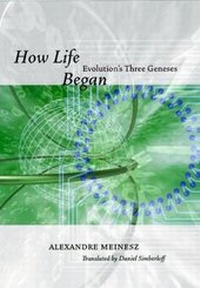
How Life Began
Evolution's Three Geneses
Published on 1. September 2008
Book
Hardback
296 pages
978-0-226-51931-9 (ISBN)
Description
The origin of life is a hotly debated topic. The Christian Bible states that God created the heavens and the Earth, all in about seven days roughly six thousand years ago. This episode of Genesis departs markedly from scientific theories developed over the last two centuries which hold that life appeared on Earth about 3 billion years ago in the form of bacteria, followed by unicellular organisms half a millennia later. It is this version of genesis the Alexandre Meinesz explores in this engaging tale of life's origins and evolution."How Life Began" elucidates three origins, or geneses, of life - bacteria, cells, and multicellular organisms - and shows how evolution has sculpted life to its current biodiversity through four main events: mutation, recombination, natural selection, and geologic cataclysm. As an ecologist who specializes in algae, the first organisms to colonize Earth, Meinesz brings a refreshingly novel voice to the history of biodiversity and emphasizes here the role of unions in organizing life. For example, the ingestion of some bacteria by other bacteria led to the mitochondria that characterize animal and plant cells, and the chloroplasts of plant cells.As Meinesz charmingly recounts, life's grandeur is a result of an evolutionary tendency toward sociality and solidarity.
He suggests that it is our cohesion and collaboration that will allow us to solve the environmental problems arising in the decades and centuries to come. Rooted in the science of evolution but enlivened with many illustrations from other disciplines and the arts, "How Life Began" intertwines the rise of bacteria and multicellular life with Vermeer's portrait of Antoni van Leeuwenhoek, the story of Genesis and Noah, Meinesz's son's early experiences with Legos, and his own encounters with other scientists. All of this brings a very human and humanistic tone to Meinesz's charismatic narrative of the three origins of life.
He suggests that it is our cohesion and collaboration that will allow us to solve the environmental problems arising in the decades and centuries to come. Rooted in the science of evolution but enlivened with many illustrations from other disciplines and the arts, "How Life Began" intertwines the rise of bacteria and multicellular life with Vermeer's portrait of Antoni van Leeuwenhoek, the story of Genesis and Noah, Meinesz's son's early experiences with Legos, and his own encounters with other scientists. All of this brings a very human and humanistic tone to Meinesz's charismatic narrative of the three origins of life.
Reviews / Votes
"Meinesz offers a wonderful tale of how one scientist's tenacity and enthusiasm may bring to light not only the degradation of natural systems but also weaknesses in our approach to science.... Meinesz's elegant and courageous story resembles an epic feat rather than just a narrative. It shows how science survived because of the author's enthusiasm and love, for his work and the biota he studies." - Joseph-Maria Gill, Science"More details
Language
English
Place of publication
Chicago
United States
Publishing group
The University of Chicago Press
Target group
College/higher education
Professional and scholarly
Dimensions
Height: 23 mm
Width: 16 mm
Thickness: 2 mm
Weight
539 gr
ISBN-13
978-0-226-51931-9 (9780226519319)
Copyright in bibliographic data and cover images is held by Nielsen Book Services Limited or by the publishers or by their respective licensors: all rights reserved.
Schweitzer Classification
Other editions
Additional editions
E-Book
05/2024
1st Edition
University of Chicago Press
from
€36.19
Available for download
Persons
Alexandre Meinesz is professor at the University of Nice - Sophia Antipolis and the author of Killer Algae, also published by the University of Chicago Press. Daniel Simberloff is the Nancy Gore Hunger Professor of Environmental Studies at the University of Tennessee and the translator of Killer Algae.