

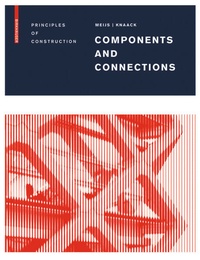
Components and Connections
Principles of Construction
1st Edition
Published on 22. May 2009
Book
Hardback
144 pages
978-3-7643-8669-6 (ISBN)
Description
Every building is composed of parts, or components, that may be organized in various ways. For example, there are different ways to configure walls so that they perform their primary functions - bearing, dividing, and sheltering - in an optimal manner.This book presents the most common load-bearing systems, such as plate, massive, and skeleton construction, and describes their impact on the structure as a whole. It explains how spaces can be vertically or horizontally connected and assembled into larger wholes. The individual elements, such as floor slabs, roofs, openings, and foundations, are described together with their functions and the various possibilities for connecting them.The book goes beyond the wealth of possible detail to demonstrate the basic principles of detailing. Numerous specially prepared drawings set forth the principles of components and then illustrate them with reference to realized projects.
More details
Language
English
Place of publication
Basel/Berlin/Boston
Switzerland
Target group
Professional and scholarly
US School Grade: College Graduate Student
Illustrations
138 s/w Zeichnungen, 115 s/w Abbildungen
115 b/w ill., 138 b/w ld
Dimensions
Height: 27 cm
Width: 21 cm
Weight
640 gr
ISBN-13
978-3-7643-8669-6 (9783764386696)
Schweitzer Classification
Other editions
Additional editions
E-Book
11/2012
1st Edition
Birkhäuser
€34.95
Available for download
Persons
Maarten Meijs, TU Delft, Niederlande; Ulrich Knaack, TU Delft, Niederlande, Fachhochschule Detmold, Deutschland.
Content
1. Introduction - characteristics of component-based construction and object-oriented modular construction (CAM), 2. Types of construction - semifinished products, components, open and closed systems, 3. Principles of modularization (skeleton construction, panel construction, panel systems) for the various building materials, 4. Assembly systems, 5. Preview of new technologies.