

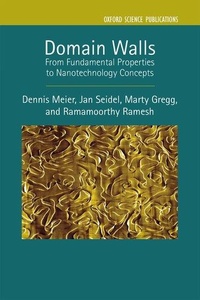
Domain Walls
From Fundamental Properties to Nanotechnology Concepts
Published on 1. September 2020
Book
Hardback
368 pages
978-0-19-886249-9 (ISBN)
Description
Technological evolution and revolution are both driven by the discovery of new functionalities, new materials and the design of yet smaller, faster, and more energy-efficient components. Progress is being made at a breathtaking pace, stimulated by the rapidly growing demand for more powerful and readily available information technology. High-speed internet and data-streaming, home automation, tablets and smartphones are now "necessities" for our everyday lives. Consumer expectations for progressively more data storage and exchange appear to be insatiable.
Oxide electronics is a promising and relatively new field that has the potential to trigger major advances in information technology. Oxide interfaces are particularly intriguing. Here, low local symmetry combined with an increased susceptibility to external fields leads to unusual physical properties distinct from those of the homogeneous bulk.
In this context, ferroic domain walls have attracted recent attention as a completely new type of oxide interface. In addition to their functional properties, such walls are spatially mobile and can be created, moved, and erased on demand. This unique degree of flexibility enables domain walls to take an active role in future devices and hold a great potential as multifunctional 2D systems for nanoelectronics. With domain walls as reconfigurable electronic 2D components, a new generation of adaptive nano-technology and flexible circuitry becomes possible, that can be altered and upgraded throughout the lifetime of the device. Thus, what started out as fundamental research, at the limit of accessibility, is finally maturing into a promising concept for next-generation technology.
Oxide electronics is a promising and relatively new field that has the potential to trigger major advances in information technology. Oxide interfaces are particularly intriguing. Here, low local symmetry combined with an increased susceptibility to external fields leads to unusual physical properties distinct from those of the homogeneous bulk.
In this context, ferroic domain walls have attracted recent attention as a completely new type of oxide interface. In addition to their functional properties, such walls are spatially mobile and can be created, moved, and erased on demand. This unique degree of flexibility enables domain walls to take an active role in future devices and hold a great potential as multifunctional 2D systems for nanoelectronics. With domain walls as reconfigurable electronic 2D components, a new generation of adaptive nano-technology and flexible circuitry becomes possible, that can be altered and upgraded throughout the lifetime of the device. Thus, what started out as fundamental research, at the limit of accessibility, is finally maturing into a promising concept for next-generation technology.
More details
Series
Language
English
Place of publication
Oxford
United Kingdom
Target group
Professional and scholarly
Product notice
sewn/stitched
Cloth over boards
Illustrations
144 illustrations
Dimensions
Height: 249 mm
Width: 173 mm
Thickness: 23 mm
Weight
885 gr
ISBN-13
978-0-19-886249-9 (9780198862499)
Copyright in bibliographic data and cover images is held by Nielsen Book Services Limited or by the publishers or by their respective licensors: all rights reserved.
Schweitzer Classification
Other editions
Additional editions
Dennis Meier | Jan Seidel | Marty Gregg
Domain Walls
From Fundamental Properties to Nanotechnology Concepts
E-Book
08/2020
1st Edition
OUP eBook
€91.99
Available for download
Persons
Professor Dennis Meier
Department of Materials Science and Engineering, Norwegian University of Science and Technology (NTNU), Trondheim.
Professor Jan Seidel
School of Materials Science & Engineering, UNSW Sydney.
Professor Marty Gregg
Centre for Nanostructured Media (CNM), Condensed Matter Physics and Materials Science, Queen's University Belfast.
Professor Ramamoorthy Ramesh
Purnendu Chatterjee Chair in Energy Technologies, Department of Materials Science and Engineering and Department of Physics, University of California, Berkeley.
Department of Materials Science and Engineering, Norwegian University of Science and Technology (NTNU), Trondheim.
Professor Jan Seidel
School of Materials Science & Engineering, UNSW Sydney.
Professor Marty Gregg
Centre for Nanostructured Media (CNM), Condensed Matter Physics and Materials Science, Queen's University Belfast.
Professor Ramamoorthy Ramesh
Purnendu Chatterjee Chair in Energy Technologies, Department of Materials Science and Engineering and Department of Physics, University of California, Berkeley.
Author
Associate Professor, Department of Materials Science and EngineeringAssociate Professor, Department of Materials Science and Engineering, Norwegian University of Science and Technology
School of Materials Science and EngineeringSchool of Materials Science and Engineering, The University of New South Wales
School of Mathematics and PhysicsSchool of Mathematics and Physics, Queen`s University Belfast
Associate Laboratory Director, Department of Physics and Department of Materials Science and EngineeringAssociate Laboratory Director, Department of Physics and Department of Materials Science and Engineering, University of California, Berkeley
Content
1: G. Catalan and N. Domingo: Physical properties inside domain walls: basic principles and scanning probe measurements
2: S. Farokhipoor, C. Magen, D. Rubi and B. Noheda: Novel phases at domain walls
3: J. Iniguez: First-principles studies of structural domain walls
4: P. Ondrejkovic, P. Marton, V. Stepkova and J. Hlinka: Fundamental properties of ferroelectric domain walls from Ginzburg-Landau models
5: E.K.H. Salje and G. Lu: Introduction to domain boundary engineering
6: D. Evans, Ch. Cochard, R. McQuaid, A. Cano, M. Gregg, and D. Meier: Improper ferroelectric domain walls
7: A. Haussmann, L.M. Eng and S. Cherifi-Hertel: Three-dimensional optical analysis of ferroelectric domain walls
8: J.F. Scott: Turing patterns in ferroelectric domains: Nonlinear instabilities
9: M.-M. Yang and M. Alexe: Photoelectric effects at domain walls
10: L. Li and X. Pan: Transmission electron microscopy study of ferroelectric domain walls in BiFeO3 thin films - structures and switching dynamics
11: A.V. Ievlev, A. Tselev, R. Vasudevan, S.V. Kalinin, A. Morozovska, and P. Maksymovych: Nanoscale ferroelectric switching - a method to inject and study non-equilibrium domain walls
12: A. Tselev, A.V. Ievlev, R. Vasudevan, S.V, Kalinin, P. Maksymovych, and A. Morozovska: Landau-Ginzburg-Devonshire theory for the domain wall conduction and observation of the microwave conduction of domain walls
13: P.V. Yudin and L.J. McGilly: Control of ferroelectric domain wall motion using electrodes with limited conductivity
14: S. Liu, I. Grinberg and A. Rappe: Multiscale simulations of domains in ferroelectrics
15: J. Seidel and R. Ramesh: Electronics based on domain walls
2: S. Farokhipoor, C. Magen, D. Rubi and B. Noheda: Novel phases at domain walls
3: J. Iniguez: First-principles studies of structural domain walls
4: P. Ondrejkovic, P. Marton, V. Stepkova and J. Hlinka: Fundamental properties of ferroelectric domain walls from Ginzburg-Landau models
5: E.K.H. Salje and G. Lu: Introduction to domain boundary engineering
6: D. Evans, Ch. Cochard, R. McQuaid, A. Cano, M. Gregg, and D. Meier: Improper ferroelectric domain walls
7: A. Haussmann, L.M. Eng and S. Cherifi-Hertel: Three-dimensional optical analysis of ferroelectric domain walls
8: J.F. Scott: Turing patterns in ferroelectric domains: Nonlinear instabilities
9: M.-M. Yang and M. Alexe: Photoelectric effects at domain walls
10: L. Li and X. Pan: Transmission electron microscopy study of ferroelectric domain walls in BiFeO3 thin films - structures and switching dynamics
11: A.V. Ievlev, A. Tselev, R. Vasudevan, S.V. Kalinin, A. Morozovska, and P. Maksymovych: Nanoscale ferroelectric switching - a method to inject and study non-equilibrium domain walls
12: A. Tselev, A.V. Ievlev, R. Vasudevan, S.V, Kalinin, P. Maksymovych, and A. Morozovska: Landau-Ginzburg-Devonshire theory for the domain wall conduction and observation of the microwave conduction of domain walls
13: P.V. Yudin and L.J. McGilly: Control of ferroelectric domain wall motion using electrodes with limited conductivity
14: S. Liu, I. Grinberg and A. Rappe: Multiscale simulations of domains in ferroelectrics
15: J. Seidel and R. Ramesh: Electronics based on domain walls