

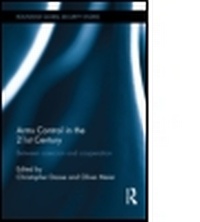
Arms Control in the 21st Century
Between Coercion and Cooperation
1st Edition
Published on 3. July 2012
Book
Hardback
264 pages
978-0-415-69817-7 (ISBN)
Description
This volume evaluates the impact of coercive arms control efforts to curb the spread of weapons of mass destruction in the twenty-first century.
A new paradigm in arms control is gradually replacing the idea that mutually agreed restrictions on armaments can improve international security. Thus, Hedley Bull's classic definition of arms control as the "cooperation between antagonistic pairs of states in military affairs" needs to be amended by a new notion of coercive arms control as the set of non-cooperative and non-reciprocal measures to restrict the weapons or military capabilities of certain states.
This volume addresses the topic of how this ongoing paradigmatic shift will affect the effectiveness of arms control as a conflict management instrument.While some argue that new instruments can complement and strengthen traditional, multilateral and inclusive arms control regimes, others maintain that conflicts and contradictions between coercive and cooperative arms control regimes will severely limit their effectiveness. This volume provides a forum for academics and practitioners from around the globe to discuss these developments in depth and to assess the specific strengths and weaknesses of these new instruments of arms control.
This book will be of much interest to students of arms control, global governance, foreign policy and IR/Security Studies in general.
A new paradigm in arms control is gradually replacing the idea that mutually agreed restrictions on armaments can improve international security. Thus, Hedley Bull's classic definition of arms control as the "cooperation between antagonistic pairs of states in military affairs" needs to be amended by a new notion of coercive arms control as the set of non-cooperative and non-reciprocal measures to restrict the weapons or military capabilities of certain states.
This volume addresses the topic of how this ongoing paradigmatic shift will affect the effectiveness of arms control as a conflict management instrument.While some argue that new instruments can complement and strengthen traditional, multilateral and inclusive arms control regimes, others maintain that conflicts and contradictions between coercive and cooperative arms control regimes will severely limit their effectiveness. This volume provides a forum for academics and practitioners from around the globe to discuss these developments in depth and to assess the specific strengths and weaknesses of these new instruments of arms control.
This book will be of much interest to students of arms control, global governance, foreign policy and IR/Security Studies in general.
More details
Series
Language
English
Place of publication
London
United Kingdom
Publishing group
Taylor & Francis Ltd
Target group
College/higher education
Professional and scholarly
Illustrations
1 s/w Zeichnung, 9 s/w Tabellen
9 Tables, black and white; 1 Line drawings, black and white
Dimensions
Height: 234 mm
Width: 156 mm
Weight
650 gr
ISBN-13
978-0-415-69817-7 (9780415698177)
Copyright in bibliographic data and cover images is held by Nielsen Book Services Limited or by the publishers or by their respective licensors: all rights reserved.
Schweitzer Classification
Other editions
Additional editions
Book
03/2014
Routledge
€79.41
Shipment within 10-20 days
E-Book
05/2013
1st Edition
Routledge
€67.49
Available for download
E-Book
05/2013
1st Edition
Routledge
€67.49
Available for download
Persons
Oliver Meier is a senior researcher with the Institute for Peace Research and Security Policy at the University of Hamburg, and the International Representative and Correspondent of the US Arms Control Association.
Christopher Daase is Professor for International Organization at the University of Frankfurt.
Christopher Daase is Professor for International Organization at the University of Frankfurt.
Content
Preface Part I: Introduction 1. Introduction, Christopher Daase and Oliver Meier Part II: Is there a Paradigm Shift in Arms Control? 2. The Changing Role of Arms Control in Historical Perspective, Alyson JK Bailes 3. Non-Cooperative Arms Control, Oliver Meier 4. Coercion and the Informalization of Arms Control, Christopher Daase Part III: Effectiveness and Legitimacy of New Arms Control Instruments 5. The Effectiveness and Legitimacy of the Use of Force to Prevent Nuclear Proliferation, Martin B. Malin 6. The Role of Sanctions in Non-Proliferation, Michael Brzoska 7. The Proliferation Security Initiative: Effective Multilateralism or "Smoke and Mirrors"?, Ian Davis Part IV: Prospects for a New Arms Control Agenda - Diverging Views 8. A Non-Proliferation (r)Evolution:US Arms Control and Non-Proliferation Policy under Bush and Obama, Caroline Fehl 9. A New Transatlantic Approach? A View from Europe, Gerrard Quille 10. Prospects for a New Arms Control Agenda: An Indian Perspective, Arundhati Ghose 11. Prospects for a New Arms Control Agenda: View from the Middle East, Emily B. Landau Part V: Conclusion 12. The Changing Nature of Arms Control and the Role of Coercion, Christopher Daase and Oliver Meier