

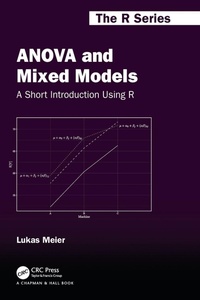
ANOVA and Mixed Models
A Short Introduction Using R
1st Edition
Published on 4. November 2022
Book
Paperback/Softback
187 pages
978-0-367-70420-9 (ISBN)
Description
ANOVA and Mixed Models: A Short Introduction Using R provides both the practitioner and researcher a compact introduction to the analysis of data from the most popular experimental designs. Based on knowledge from an introductory course on probability and statistics, the theoretical foundations of the most important models are introduced. The focus is on an intuitive understanding of the theory, common pitfalls in practice, and the application of the methods in R. From data visualization and model fitting, up to the interpretation of the corresponding output, the whole workflow is presented using R. The book does not only cover standard ANOVA models, but also models for more advanced designs and mixed models, which are common in many practical applications.
Features
Accessible to readers with a basic background in probability and statistics
Covers fundamental concepts of experimental design and cause-effect relationships
Introduces classical ANOVA models, including contrasts and multiple testing
Provides an example-based introduction to mixed models
Features basic concepts of split-plot and incomplete block designs
R code available for all steps
Supplementary website with additional resources and updates are available here.
This book is primarily aimed at students, researchers, and practitioners from all areas who wish to analyze corresponding data with R. Readers will learn a broad array of models hand-in-hand with R, including the applications of some of the most important add-on packages.
Features
Accessible to readers with a basic background in probability and statistics
Covers fundamental concepts of experimental design and cause-effect relationships
Introduces classical ANOVA models, including contrasts and multiple testing
Provides an example-based introduction to mixed models
Features basic concepts of split-plot and incomplete block designs
R code available for all steps
Supplementary website with additional resources and updates are available here.
This book is primarily aimed at students, researchers, and practitioners from all areas who wish to analyze corresponding data with R. Readers will learn a broad array of models hand-in-hand with R, including the applications of some of the most important add-on packages.
More details
Series
Language
English
Place of publication
Oxford
United Kingdom
Publishing group
Taylor & Francis Ltd
Illustrations
41 s/w Abbildungen, 41 s/w Zeichnungen, 18 s/w Tabellen
18 Tables, black and white; 41 Line drawings, black and white; 41 Illustrations, black and white
Dimensions
Height: 234 mm
Width: 156 mm
Thickness: 12 mm
Weight
316 gr
ISBN-13
978-0-367-70420-9 (9780367704209)
Copyright in bibliographic data and cover images is held by Nielsen Book Services Limited or by the publishers or by their respective licensors: all rights reserved.
Schweitzer Classification
Other editions
Additional editions
E-Book
11/2022
1st Edition
Chapman & Hall/CRC
€76.49
Available for download
Book
11/2022
1st Edition
Chapman & Hall/CRC
€206.10
Shipment within 15-20 days
E-Book
11/2022
1st Edition
Chapman & Hall/CRC
€76.49
Available for download
Person
Lukas Meier is a senior scientist at the Seminar fuer Statistik at ETH Zuerich. His main interests are teaching statistics at various levels, the application of statistics in many fields of applications using advanced ANOVA or regression models, and high-dimensional statistics. He co-leads the statistical consulting service at ETH Zuerich and is the director of a continuing education program in applied statistics.
Content
1. Learning from Data. 1.1. Cause-Effect Relationships. 1.2. Experimental Studies. 2. Completely Randomized Designs. 2.1. One-Way Analysis of Variance. 2.2. Checking Model Assumptions. 2.3. Nonparametric Approaches. 2.4. Power or "What Sample Size Do I Need?". 2.5. Adjusting for Covariates. 2.6. Appendix. 3. Contrasts and Multiple Testing. 3.1. Contrasts. 3.2. Multiple Testing. 4. Factorial Treatment Structure. 4.1. Introduction. 4.2. Two-Way ANOVA Model. 5. Complete Block Designs. 5.1. Introduction. 5.2. Randomized Complete Block Designs (RCBD). 5.3. Nonparametric Alternatives. 5.4. Outlook: Multiple Block Factors. 6. Random and Mixed Effects Models. 6.1. Random Effects Models. 7. Split-Plot Designs. 7.1. Introduction. 7.2. Properties of Split-Plot Designs. 7.3. A More Complex Example in Detail: Oat Varieties. 8. Incomplete Block Designs. 8.1. Introduction. 8.2. Balanced Incomplete Block Designs (BIBD). 8.3. Analysis of Incomplete Block Designs. 8.4. Outlook. 8.5. Concluding Remarks. Bibliography. Index