

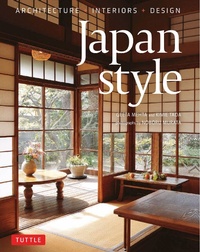
Japan Style
Architecture + Interiors + Design
Will be published approx. on 24. September 2019
Book
Hardback
224 pages
978-4-8053-1523-1 (ISBN)
Description
Japanese homes speak to the soul and provide a contemplative environment from which to experience the world.
Japan Style offers rare glimpses into twenty exquisite traditional homes in Japan. The lavish photographs in this volume demonstrate how Japanese design achieves a timeless tranquility using a few very simple, natural elements.
Wood is the preferred building material since it is considered a "living" material; the country's Shinto and Zen Buddhist roots have inculcated a deep respect for nature. The houses in this book are a wonderful reminder that there are alternatives to "big is beautiful"-and that neither timelessness nor modernity has to be about using cold steel, glass and concrete.
The wabi-sabi ideal, translated loosely by Frank Lloyd Wright as a "rusticity and simplicity that borders on loneliness," is considered the epitome of sophistication in Japanese interior design. The houses in this book invite us to rethink the wisdom of our hurried modern lifestyle and return to a simpler, slower life.
The quintessential Japanese aesthetic can be seen in a 100-year-old minka farmhouse, an old merchant's machiya townhouse in Kyoto, a sprawling country Samurai villa, and in a modern seaside cottage. This book offers insights for architects and homeowners alike by providing inspiring and surprising alternatives, relevant to the design of homes anywhere in the world today.
Japan Style offers rare glimpses into twenty exquisite traditional homes in Japan. The lavish photographs in this volume demonstrate how Japanese design achieves a timeless tranquility using a few very simple, natural elements.
Wood is the preferred building material since it is considered a "living" material; the country's Shinto and Zen Buddhist roots have inculcated a deep respect for nature. The houses in this book are a wonderful reminder that there are alternatives to "big is beautiful"-and that neither timelessness nor modernity has to be about using cold steel, glass and concrete.
The wabi-sabi ideal, translated loosely by Frank Lloyd Wright as a "rusticity and simplicity that borders on loneliness," is considered the epitome of sophistication in Japanese interior design. The houses in this book invite us to rethink the wisdom of our hurried modern lifestyle and return to a simpler, slower life.
The quintessential Japanese aesthetic can be seen in a 100-year-old minka farmhouse, an old merchant's machiya townhouse in Kyoto, a sprawling country Samurai villa, and in a modern seaside cottage. This book offers insights for architects and homeowners alike by providing inspiring and surprising alternatives, relevant to the design of homes anywhere in the world today.
More details
Language
English
Place of publication
Boston
United States
Product notice
With dust jacket
Illustrations
color photos throughout
Dimensions
Height: 261 mm
Width: 202 mm
Thickness: 25 mm
Weight
995 gr
ISBN-13
978-4-8053-1523-1 (9784805315231)
Copyright in bibliographic data and cover images is held by Nielsen Book Services Limited or by the publishers or by their respective licensors: all rights reserved.
Schweitzer Classification
Other editions
Additional editions
E-Book
09/2019
Tuttle Publishing
€24.49
Available for download
Previous edition
Book
03/2013
Tuttle Publishing
€50.94
Article exhausted; check for reprint
Persons
Kimie Tada graduated from Rikkyo University (Tokyo) with a degree in English literature, after which she worked as the editor-in-chief of Confort a Japanese magazine that features traditional Japanese houses and interiors. She now runs I See All Inc., an editorial company which she founded in 2000.
Geeta Mehta teaches architecture and urban design at Columbia University in New York. A resident of Japan for 23 years, she is a partner in the firm of Braden and Mehta, and has designed projects in the USA, Japan, India, Vietnam and Indonesia. Educated at the University of Tokyo, Columbia University, and SPA in Delhi, she is the co-author of several books, including Japan Houses, Japan Living, Japanese Gardens and New Japan Architecture, all published by Tuttle Publishing.
Noboru Murata has had a career of more than thirty years as an advertising photographer. With Tokyo as his base, he has photographed for clients in a wide range of genres, including interiors, cuisines, automobiles and jewelry. His recent publications include The Japanese House, Japanese Gardens, The Sushi Lover's Cookbook and Japanese Ikebana for Every Season.
Geeta Mehta teaches architecture and urban design at Columbia University in New York. A resident of Japan for 23 years, she is a partner in the firm of Braden and Mehta, and has designed projects in the USA, Japan, India, Vietnam and Indonesia. Educated at the University of Tokyo, Columbia University, and SPA in Delhi, she is the co-author of several books, including Japan Houses, Japan Living, Japanese Gardens and New Japan Architecture, all published by Tuttle Publishing.
Noboru Murata has had a career of more than thirty years as an advertising photographer. With Tokyo as his base, he has photographed for clients in a wide range of genres, including interiors, cuisines, automobiles and jewelry. His recent publications include The Japanese House, Japanese Gardens, The Sushi Lover's Cookbook and Japanese Ikebana for Every Season.