

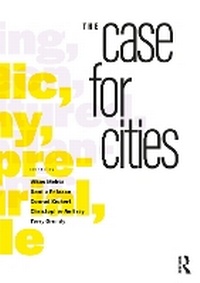
The Case for Cities
1st Edition
Published on 31. July 2024
Book
Hardback
326 pages
978-1-032-56066-3 (ISBN)
Description
The fateful year 2020 brought dramatic challenges to American cities. The COVID-19 pandemic and the civil unrest caused by the killing of George Floyd led to a cascade of negative media stories about cities, often politically motivated. It seemed possible that the economic and demographic gains cities had achieved over the last few decades could be lost. In fact, there has been measurable population loss in larger cities caused by changing work/life patterns and changing public perceptions about the costs and benefits of urban living. Faced with these challenges, advocates for cities must make a vigorous case for cities and show how they aren't the cause of America's social, environmental, economic, and public health problems but, in fact, are the places where the solutions to those problems will be found. The 38 chapters in The Case for Cities draw on the expertise of contributors from the academic, professional, and civic sectors to explore the creative tension between the two great values on which the vigor of cities depends--that they should be "Cities of Choice" (places where people who have choice want to live) and "Cities of Justice" (places that welcome and support people with limited choices). The book's underlying perspective is that these two values are symbiotic and that promoting both is what leads to viable, sustainable urban resurgence. This book will be of keen interest to students and practitioners in urban planning, urban design, real estate, architecture, and landscape architecture and to urban advocates and civic leaders.
More details
Language
English
Place of publication
London
United Kingdom
Publishing group
Taylor & Francis Ltd
Target group
College/higher education
Professional and scholarly
Postgraduate, Professional Practice & Development, and Undergraduate Advanced
Illustrations
128 farbige Abbildungen, 128 Farbfotos bzw. farbige Rasterbilder
128 Halftones, color; 128 Illustrations, color
Dimensions
Height: 246 mm
Width: 174 mm
Weight
760 gr
ISBN-13
978-1-032-56066-3 (9781032560663)
Copyright in bibliographic data and cover images is held by Nielsen Book Services Limited or by the publishers or by their respective licensors: all rights reserved.
Schweitzer Classification
Other editions
Additional editions
Vikas Mehta | Danilo Palazzo | Conrad Kickert
The Case for Cities
Book
07/2024
1st Edition
Routledge
€46.00
Shipment within 10-20 days
Vikas Mehta | Danilo Palazzo | Conrad Kickert
The Case for Cities
E-Book
07/2024
1st Edition
Routledge
€39.49
Available for download
Vikas Mehta | Danilo Palazzo | Conrad Kickert
The Case for Cities
E-Book
07/2024
1st Edition
Routledge
€39.49
Available for download
Persons
Vikas Mehta, PhD, is the Fruth/Gemini Chair, Ohio Eminent Scholar of Urban/Environmental Design, and Professor at the School of Planning, University of Cincinnati. His work focuses on the exploration of place as a social and ecological setting and as a sensorial art in creating a more responsive, equitable, stimulating, and communicative environment. Dr. Mehta is the author/co-author and editor/co-editor of six books including most recently Public Space: Notes on why it matters, what we should know, and how to realize its potential.
Danilo Palazzo, PhD, is Director of the School of Planning at the University of Cincinnati, USA. Before moving to Cincinnati, he was on the faculty of the Polytechnic University of Milan, Italy. Dr. Palazzo has authored, with Frederick Steiner, Urban Ecological Design (2011). He co-edited Companion to Public Space (2020) with Vikas Mehta, and Routledge Companion to Professional Awareness and Diversity in Planning Education (2023) with Stephen Diko and Leah Hollstein.
Conrad Kickert, PhD, is an Associate Professor at the University at Buffalo's School of Architecture and Planning. Dr. Kickert's research studies the evolving relationship between urban form, urban life, and the urban economy. He has a background in urbanism and architecture from The Netherlands and the United States, and has worked as an urban researcher and designer for various design offices, property developers and non-profit organizations in Europe and North America.
Christopher Auffrey, PhD, is a Professor in the School of Planning at the University of Cincinnati where he teaches courses in healthy urban planning, and planning theory. His research focuses on promoting the social determinants of health to reduce disparities and create healthier, livable neighborhoods. He co-authored the fourth and fifth editions of the Social Areas of Cincinnati with Michael Maloney and is currently completing the sixth edition.
Terry Grundy, a passionate urbanist, is Adjunct Associate Professor at the University of Cincinnati's School of Planning, where he teaches courses on ethics and social justice. For many years, he served at United Way of Greater Cincinnati, directing its social research efforts and forming funders' partnerships for neighborhood-focused community development.
Danilo Palazzo, PhD, is Director of the School of Planning at the University of Cincinnati, USA. Before moving to Cincinnati, he was on the faculty of the Polytechnic University of Milan, Italy. Dr. Palazzo has authored, with Frederick Steiner, Urban Ecological Design (2011). He co-edited Companion to Public Space (2020) with Vikas Mehta, and Routledge Companion to Professional Awareness and Diversity in Planning Education (2023) with Stephen Diko and Leah Hollstein.
Conrad Kickert, PhD, is an Associate Professor at the University at Buffalo's School of Architecture and Planning. Dr. Kickert's research studies the evolving relationship between urban form, urban life, and the urban economy. He has a background in urbanism and architecture from The Netherlands and the United States, and has worked as an urban researcher and designer for various design offices, property developers and non-profit organizations in Europe and North America.
Christopher Auffrey, PhD, is a Professor in the School of Planning at the University of Cincinnati where he teaches courses in healthy urban planning, and planning theory. His research focuses on promoting the social determinants of health to reduce disparities and create healthier, livable neighborhoods. He co-authored the fourth and fifth editions of the Social Areas of Cincinnati with Michael Maloney and is currently completing the sixth edition.
Terry Grundy, a passionate urbanist, is Adjunct Associate Professor at the University of Cincinnati's School of Planning, where he teaches courses on ethics and social justice. For many years, he served at United Way of Greater Cincinnati, directing its social research efforts and forming funders' partnerships for neighborhood-focused community development.
Content
1. Why Cities? 2. The Living City 3. The Mobile City 4. The Green City 5. The Healthy City 6. The Entrepreneurial City 7. The Public City 8. The Cultured City 9. The Philanthropic City