

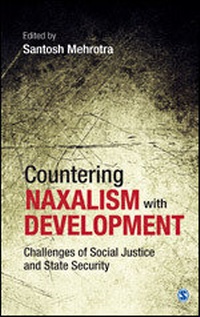
Countering Naxalism with Development
Challenges of Social Justice and State Security
1st Edition
Published on 28. February 2020
Book
Paperback/Softback
212 pages
978-93-5388-046-0 (ISBN)
Description
This book, for the first time, presents an authentic assessment and presentation of the human development and security challenges faced by districts of the country that have a high concentration of Scheduled Castes and Scheduled Tribes.
Countering Naxalism with Development: Challenges of Social Justice and State Security is a compilation of background papers by a group of profoundly knowledgeable and experienced persons commonly known as the Expert Group. The various chapters of the book discuss how the law and order issues of the situation are inextricably intertwined with the development problems faced by the marginalised social groups of some 200 districts in the country affected by Naxalism.
Countering Naxalism with Development: Challenges of Social Justice and State Security is a compilation of background papers by a group of profoundly knowledgeable and experienced persons commonly known as the Expert Group. The various chapters of the book discuss how the law and order issues of the situation are inextricably intertwined with the development problems faced by the marginalised social groups of some 200 districts in the country affected by Naxalism.
More details
Other editions
Additional editions
Santosh Mehrotra
Countering Naxalism with Development
Challenges of Social Justice and State Security
Book
07/2014
1st Edition
SAGE Publications India Pvt Ltd
€82.00
Article not available for order
Person
Editor
Professor of Economics, Centre for Informal Sector and Labour Studies, Jawaharlal Nehru University, New Delhi
Dr Santosh Mehrotra is currently Professor of Economics, Centre for Informal Sector and Labour Studies, Jawaharlal Nehru University. Prior to this, he was the Director General of Institute of Applied Manpower Research, New Delhi, the only research institute of the Planning Commission, Government of India. He was first Head of Rural Development Division, and then Head, Development Policy Division, Planning Commission, from 2006 to 2009. He was one of the authors of India's 11th Five-Year Plan (2007-12) and of the 12th Plan, and also led the team on the India Human Development Report 2011. Dr Mehrotra held a three-year appointment at the Centre for Development Studies, University of Bath, UK, as Parkin Visiting Professor (2010-13). He has worked with the United Nations Development Programme and UNICEF too. He is a human development economist, and his research interests have spanned industry and trade issues, the impact of macroeconomic policy on health and education, the informal sector, and the economics of health and education. His books include Asian Informal Workers: Global Risks, Local Protection (2007, co-edited); Eliminating Human Poverty: Macro-economic Policies for Equitable Growth (2007, co-authored); The Economics of Elementary Education in India (2006, edited); Universalizing Elementary Education in India: Uncaging the Tiger Economy (2005, co-authored); Development with a Human Face: Experiences in Social Achievement and Economic Growth (1997, co-edited, translated into French); and India and the Soviet Union: Trade and Technology Transfer (1990). His latest books are: Seizing the Demographic Dividend: Polices to Achieve Inclusive Growth in India; India's Skills Challenge: Reforming Vocational Education and Training; and Land Policies for Equity and Growth: Transforming the Agarian Structure in Uttar Pradesh. The current book is the third by Dr Mehrotra for SAGE publications.
Dr Santosh Mehrotra is currently Professor of Economics, Centre for Informal Sector and Labour Studies, Jawaharlal Nehru University. Prior to this, he was the Director General of Institute of Applied Manpower Research, New Delhi, the only research institute of the Planning Commission, Government of India. He was first Head of Rural Development Division, and then Head, Development Policy Division, Planning Commission, from 2006 to 2009. He was one of the authors of India's 11th Five-Year Plan (2007-12) and of the 12th Plan, and also led the team on the India Human Development Report 2011. Dr Mehrotra held a three-year appointment at the Centre for Development Studies, University of Bath, UK, as Parkin Visiting Professor (2010-13). He has worked with the United Nations Development Programme and UNICEF too. He is a human development economist, and his research interests have spanned industry and trade issues, the impact of macroeconomic policy on health and education, the informal sector, and the economics of health and education. His books include Asian Informal Workers: Global Risks, Local Protection (2007, co-edited); Eliminating Human Poverty: Macro-economic Policies for Equitable Growth (2007, co-authored); The Economics of Elementary Education in India (2006, edited); Universalizing Elementary Education in India: Uncaging the Tiger Economy (2005, co-authored); Development with a Human Face: Experiences in Social Achievement and Economic Growth (1997, co-edited, translated into French); and India and the Soviet Union: Trade and Technology Transfer (1990). His latest books are: Seizing the Demographic Dividend: Polices to Achieve Inclusive Growth in India; India's Skills Challenge: Reforming Vocational Education and Training; and Land Policies for Equity and Growth: Transforming the Agarian Structure in Uttar Pradesh. The current book is the third by Dr Mehrotra for SAGE publications.
Content
Foreword - D Bandyopadhyay
Preface
Human Development in India's Tribal Areas: Peace to Secure Development - or the Other Way Round? - Santosh Mehrotra
Recommendations of the Expert Group on "Development Challenges in Extremist-affected Areas"
Development to Deal with Causes of Discontent, Unrest and Extremism - Prakash Singh and Ajit K Doval
The Naxalite Movement and State Policy - K B Saxena
Access of Scheduled Castes and Scheduled Tribes to Common Property Resources - K B Saxena
The State and the Scheduled Tribes: Past, Present and Future - B D Sharma
Panchayats (Extension to the Scheduled Areas) Act: Realising Its Potential - B D Sharma
The Factors Underlying Tribal Unrest - S R Sankaran
Indian Extremism: A Case of Chronic Poverty, Denial of Equal Opportunity, and Violence among the Socially Disadvantaged Groups - Sukhadeo Thorat and Sandeep Sharma
Index
Preface
Human Development in India's Tribal Areas: Peace to Secure Development - or the Other Way Round? - Santosh Mehrotra
Recommendations of the Expert Group on "Development Challenges in Extremist-affected Areas"
Development to Deal with Causes of Discontent, Unrest and Extremism - Prakash Singh and Ajit K Doval
The Naxalite Movement and State Policy - K B Saxena
Access of Scheduled Castes and Scheduled Tribes to Common Property Resources - K B Saxena
The State and the Scheduled Tribes: Past, Present and Future - B D Sharma
Panchayats (Extension to the Scheduled Areas) Act: Realising Its Potential - B D Sharma
The Factors Underlying Tribal Unrest - S R Sankaran
Indian Extremism: A Case of Chronic Poverty, Denial of Equal Opportunity, and Violence among the Socially Disadvantaged Groups - Sukhadeo Thorat and Sandeep Sharma
Index