

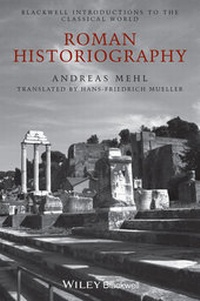
Roman Historiography
An Introduction to its Basic Aspects and Development
Published on 27. December 2013
Book
Paperback/Softback
300 pages
978-1-118-78513-3 (ISBN)
Description
Roman Historiography: An Introduction to its Basic Aspects and Development presents a comprehensive introduction to the development of Roman historical writings in both Greek and Latin, from the early annalists to Orosius and Procopius of Byzantium.
* Provides an accessible survey of every historical writer of significance in the Roman world
* Traces the growth of Christian historiography under the influence of its pagan adversaries
* Offers valuable insight into current scholarly trends on Roman historiography
* Includes a user-friendly bibliography, catalog of authors and editions, and index
* Selected by Choice as a 2013 Outstanding Academic Title
Reviews / Votes
Named CHOICE Outstanding Title for 2012 "Appropriate for advanced undergraduate students, this work provides a foundation for further study of classical historical writing." (Book News, Inc., 1 August 2011)More details
Series
Edition
1. Auflage
Language
English
Place of publication
Hoboken
United Kingdom
Publishing group
John Wiley and Sons Ltd
Target group
College/higher education
Product notice
Paperback (trade)
Unsewn / adhesive bound
Dimensions
Height: 229 mm
Width: 152 mm
Thickness: 16 mm
Weight
441 gr
ISBN-13
978-1-118-78513-3 (9781118785133)
Schweitzer Classification
Other editions
Additional editions
Book
04/2011
Wiley
€148.50
Shipment within 3-4 weeks
Persons
Andreas Mehl is Professor of Ancient History at the Martin Luther University at Halle and Wittenberg. He is the author of Seleukos Nikator und sein Reich (1986); Tacitus über Kaiser Claudius: Die Ereignisse Am Hof (1974); and Römische Geschichtsschreibung: Grundlagen und Entwicklungen: eine Einführung (2001).
Hans-Friedrich Mueller is the William D. Williams Professor of Classics at Union College in Schenectady, New York. He is the author of Roman Religion in Valerius Maximus (2002) and the editor of an abridgment of Edward Gibbon's Decline and Fall of the Roman Empire (2003).
Content
Translator's Preface ix
Introduction: The Importance of Ancient Historiography and the Purpose of this Book 1
Chapter 1: Ancient Literature and Roman Historiography 9
1.1 Roman Literature and its Relation to Greek Literature 9
1.2 Roman Historiography and the City of Rome 12
1.3 The Claims of Artistry and Truth in Ancient, especially Roman, Historiography 17
Chapter 2: The Formation and Establishment of Tradition in the Ruling Class of the Early and Middle Roman Republic 33
2.1 Family Histories and Clan Traditions 34
2.2 The Annales Maximi and the Almanacs of Publius Mucius Scaevola 37
Chapter 3: Early Roman Historiography: Self-Justifi cation and Memory in earlier Annalistic Writing 41
3.1 Early Annalistic Writing (I) 43
3.2 Early Annalistic Writing (II) 49
3.3 Early Historical Epic in Rome (Naevius and Ennius) 60
Chapter 4: The Historiography of Rome between the Fronts of the Civil Wars 63
4.1 Later Annalistic Writing: Optimates vs. Populares and Traditional Annalistic Writing vs. Contemporary History 66
4.2 Autobiographies, Memoirs, Hypomnemata, Commentarii, and their Infl uence on the Historiography of Current Events 69
4.3 The History of Current Events Made to Order and Contemporary Concepts of Historiography (Cicero) 77
4.4 Biography (Cornelius Nepos) 81
4.5 The Experience of the Collapsing and Ruined Republic 84
4.6 Antiquarian Writings 96
Chapter 5: Augustan Rome, Roman Empire, and other Peoples and Kingdoms 98
5.1 Titus Livius: Roman History from Romulus to Augustus in its Entirety 100
5.2 World History, the History of the World beyond Rome, and Roman History by Non-Romans and New Romans 110
Chapter 6: Imperial History and the History of Emperors - Imperial History as the History of Emperors 121
6.1 Empire and "Republic": Senatorial Historiography 127
6.2 Rome and Foreign Peoples 156
6.3 Imperial History as Imperial Biography 165
6.4 Personal History and Biography in the High Empire beyond Roman Emperors 178
6.5 History in "Pocket-Size" 186
6.6 Exempla-Literature and Historical Understanding 197
Chapter 7: Roman History and Universal History between Classical Religion ("Paganism") and Christianity 199
7.1 Zosimus and his Predecessors: Classically Religious Historiography and Historical Interpretation in a Christian Age 203
7.2 Ammianus Marcellinus: Indifferent to Religion? 207
7.3 Christian Historiography 216
Chapter 8: Some Basic Principles of Ancient Historical Thought 243
Chronological Table 252
Notes 255
Select Bibliography 264
1. General Bibliography 264
1.1 Editions, Translations, and Commentaries for the Historiographical and Biographical Works Treated in this Book 264
1.2 Editions of Historiographical Works and Historical Epics in Greek and Latin that Survive only in Fragments 270
1.3 Histories of Greek and Latin Literature, especially Historiography: Recent Surveys and Collections 271
1.4 Ancient Historiography, especially Roman: its Basic Literary, Social, and Intellectual Contexts 272
2. The Formation and Establishment of Tradition in the Ruling Class of the Early and Middle Roman Republic 275
3. Early Roman Historiography: Self-Justifi cation and Memory in Early Annalistic Writing 276
4. The Historiography of Rome between the Fronts of the Civil Wars 277
5. Augustan Rome, Roman Empire, and other Peoples and Kingdoms 279
6. Imperial History and the History of Emperors - Imperial History as the History of Emperors 280
7. Roman History and Universal History between Classical Religion ("Paganism") and Christianity 284
Index 287