

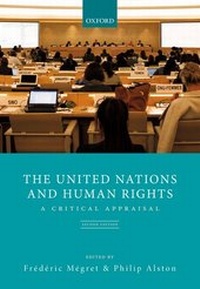
The United Nations and Human Rights
A Critical Appraisal
2nd Edition
Published on 2. April 2020
Book
Paperback/Softback
768 pages
978-0-19-829838-0 (ISBN)
Description
The very concept of human rights implies governmental accountability. To ensure that governments are indeed held accountable for their treatment of citizens and others the United Nations has established a wide range of mechanisms to monitor compliance, and to seek to prevent as well as respond to violations.
The panoply of implementation measures that the UN has taken since 1945 has resulted in a diverse and complex set of institutional arrangements, the effectiveness of which varies widely. Indeed, there is much doubt as to the effectiveness of much of the UN's human rights efforts but also about what direction it should take. Inevitable instances of politicization and the hostile, or at best ambivalent, attitude of most governments, has at times endangered the fragile progress made on the more technical fronts. At the same time, technical efforts cannot dispense with the complex politics of actualizing the promise of human rights at and through the UN. In addition to significant actual and potential problems of duplication, overlapping and inconsistent approaches, there are major problems of under-funding and insufficient expertise. The complexity of these arrangements and the difficulty in evaluating their impact makes a comprehensive guide of the type provided here all the more indispensable.
These essays critically examine the functions, procedures, and performance of each of the major UN organs dealing with human rights, including the Security Council and the International Court of Justice as well as the more specialized bodies monitoring the implementation of human rights treaties. Significant attention is devoted to the considerable efforts at reforming the UN's human rights machinery, as illustrated most notably by the creation of the Human Rights Council to replace the Commission on Human Rights. The book also looks at the relationship between the various bodies and the potential for major reforms and restructuring.
The panoply of implementation measures that the UN has taken since 1945 has resulted in a diverse and complex set of institutional arrangements, the effectiveness of which varies widely. Indeed, there is much doubt as to the effectiveness of much of the UN's human rights efforts but also about what direction it should take. Inevitable instances of politicization and the hostile, or at best ambivalent, attitude of most governments, has at times endangered the fragile progress made on the more technical fronts. At the same time, technical efforts cannot dispense with the complex politics of actualizing the promise of human rights at and through the UN. In addition to significant actual and potential problems of duplication, overlapping and inconsistent approaches, there are major problems of under-funding and insufficient expertise. The complexity of these arrangements and the difficulty in evaluating their impact makes a comprehensive guide of the type provided here all the more indispensable.
These essays critically examine the functions, procedures, and performance of each of the major UN organs dealing with human rights, including the Security Council and the International Court of Justice as well as the more specialized bodies monitoring the implementation of human rights treaties. Significant attention is devoted to the considerable efforts at reforming the UN's human rights machinery, as illustrated most notably by the creation of the Human Rights Council to replace the Commission on Human Rights. The book also looks at the relationship between the various bodies and the potential for major reforms and restructuring.
Reviews / Votes
Review from other book by this author ... an excellent study of the many different aspects of human rights in the EU ... The volume is all the more interesting since it has a multidisciplinary approach. It does not only focus on legal aspects of human rights policies, but also deals with anthropological, social and political views on the EU and human rights. ... exceptional ... * Maastricht Journal of European and Comparative Law, 8MJ2 (2001) * What is clear is that this is a seminal book on a key issue of our times. It has been well worth the wait. We must just hope that if the next edition is nearly 30 years in the coming, it will have a somewhat happier story to tell. * Malcolm Evans, International and Comparative Law Quarterly *More details
Edition
2nd Revised edition
Language
English
Place of publication
Oxford
United Kingdom
Target group
Professional and scholarly
Edition type
Revised edition
Product notice
Paperback (trade)
Unsewn / adhesive bound
Dimensions
Height: 244 mm
Width: 174 mm
Thickness: 48 mm
Weight
1363 gr
ISBN-13
978-0-19-829838-0 (9780198298380)
Copyright in bibliographic data and cover images is held by Nielsen Book Services Limited or by the publishers or by their respective licensors: all rights reserved.
Schweitzer Classification
Other editions
Additional editions
Book
04/2020
2nd Edition
Oxford University Press
€198.70
Shipment within 15-20 days
Persons
Frederic Megret is a Full-Professor and Dawson Fellow at the Faculty of Law of McGill University. He holds a Phd in international law from the Universite Pantheon-Sorbonne and the Graduate Institute of International Studies of the University of Geneva. He is a graduate of Sciences Po Paris and the author of many articles on international human rights law, public international law, international criminal law and the laws of war.
Philip Alston is an international lawyer whose teaching focuses primarily on human rights law and the law of international organizations. He directs the recently-established NYU Center for Human Rights and Global Justice, part of the Institute for International Law and Justice. He is currently John Norton Pomeroy Professor of Law, NYU School of Law.
Philip Alston is an international lawyer whose teaching focuses primarily on human rights law and the law of international organizations. He directs the recently-established NYU Center for Human Rights and Global Justice, part of the Institute for International Law and Justice. He is currently John Norton Pomeroy Professor of Law, NYU School of Law.
Content
PENDING