

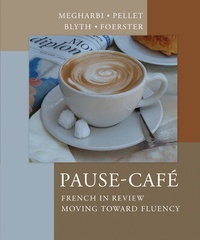
Pause-cafe (Student Edition)
Published on 16. September 2008
Book
Paperback/Softback
352 pages
978-0-07-240784-6 (ISBN)
Description
Pause-cafe is designed for the full second year of the study of French with emphasis on seven communicative functions: describing, comparing, narrating in the past, reacting and recommending, asking questions, talking about the future, and hypothesizing. These communicative functions are identified throughout the textbook by distinctive icons and are recycled in all six chapters. Although each chapter highlights at least one of the seven functions in turn, all seven are integrated into the chapter's oral and written work. The key grammatical structures that support these functions, called Points cles, appear with practice exercises at the back of the book. Pause-cafe helps students focus primarily on communicative functions because they are continuously recycled throughout the text, while the content and themes change with each new chapter.
More details
Edition
Student ed
Language
English
Place of publication
United States
Publishing group
McGraw-Hill Education - Europe
Target group
College/higher education
Dimensions
Height: 254 mm
Width: 208 mm
Thickness: 13 mm
Weight
617 gr
ISBN-13
978-0-07-240784-6 (9780072407846)
Copyright in bibliographic data and cover images is held by Nielsen Book Services Limited or by the publishers or by their respective licensors: all rights reserved.
Schweitzer Classification
Persons
Nora Megharbi is currently a lecturer at the University of California in Santa Cruz and serves as Coordinator of the French Program. A native of Paris, she has taught both in France and in the United States. She received her PhD. in Applied Linguistics / Second Language Acquisition from the University of Texas at Austin in 2007. Her research focuses on language teaching, pedagogical grammar and the use of multimedia and technology. At the University of Texas at Austin, she was a member of the development team for an online reference grammar of French entitled Tex's French Grammar (http://www.laits.utexas.edu/tex/index.html), and a multimedia-based first-year French program, Frani?ais Interactif (http://www.laits.utexas.edu/fi/). She designed materials for the first-year program project using video, multimedia technology, and Internet resources.
Sti?phanie H. Pellet is an Assistant Professor of French at Wake Forest University, where she teaches French language and sociolinguistics courses. She received her Ph.D. in French linguistics from the University of Texas at Austin, where she taught French language courses for several years. She has also taught French at Southwest Texas State University, Austin Community College, and Huston-Tillotson. She presents conference papers and writes on sociolinguistics and pragmatics in particular from the viewpoint of second language learners.
Carl S. Blyth (Ph.D., Cornell University) is the Director of the Texas Language Technology Center and Associate Professor of French Linguistics in the Department of French and Italian at the University of Texas at Austin. At UT-Austin, he has served as Coordinator of Lower-Division French (1993-2002); Acting Director of Technology, Literacy, and Culture (2001-2002); and Director/Assistant Director of the UT Summer Program in Lyon, France. With his colleagues at the University of Texas at Austin, Carl has developed an online reference grammar of French called Tex's French Grammar (http://www.laits.utexas.edu/tex/index.html), and a multimedia-based first-year French program entitled Frani?ais Interactif (http://www.laits.utexas.edu/fi/). In addition to his efforts in electronic publishing, Carl has written various journal articles, chapter essays, and books. Most notably, he was author of Untangling the Web: Nonce's Guide to Language and Culture on the Internet (1999) and editor of The Sociolinguistics of Foreign Language Classrooms (2003). More recently, he co-authored with Stacey Katz (University of Utah) Teaching French Grammar in Context (2007). Currently, he serves as the series editor of Issues in Language Program Direction, an annual volume devoted to foreign language learning in higher education. As his publications indicate, his main research interests lie at the intersection of sociolinguistics, technology, and language learning.
Sharon Wilson Foerster retired from the University of Texas at Austin in 2001, where she had been the Coordinator of Lower-Division Courses in the Department of Spanish and Portuguese, directing the first- and second-year Spanish language program and training graduate assistant instructors. She continues to teach in the Spanish Summer Language School at Middlebury College in Vermont. She received her Ph.D. in Intercultural Communications from the University of Texas in 1981. Before joining the faculty at the University of Texas, she was Director of the Center for Cross-Cultural Study in Seville, Spain, for four years. She continues her involvement in study abroad through her work as Director of the Spanish Teaching Institute and as Academic Advisor for Academic Programs International. She is the co-author of the following McGraw-Hill titles: Pasaporte: Spanish for High Beginners (2009); Supplementary Materials to accompany Puntos de partida, Eighth Edition (2009); Metas: Spanish in Review, Moving Toward Fluency (2008); Punto y aparte: Spanish in Review, Moving Toward Fluency, Third Edition (2007); Lecturas literarias: Moving Toward Linguistic and Cultural Fluency Through Literature (2007); Metas comunicativas para maestros (1999); and Metas comunicativas para negocios (1998).
Sti?phanie H. Pellet is an Assistant Professor of French at Wake Forest University, where she teaches French language and sociolinguistics courses. She received her Ph.D. in French linguistics from the University of Texas at Austin, where she taught French language courses for several years. She has also taught French at Southwest Texas State University, Austin Community College, and Huston-Tillotson. She presents conference papers and writes on sociolinguistics and pragmatics in particular from the viewpoint of second language learners.
Carl S. Blyth (Ph.D., Cornell University) is the Director of the Texas Language Technology Center and Associate Professor of French Linguistics in the Department of French and Italian at the University of Texas at Austin. At UT-Austin, he has served as Coordinator of Lower-Division French (1993-2002); Acting Director of Technology, Literacy, and Culture (2001-2002); and Director/Assistant Director of the UT Summer Program in Lyon, France. With his colleagues at the University of Texas at Austin, Carl has developed an online reference grammar of French called Tex's French Grammar (http://www.laits.utexas.edu/tex/index.html), and a multimedia-based first-year French program entitled Frani?ais Interactif (http://www.laits.utexas.edu/fi/). In addition to his efforts in electronic publishing, Carl has written various journal articles, chapter essays, and books. Most notably, he was author of Untangling the Web: Nonce's Guide to Language and Culture on the Internet (1999) and editor of The Sociolinguistics of Foreign Language Classrooms (2003). More recently, he co-authored with Stacey Katz (University of Utah) Teaching French Grammar in Context (2007). Currently, he serves as the series editor of Issues in Language Program Direction, an annual volume devoted to foreign language learning in higher education. As his publications indicate, his main research interests lie at the intersection of sociolinguistics, technology, and language learning.
Sharon Wilson Foerster retired from the University of Texas at Austin in 2001, where she had been the Coordinator of Lower-Division Courses in the Department of Spanish and Portuguese, directing the first- and second-year Spanish language program and training graduate assistant instructors. She continues to teach in the Spanish Summer Language School at Middlebury College in Vermont. She received her Ph.D. in Intercultural Communications from the University of Texas in 1981. Before joining the faculty at the University of Texas, she was Director of the Center for Cross-Cultural Study in Seville, Spain, for four years. She continues her involvement in study abroad through her work as Director of the Spanish Teaching Institute and as Academic Advisor for Academic Programs International. She is the co-author of the following McGraw-Hill titles: Pasaporte: Spanish for High Beginners (2009); Supplementary Materials to accompany Puntos de partida, Eighth Edition (2009); Metas: Spanish in Review, Moving Toward Fluency (2008); Punto y aparte: Spanish in Review, Moving Toward Fluency, Third Edition (2007); Lecturas literarias: Moving Toward Linguistic and Cultural Fluency Through Literature (2007); Metas comunicativas para maestros (1999); and Metas comunicativas para negocios (1998).
Content
Pour commencer: Les six amis
PresentationsPoints cles: Introduction[D]Decrire
[C]Comparer
[P]Parler du passe
[R]Reagir et recommander
[Q]Poser des questions
[F]Parler du futur
[H]Faire des hypothesesPour ecrire
Chapitre 1 Perspectives: Perceptions et impressions
Rencontres: Les premieres impressionsVocabulaire thematique
Note culturelle: Une question de sensibilitePoints cles: Decrire et Comparer [D] [C]Coin-culture
Destination: Paris
Un cineaste francais: Jean-Pierre JeunetLecture: L'Etudiant etranger de Philippe LabroPour ecrireAutres themes pour discuter
Chapitre 2 Passions et sentiments: Quelle est l'influence des autres sur notre vie?
Rencontres: Une soiree inoubliableVocabulaire thematique
Note culturelle: Les relations sentimentales en FrancePoints cles: Parler du passe [P]Coin-culture
Destination: La Provence
Les Arts provencaux: Les santons de ProvenceLecture: Comment cuisiner son mari a l'africaine de Calixthe BelayaPour ecrireAutres themes pour discuter
Chapitre 3 Les relations familiales: Quelle est l'importance de nos racines?
Rencontres: Maman vient me rendre visite. Que faire?Vocabulaire thematique
Note culturelle: La famille en FrancePoints cles: Reagir et recommander [R]Coin-culture
Destination: Les Caraibes francophones
Un groupe antillais: Kassav', createur du zoukLecture: <<Elle avait pris ce pli...>> de Victor HugoPour ecrireAutres themes pour discuter
Chapitre 4 Travail et loisirs: Comment vous detendez-vous?
Rencontres: Il faut bien vivre!Vocabulaire thematique
Note culturelle: Comment eviter les faux pas culturelsPoints cles: Poser des questions [Q]Coin-culture
Destination: L'Afrique francophone
Un realisateur senegalais: Ousmane SembeneLecture: La Greve des battu de Aminata Sow FallPour ecrireAutres themes pour discuter
Chapitre 5 Le nouveau millenaire et l'avenir: Que se passera-t-il dans le futur?
Rencontres: Les projets pour l'eteVocabulaire thematique
Note culturelle: De l'Europe a l'Union europeennePoints cles: Parler du futur [F]Coin-culture
Destination: L'Europe francophone
Un artiste belge: Rene MagritteLecture: <<Liberte>> de Paul Eluard Pour ecrireAutres themes pour discuter
Chapitre 6 Le monde actuel: Quelle influence ont sur nous les problemes dans le monde?
Rencontres: Parlons de la France!Vocabulaire thematique
Note culturelle: La vie politique en France Points cles: Faire des hypotheses [H]Coin-culture
Destination: Le Quebec
Un realisateur quebecois: Denys ArcandLecture: La Noel d'Okarnak d'Yves TheriaultPour ecrireAutres themes pour discuter
Explications grammaticales: Les points cles
Decrire [D]
Gender of nouns
Adjectives
C'est vs. Il est / Elle est
Negation
Relative pronouns
Comparer [C]
Regular comparative forms
Irregular comparative forms
Superlatives
Parler du passe [P]
Formation of the passe compose
Formation of the imparfait
Using the passe compose and the imparfait
Verbs with different meanings in the imparfait and the passe compose
Plus-que-parfait
Passe simple
Reagir et recommander [R]
Present subjunctive
Using the subjunctive
Conjunctions that require the subjunctive
Past subjunctive
Imperative mood (Commands)
Poser des questions [Q]
Yes/No questions
Information questions
Interrogative pronouns qui and que
Adjective quel
Interrogative pronoun lequel
Parler du futur [F]
Near future
Simple future
Future perfect
Faire des hypotheses [H]
Formation of the present conditional
Using the present conditional
Si clauses and hypothetical events
Formation and use of the past conditional
Autres points de grammaire [APG]
1. Determiners1.1 Definite articles1.2 Indefinite articles1.3 Partitive articles1.4 Possessive adjectives1.5 Demonstrative adjectives
2. Adverbs2.1 Types of adverbs2.2 Formation of adverbs2.3 Placement
3. Pronouns3.1. Direct object pronouns3.2. Indirect object pronouns3.3. y and en3.4 Disjunctive pronouns3.5 Possessive pronouns3.6 Demonstrative pronouns
4. Verbs4.1 Expressions with avoir4.2 savoir and connaitre4.3 Pronominal verbs4.4 Verbs followed by a preposition4.5 faire causatif
Appendice 1: Answer KeyAppendice 2: Verb Charts
PresentationsPoints cles: Introduction[D]Decrire
[C]Comparer
[P]Parler du passe
[R]Reagir et recommander
[Q]Poser des questions
[F]Parler du futur
[H]Faire des hypothesesPour ecrire
Chapitre 1 Perspectives: Perceptions et impressions
Rencontres: Les premieres impressionsVocabulaire thematique
Note culturelle: Une question de sensibilitePoints cles: Decrire et Comparer [D] [C]Coin-culture
Destination: Paris
Un cineaste francais: Jean-Pierre JeunetLecture: L'Etudiant etranger de Philippe LabroPour ecrireAutres themes pour discuter
Chapitre 2 Passions et sentiments: Quelle est l'influence des autres sur notre vie?
Rencontres: Une soiree inoubliableVocabulaire thematique
Note culturelle: Les relations sentimentales en FrancePoints cles: Parler du passe [P]Coin-culture
Destination: La Provence
Les Arts provencaux: Les santons de ProvenceLecture: Comment cuisiner son mari a l'africaine de Calixthe BelayaPour ecrireAutres themes pour discuter
Chapitre 3 Les relations familiales: Quelle est l'importance de nos racines?
Rencontres: Maman vient me rendre visite. Que faire?Vocabulaire thematique
Note culturelle: La famille en FrancePoints cles: Reagir et recommander [R]Coin-culture
Destination: Les Caraibes francophones
Un groupe antillais: Kassav', createur du zoukLecture: <<Elle avait pris ce pli...>> de Victor HugoPour ecrireAutres themes pour discuter
Chapitre 4 Travail et loisirs: Comment vous detendez-vous?
Rencontres: Il faut bien vivre!Vocabulaire thematique
Note culturelle: Comment eviter les faux pas culturelsPoints cles: Poser des questions [Q]Coin-culture
Destination: L'Afrique francophone
Un realisateur senegalais: Ousmane SembeneLecture: La Greve des battu de Aminata Sow FallPour ecrireAutres themes pour discuter
Chapitre 5 Le nouveau millenaire et l'avenir: Que se passera-t-il dans le futur?
Rencontres: Les projets pour l'eteVocabulaire thematique
Note culturelle: De l'Europe a l'Union europeennePoints cles: Parler du futur [F]Coin-culture
Destination: L'Europe francophone
Un artiste belge: Rene MagritteLecture: <<Liberte>> de Paul Eluard Pour ecrireAutres themes pour discuter
Chapitre 6 Le monde actuel: Quelle influence ont sur nous les problemes dans le monde?
Rencontres: Parlons de la France!Vocabulaire thematique
Note culturelle: La vie politique en France Points cles: Faire des hypotheses [H]Coin-culture
Destination: Le Quebec
Un realisateur quebecois: Denys ArcandLecture: La Noel d'Okarnak d'Yves TheriaultPour ecrireAutres themes pour discuter
Explications grammaticales: Les points cles
Decrire [D]
Gender of nouns
Adjectives
C'est vs. Il est / Elle est
Negation
Relative pronouns
Comparer [C]
Regular comparative forms
Irregular comparative forms
Superlatives
Parler du passe [P]
Formation of the passe compose
Formation of the imparfait
Using the passe compose and the imparfait
Verbs with different meanings in the imparfait and the passe compose
Plus-que-parfait
Passe simple
Reagir et recommander [R]
Present subjunctive
Using the subjunctive
Conjunctions that require the subjunctive
Past subjunctive
Imperative mood (Commands)
Poser des questions [Q]
Yes/No questions
Information questions
Interrogative pronouns qui and que
Adjective quel
Interrogative pronoun lequel
Parler du futur [F]
Near future
Simple future
Future perfect
Faire des hypotheses [H]
Formation of the present conditional
Using the present conditional
Si clauses and hypothetical events
Formation and use of the past conditional
Autres points de grammaire [APG]
1. Determiners1.1 Definite articles1.2 Indefinite articles1.3 Partitive articles1.4 Possessive adjectives1.5 Demonstrative adjectives
2. Adverbs2.1 Types of adverbs2.2 Formation of adverbs2.3 Placement
3. Pronouns3.1. Direct object pronouns3.2. Indirect object pronouns3.3. y and en3.4 Disjunctive pronouns3.5 Possessive pronouns3.6 Demonstrative pronouns
4. Verbs4.1 Expressions with avoir4.2 savoir and connaitre4.3 Pronominal verbs4.4 Verbs followed by a preposition4.5 faire causatif
Appendice 1: Answer KeyAppendice 2: Verb Charts