

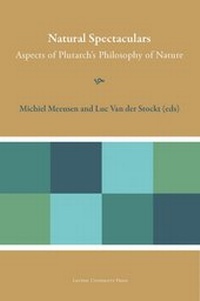
Natural Spectaculars
Aspects of Plutarch's Philosophy of Nature
1st Edition
Published on 17. November 2015
Book
Hardback
264 pages
978-94-6270-043-7 (ISBN)
Description
The value of Plutarch's perception of physical reality and his attitude towards the natural spectacle. Plutarch was very interested in the natural world around him, not only in terms of its elementary composition and physical processes, but also with respect to its providential ordering and 'wonders'. His writings teach us a lot about his perception of physical reality and about his attitude to the natural spectacle. He found his greatest inspiration in the ontological and epistemological framework of Plato's Timaeus, but a wide range of other authors were also of seminal interest to his project. Clearly, the highly literary value of Plutarch's natural philosophical writings should not be underrated. It is therefore not surprising that recently scholars have started to reassess the ancient scientific value of Plutarch's natural philosophical writings. Natural Spectaculars aims to give further impetus to this dynamic by treating several aspects of Plutarch's natural philosophy which have remained unexplored up to now.
This publication is GPRC-labeled (Guaranteed Peer-Reviewed Content).
Contributors: Jan Opsomer (KU Leuven), Suzan Sierksma-Agteres (Rijksuniversiteit Groningen), Angelo Casanova (Universita degli Studi di Firenze), Paola Volpe Cacciatore (Universita degli Studi di Salerno), Aldo Setaioli (Universita degli Studi di Perugia), Fabio Tanga (Universita degli Studi di Salerno), Michiel Meeusen (KU Leuven), Luisa Lesage Garriga (Universidad de Malaga), Ana Ferreira (Universidade do Porto), Israel Munoz Gallarte (Universidad de Cordoba), Lautaro Roig Lanzillotta (Rijksuniversiteit Groningen), Bram Demulder (KU Leuven), Aurelio Perez Jimenez (Universidad de Malaga), Delfim Ferreira Leao (Universidade de Coimbra)
This publication is GPRC-labeled (Guaranteed Peer-Reviewed Content).
Contributors: Jan Opsomer (KU Leuven), Suzan Sierksma-Agteres (Rijksuniversiteit Groningen), Angelo Casanova (Universita degli Studi di Firenze), Paola Volpe Cacciatore (Universita degli Studi di Salerno), Aldo Setaioli (Universita degli Studi di Perugia), Fabio Tanga (Universita degli Studi di Salerno), Michiel Meeusen (KU Leuven), Luisa Lesage Garriga (Universidad de Malaga), Ana Ferreira (Universidade do Porto), Israel Munoz Gallarte (Universidad de Cordoba), Lautaro Roig Lanzillotta (Rijksuniversiteit Groningen), Bram Demulder (KU Leuven), Aurelio Perez Jimenez (Universidad de Malaga), Delfim Ferreira Leao (Universidade de Coimbra)
Reviews / Votes
To conclude, this is a volume that significantly advances our understanding of Plutarch as a natural philosopher and scientist, among other things, by doing justice to the different genres of Plutarchan writing that serve as platforms for enquiry into the mechanisms or laws of nature. Scholars and students alike will have much to gain from its contents. Katerina Oikonomopoulou, The Journal of Hellenic Studies, 140, 283-284. doi:10.1017/S0075426920000543More details
Series
Edition
01
Language
English
Place of publication
Leuven
Belgium
Target group
US School Grade: College Graduate Student and over
Product notice
Paper over boards
Illustrations
Not illustrated
Dimensions
Height: 240 mm
Width: 160 mm
Weight
400 gr
ISBN-13
978-94-6270-043-7 (9789462700437)
Copyright in bibliographic data and cover images is held by Nielsen Book Services Limited or by the publishers or by their respective licensors: all rights reserved.
Schweitzer Classification
Other editions
Additional editions
E-Book
11/2015
1st Edition
Leuven University Press
€72.99
Available for download
Persons
Michiel Meeusen is British Academy Postdoctoral Research Associate at King's College London, Department of Classics.
Luc Van der Stockt is Professor of Greek language and literature at the KU Leuven and Honorary President of the International Plutarch Society.
Luc Van der Stockt is Professor of Greek language and literature at the KU Leuven and Honorary President of the International Plutarch Society.
Content
Contents
Acknowledgements
Contributors
Introducing Plutarch's Natural Philosophy MICHIEL MEEUSEN -; LUC VAN DER STOCKT
I. Physics and Metaphysics
Plutarch on the Geometry of the Elements JAN OPSOMER
'Say Goodbye to Opinions!' Plutarch's Philosophy of Natural Phenomena and the Journey to Metaphysical Knowledge SUZAN SIERKSMA-AGTERES
II. Physical Aetiology and Exegesis
Are Women Colder or Hotter than Men? (Quaest. conv. 3,4) ANGELO CASANOVA
Plutarch and the Commentary on the Phaenomena of Aratus PAOLA VOLPE CACCIATORE
The Moon as Agent of Decay (Plut., Quaest. conv. 3,10; Macr., Sat. 7,16,15-;34) ALDO SETAIOLI
Some Notes on Plutarch's Quaestiones naturales FABIO TANGA
Plutarch Solving Natural Problems: For What Cause? (The Case of Quaest. nat. 29,919AB) MICHIEL MEEUSEN
III. Man's Place in the Cosmos
The Light of the Moon: An Active Participant on the Battlefield in Plutarch's Parallel Lives LUISA LESAGE GaRRIGA
The Power of Nature and Its Influence on Statesmen in the Work of Plutarch ANA FERREIRA
Chasing Butterflies: The Conception of the Soul in Plutarch's Works ISRAEL MUa'OZ GALLARTE
Plutarch's Anthropology and Its Influence on His Cosmological Framework LAUTARO ROIG LANZILLOTTA
IV. Compositional Technique and Style
From Chaos to Cosmos (and Back Again): Plato's Timaeus and the Composition of De animae procreatione and De facie in orbe lunae BRAM DEMULDER
Plutarch and Transgressions of Nature: Stylistic Analysis of De facie in orbe lunae 926CD AURELIO PEREZ-JIMENEZ
Plutarch on Solon's Simplicity Concerning Natural Philosophy: Sol. 3,6-;7 and Frs. 9 and 12 West DELFIM FERREIRA LEa?O
Index Nominum et Rerum
Acknowledgements
Contributors
Introducing Plutarch's Natural Philosophy MICHIEL MEEUSEN -; LUC VAN DER STOCKT
I. Physics and Metaphysics
Plutarch on the Geometry of the Elements JAN OPSOMER
'Say Goodbye to Opinions!' Plutarch's Philosophy of Natural Phenomena and the Journey to Metaphysical Knowledge SUZAN SIERKSMA-AGTERES
II. Physical Aetiology and Exegesis
Are Women Colder or Hotter than Men? (Quaest. conv. 3,4) ANGELO CASANOVA
Plutarch and the Commentary on the Phaenomena of Aratus PAOLA VOLPE CACCIATORE
The Moon as Agent of Decay (Plut., Quaest. conv. 3,10; Macr., Sat. 7,16,15-;34) ALDO SETAIOLI
Some Notes on Plutarch's Quaestiones naturales FABIO TANGA
Plutarch Solving Natural Problems: For What Cause? (The Case of Quaest. nat. 29,919AB) MICHIEL MEEUSEN
III. Man's Place in the Cosmos
The Light of the Moon: An Active Participant on the Battlefield in Plutarch's Parallel Lives LUISA LESAGE GaRRIGA
The Power of Nature and Its Influence on Statesmen in the Work of Plutarch ANA FERREIRA
Chasing Butterflies: The Conception of the Soul in Plutarch's Works ISRAEL MUa'OZ GALLARTE
Plutarch's Anthropology and Its Influence on His Cosmological Framework LAUTARO ROIG LANZILLOTTA
IV. Compositional Technique and Style
From Chaos to Cosmos (and Back Again): Plato's Timaeus and the Composition of De animae procreatione and De facie in orbe lunae BRAM DEMULDER
Plutarch and Transgressions of Nature: Stylistic Analysis of De facie in orbe lunae 926CD AURELIO PEREZ-JIMENEZ
Plutarch on Solon's Simplicity Concerning Natural Philosophy: Sol. 3,6-;7 and Frs. 9 and 12 West DELFIM FERREIRA LEa?O
Index Nominum et Rerum