

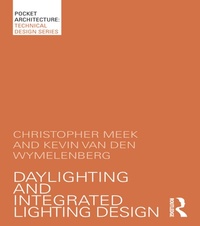
Daylighting and Integrated Lighting Design
1st Edition
Published on 28. October 2014
Book
Hardback
148 pages
978-0-415-72525-5 (ISBN)
Description
Daylighting and Integrated Lighting Design provides architects, building designers, and students clear direction for the successful inclusion of daylight and integrated electric light in buildings. It presents design teams with the performance analysis resources, energy saving estimates and user satisfaction results they need in order to make informed decisions regarding daylighting and lighting design.
Written by two well-known experts in the field, the book provides:
critical geometric and material relationships along with proven design process activities, offered in a quick-reference format, with sufficient context to address the range of associated issues present in any building project
both the "fundamentals" and "applications" which cover design concepts and practice activities applicable to all integrated lighting projects
specific directives for how the concepts covered are applied in a range of common design scenarios, including architectural rules-of-thumb, instructions for ensuring visual comfort, and preferred approaches for electric lighting control integration.
In demonstrating these necessary insights to designers, the authors employ an iterative analysis of common "daylighting patterns" and illustrate and annotate both successful and unsuccessful examples via built form and simulation. Part of the PocketArchitecture series, this is the ideal pocketbook for any designer serious about reducing the energy impact of their buildings.
Written by two well-known experts in the field, the book provides:
critical geometric and material relationships along with proven design process activities, offered in a quick-reference format, with sufficient context to address the range of associated issues present in any building project
both the "fundamentals" and "applications" which cover design concepts and practice activities applicable to all integrated lighting projects
specific directives for how the concepts covered are applied in a range of common design scenarios, including architectural rules-of-thumb, instructions for ensuring visual comfort, and preferred approaches for electric lighting control integration.
In demonstrating these necessary insights to designers, the authors employ an iterative analysis of common "daylighting patterns" and illustrate and annotate both successful and unsuccessful examples via built form and simulation. Part of the PocketArchitecture series, this is the ideal pocketbook for any designer serious about reducing the energy impact of their buildings.
More details
Series
Language
English
Place of publication
London
United Kingdom
Publishing group
Taylor & Francis Ltd
Target group
College/higher education
Professional and scholarly
Postgraduate, Professional, Professional Practice & Development, and Undergraduate
Product notice
sewn/stitched
Cloth over boards
Illustrations
103 Farbfotos bzw. farbige Rasterbilder, 1 farbige Tabelle
1 Tables, color; 103 Halftones, color
Dimensions
Height: 188 mm
Width: 124 mm
Thickness: 13 mm
Weight
236 gr
ISBN-13
978-0-415-72525-5 (9780415725255)
Copyright in bibliographic data and cover images is held by Nielsen Book Services Limited or by the publishers or by their respective licensors: all rights reserved.
Schweitzer Classification
Other editions
Additional editions
Christopher Meek | Kevin Van Den Wymelenberg
Daylighting and Integrated Lighting Design
Book
10/2014
1st Edition
Routledge
€45.50
Shipment within 15-20 days
Christopher Meek | Kevin Van Den Wymelenberg
Daylighting and Integrated Lighting Design
E-Book
10/2014
1st Edition
Routledge
€47.49
Available for download
Christopher Meek | Kevin Van Den Wymelenberg
Daylighting and Integrated Lighting Design
E-Book
10/2014
1st Edition
Routledge
€47.49
Available for download
Persons
Christopher Meek is Research Associate Professor of Architecture at the University of Washington and a registered architect. He is co-Director of the Integrated Design Lab (IDL) in Seattle where he consults with design teams in the Pacific Northwest and nationally with a focus on building energy performance, daylighting, visual comfort, electric lighting, and climate responsive design.
Kevin Van Den Wymelenberg is an Associate Professor at the University of Idaho, and Director of the Integrated Design Lab in Boise. He has consulted on several hundred building projects with architects and engineers regarding daylight, integrated design, and low-energy strategies since 2000. He has a PhD in the Built Environment from the University of Washington.
Kevin Van Den Wymelenberg is an Associate Professor at the University of Idaho, and Director of the Integrated Design Lab in Boise. He has consulted on several hundred building projects with architects and engineers regarding daylight, integrated design, and low-energy strategies since 2000. He has a PhD in the Built Environment from the University of Washington.
Content
Acknowledgements Introduction Part 1: Fundamentals 1.1. Why Use Daylight as the Primary Light Source? 1.2. What Design Steps Will Help Ensure an Integrated Holistic Lighting Design? 1.3. What are the Critical Schematic Design Factors Affecting Daylight Provision and Electric Lighting Integration? Part 2: Applications 2.1. Using this Book 2.2. Floor Plate Geometry 2.3. Window Area - Sidelit Office 2.4. Section Depth - Sidelit Office 2.5. Work Station Partitions - Sidelit Office 2.6. Glass Area Ratios - Fenestration Patterns From Two or More Sides 2.7. Blinds and Shades - Blind Types 2.8. Toplighting - Gymnasium Toplighting Design 2.9. Toplighting - Classroom Toplighting Design 2.10. Atrium and Adjacent Floorplate - Atrium Fenestration 2.11. Daylight From Top and Side - Small Building 2.12. Daylight From Top and Side - Office Building 2.13. Daylight From Top and Side - Classroom 2.14. Fixed Building Shading - Fixed Classroom Shading - South Facade References