

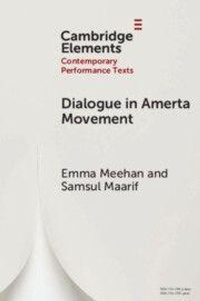
Dialogue in Amerta Movement
Will be published approx. on 30. June 2026
Book
Paperback/Softback
75 pages
978-1-009-64824-0 (ISBN)
Description
Dialogue is often understood as the verbal interaction between different people or groups. This Element reconceptualises dialogue through dance and somatic practices, foregrounding sensory relationality and responsiveness to the environment. Rather than centring conflict between specific 'actors', it evolves a framework for dialogue as a holistic system of embodied exchange. This Element focuses on Amerta Movement - a free-form style of dance developed by Javanese dance artist Suprapto Suryodarmo (Prapto) through transcultural practice - to explore how movement facilitates dialogue with oneself, the environment, other people, and wider communities. Drawing on fieldwork and practice in Indonesia, the authors analyse the work of seven performing artists who engage with Amerta Movement in their workshops and performances. This Element considers how such movement practices cultivate conditions for interreligious and intercultural dialogue, while contributing to debates on social cohesion and social justice. This title is also available as Open Access on Cambridge Core.
More details
Series
Language
English
Place of publication
Cambridge
United Kingdom
Product notice
Paperback (trade)
Illustrations
Worked examples or Exercises
ISBN-13
978-1-009-64824-0 (9781009648240)
Copyright in bibliographic data and cover images is held by Nielsen Book Services Limited or by the publishers or by their respective licensors: all rights reserved.
Schweitzer Classification
Other editions
Additional editions
Emma Meehan | Samsul Maarif
Dialogue in Amerta Movement
Book
approx. 06/2026
Cambridge University Press
€68.50
Not yet published
Persons
Content
Part I. Dialogue In Context: 1. Introduction; 2. Somatic practices across cultures; 3. Introducing dialogue through movement; 4. Some reflections on dialogue and conflict; Part II. Dialogue, Collaboration and Positionality: 5. Embodied dialogue as decolonial methodology; 6. Fieldwork; 7. Positionality; 8. Conclusion; Part III. Dialogue with Oneself: Inner Enquiry Through Connection: 9. Knowing oneself; 10. Growing oneself; Part IV. Dialogue with Other-Than-Humans: Connection and Equal Value: 11. Connection through sensing environments; 12. Recognising inter-independence and equal value; Part V. Dialogue with Other People: Respect, Difference and Transformation: 13. Connecting to other people; 14. Exploring difference; 15. Intercultural dialogue; Part VI. Dialogue with Communities: Consensus, Diversity and Social Justice: 16. Engaging diversity for the community; 17. Benefitting the community; Part VII. Dialogue Moves: Values and Practices: 18. Dialogue as non-hierarchical, engaging equal value and diversity; 19. Respectful relations through sensing together and grassroots leadership; 20. Practicing dialogue; 21. Final reflections on dialogue and conflict; 22. Conclusions; References.