

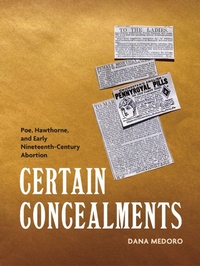
Certain Concealments
Poe, Hawthorne, and Early Nineteenth-Century Abortion
Published on 29. July 2022
Book
Paperback/Softback
256 pages
978-1-62534-647-6 (ISBN)
Description
Antebellum America saw a great upsurge in abortion, driven in part by the rise of the pharmaceutical industry. Unsurprisingly, the practice became increasingly visible in the popular culture and literature of the era, appearing openly in advertisements, popular fiction, and newspaper reports. One figure would come to dominate national headlines from the 1840s onward: Madame Restell. Facing public condemnation and mob attacks at her home for her dogged support of women's reproductive rights, Restell built an empire selling her powders, pills, and services along the Eastern Seaboard.Edgar Allan Poe and Nathaniel Hawthorne undoubtedly knew of Restell's work and would go on to depict the incompatibility of abortion and nationalism in their writings. Through the thwarted plotlines, genealogical interruptions, and terminated ideas of Poe's Dupin trilogy and Hawthorne's The Scarlet Letter, The House of Seven Gables, and The Blithedale Romance, these authors consider new concepts around race, reproduction, and American exceptionalism. Dana Medoro demonstrates that their work can be usefully read in the context of debates on fetal life and personhood that circulated in the era.
More details
Series
Language
English
Place of publication
Massachusetts
United States
Product notice
Paperback (trade)
Unsewn / adhesive bound
Illustrations
6 illustrations
Dimensions
Height: 226 mm
Width: 150 mm
Thickness: 18 mm
Weight
299 gr
ISBN-13
978-1-62534-647-6 (9781625346476)
Copyright in bibliographic data and cover images is held by Nielsen Book Services Limited or by the publishers or by their respective licensors: all rights reserved.
Schweitzer Classification
Person
DANA MEDORO is professor of English at the University of Manitoba and author of The Bleeding of America: Menstruation as Symbolic Economy in Pynchon, Faulkner, and Morrison.