

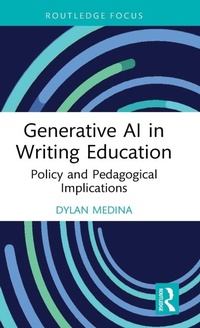
Generative AI in Writing Education
Policy and Pedagogical Implications
1st Edition
Published on 2. October 2024
Book
Hardback
96 pages
978-1-032-79249-1 (ISBN)
Description
This book provides a theoretical framework to allow educators, researchers, and policymakers to better understand computer-generated writing and the policy and pedagogical implications of generative AI.
Generative AI, such as ChatGPT and Gemini, has substantially disrupted educational spaces, forcing educators, policymakers, and other stakeholders to reconsider writing and how it should be used in education. Responding to this disruption, this book provides technically sound guidance on how various stakeholders should engage with generative AI. After providing a foundational and technical discussion of the technology, this book directly addresses the educational context. Informed by theories of learning and knowledge transfer and utilizing rhetorical theories of writing, this book assesses the impact of AI on student learning, student performance, and academic honesty and integrity. In doing so, the book outlines how generative AI can be both a help and a hindrance for students, enabling readers to craft informed and meaningful policies and successfully integrate AI in the composition classroom.
This book will be of interest to scholars in the fields of Rhetoric and Composition, Technical Writing, Communication Studies, Linguistics, and TESOL, as well as to Education and Machine Learning policymakers, program directors, and researchers.
Generative AI, such as ChatGPT and Gemini, has substantially disrupted educational spaces, forcing educators, policymakers, and other stakeholders to reconsider writing and how it should be used in education. Responding to this disruption, this book provides technically sound guidance on how various stakeholders should engage with generative AI. After providing a foundational and technical discussion of the technology, this book directly addresses the educational context. Informed by theories of learning and knowledge transfer and utilizing rhetorical theories of writing, this book assesses the impact of AI on student learning, student performance, and academic honesty and integrity. In doing so, the book outlines how generative AI can be both a help and a hindrance for students, enabling readers to craft informed and meaningful policies and successfully integrate AI in the composition classroom.
This book will be of interest to scholars in the fields of Rhetoric and Composition, Technical Writing, Communication Studies, Linguistics, and TESOL, as well as to Education and Machine Learning policymakers, program directors, and researchers.
More details
Series
Language
English
Place of publication
London
United Kingdom
Publishing group
Taylor & Francis Ltd
Target group
College/higher education
Professional and scholarly
Academic
Illustrations
5 s/w Zeichnungen, 4 s/w Tabellen, 5 s/w Abbildungen
4 Tables, black and white; 5 Line drawings, black and white; 5 Illustrations, black and white
Dimensions
Height: 222 mm
Width: 145 mm
Thickness: 10 mm
Weight
278 gr
ISBN-13
978-1-032-79249-1 (9781032792491)
Copyright in bibliographic data and cover images is held by Nielsen Book Services Limited or by the publishers or by their respective licensors: all rights reserved.
Schweitzer Classification
Other editions
Additional editions
Book
05/2026
1st Edition
Routledge
€30.00
Shipment within 10-20 days
E-Book
10/2024
1st Edition
Routledge
€31.49
Available for download
E-Book
10/2024
1st Edition
Routledge
€31.49
Available for download
Person
Dylan Medina is an Acting Assistant Professor in the Department of English at the University of Washington, USA. He is also the Director of Software Engineering at gotLearning.
Content
Introduction. Acknowledgments 1. How I Learned to Stop Worrying and Love AI 2. A Background in Computing 3. Computers and Language 4. Writing Theory for Generative AI 5. Risks and Opportunities in Pedagogy and Research. Conclusion. References. Index