

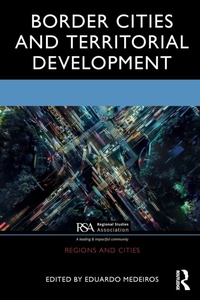
Border Cities and Territorial Development
1st Edition
Published on 31. May 2023
Book
Paperback/Softback
280 pages
978-0-367-75944-5 (ISBN)
Description
This monograph analyses the role of border cities in promoting territorial development processes in border regions across the world. It not only embraces the scientific fields of regional and urban studies but also addresses territorial (urban, local, regional) development and planning theories, as well as the effects of development policies applied to border regions in both Europe and North America.
In essence, the book offers a full toolkit of border regions' territorial development knowledge and, in particular, advances a range of policy development proposals. It provides a comprehensive introduction to contemporary thinking about how border cities can play a decisive role in boosting territorial development processes in border regions.
The book is divided into three parts. Part I presents a theoretical framework on the role of border cities in promoting territorial development and planning in border regions. Part II debates current mainstream policies focusing on supporting border regions and specifically border cities in the EU, the UK, and North America. Finally, Part III presents a wealth of updated knowledge, based on the analysis of several concrete case studies: border cities from both Europe (north, south, east and west) and North America (Canada, the United States, and Mexico). The chapters are written by some of the most renowned authors on the subject, including scholars from several European and North American countries, as well as the secretary generals of three European border regions associations (AEBR, MOT, and CESCI).
The book will thoroughly prepare students and provide knowledge to academics and policymakers in the fields of urban and regional planning and development studies, human geography, economic development, EU policies, border regions, and policy impacts.
In essence, the book offers a full toolkit of border regions' territorial development knowledge and, in particular, advances a range of policy development proposals. It provides a comprehensive introduction to contemporary thinking about how border cities can play a decisive role in boosting territorial development processes in border regions.
The book is divided into three parts. Part I presents a theoretical framework on the role of border cities in promoting territorial development and planning in border regions. Part II debates current mainstream policies focusing on supporting border regions and specifically border cities in the EU, the UK, and North America. Finally, Part III presents a wealth of updated knowledge, based on the analysis of several concrete case studies: border cities from both Europe (north, south, east and west) and North America (Canada, the United States, and Mexico). The chapters are written by some of the most renowned authors on the subject, including scholars from several European and North American countries, as well as the secretary generals of three European border regions associations (AEBR, MOT, and CESCI).
The book will thoroughly prepare students and provide knowledge to academics and policymakers in the fields of urban and regional planning and development studies, human geography, economic development, EU policies, border regions, and policy impacts.
More details
Series
Language
English
Place of publication
London
United Kingdom
Publishing group
Taylor & Francis Ltd
Target group
College/higher education
Postgraduate and Undergraduate
Illustrations
42 s/w Abbildungen, 42 s/w Zeichnungen, 13 s/w Tabellen
13 Tables, black and white; 42 Line drawings, black and white; 42 Illustrations, black and white
Dimensions
Height: 234 mm
Width: 156 mm
Thickness: 15 mm
Weight
433 gr
ISBN-13
978-0-367-75944-5 (9780367759445)
Copyright in bibliographic data and cover images is held by Nielsen Book Services Limited or by the publishers or by their respective licensors: all rights reserved.
Schweitzer Classification
Other editions
Additional editions
Eduardo Medeiros
Border Cities and Territorial Development
Book
11/2021
1st Edition
Routledge
€205.90
Shipment within 15-20 days
Eduardo Medeiros
Border Cities and Territorial Development
E-Book
11/2021
1st Edition
Routledge
€59.49
Available for download
Eduardo Medeiros
Border Cities and Territorial Development
E-Book
11/2021
1st Edition
Routledge
€59.49
Available for download
Person
Eduardo Medeiros is a geography professor and an integrated research fellow in DINAMIA'CET-IUL, Instituto Universitario de Lisboa, Portugal. He has a PhD in geography - regional and urban planning, and has around 200 publications, including more than 40 published papers in international journals, 10 books, and 11 book chapters. His research interests are focused on territorial impact assessment, territorial cohesion, territorial development, territorial cooperation, and spatial planning.
Content
Introduction; Part I: Territorial development and border cities: A theoretical debate; 1. Territorial development and border cities: A theoretical debate; 2. The challenge for economic development and innovation in border regions: Cases from Inner Scandinavia; 3. Cross-border spatial planning and border cities: Unpacking the symbolic role of borders; Part II: Territorial development policies for border cities and regions; 4. European policies and border cities; 5. Border cities: Spatial and institutional expressions of bordering; 6. Brexit and the policy landscape for cities at the Ireland-Northern Ireland border; Part III: Evidence from border cities and their contribution to territorial development; 7. French border cities and their cross-border strategies; 8. Rural border cities: The Danish-German border region of Schleswig; 9. Borderland formation processes: Cross-border urban functional cooperation along the Slovak-Hungarian border; 10. Border cities in Portugal-Spain and territorial development trends; 11. US-Canada border cities and territorial development trends; 12. US-Mexico border cities and territorial development trends; 13. Conclusion