

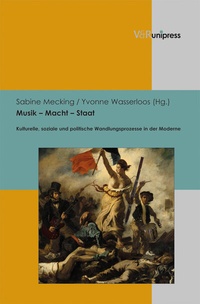
Musik - Macht - Staat
Kulturelle, soziale und politische Wandlungsprozesse in der Moderne
1st Edition
Published on 15. August 2012
Book
Hardback
399 pages
978-3-89971-872-0 (ISBN)
Description
Music is regarded as an expression of the individually emotional. Nevertheless, it can be used also to representative purposes or collective protest in the same way. The musical power does not refer in this way only to individually emotional and emphatic moments, but also and or about that onto public places. In this function music can create cultural identity and identities, support power systems and state systems or undermine as well as serve the political positioning and its expression. In this way music supports and accompanies cultural, social and political developments. By means of well-chosen case studies these transformation processes are analyzed in Europe of the early modern times up to the present. Beside nobility courts, armies or political rulers social movements and groups as civic movements and musical youth and subcultures will be focused. The spectrum ranges from state music and art music about (national) songs, the German "Schlager" and hits up to rock songs and pop songs. The authors are experts in the field of history and musicology as well as police science and the military music of the German Federal Armed Forces.
More details
Persons
Editor
Prof. Dr. Sabine Mecking ist Professorin für Landes- und Zeitgeschichte an der Philipps-Universität Marburg.
Prof. Dr. Yvonne Wasserloos ist Professorin für Musikwissenschaft an der Universität Mozarteum Salzburg. Ihr Forschungsschwerpunkt liegt auf der Untersuchung des Verhältnisses von Musik, Gesellschaft, Staat und Politik. Im Herbst 2023 gründete sie an der Universität Mozarteum Salzburg den Arbeitsschwerpunkt »Musik und Macht - Dimension und Kontext«, den sie seitdem leitet.
Content
Music is regarded as an expression of the individually emotional. Nevertheless, it can be used also to representative purposes or collective protest in the same way. The musical power does not refer in this way only to individually emotional and emphatic moments, but also and or about that onto public places. In this function music can create cultural identity and identities, support power systems and state systems or undermine as well as serve the political positioning and its expression. In this way music supports and accompanies cultural, social and political developments. By means of well-chosen case studies these transformation processes are analyzed in Europe of the early modern times up to the present. Beside nobility courts, armies or political rulers social movements and groups as civic movements and musical youth and subcultures will be focused. The spectrum ranges from state music and art music about (national) songs, the German "Schlager" and hits up to rock songs and pop songs. The authors are experts in the field of history and musicology as well as police science and the military music of the German Federal Armed Forces.>